
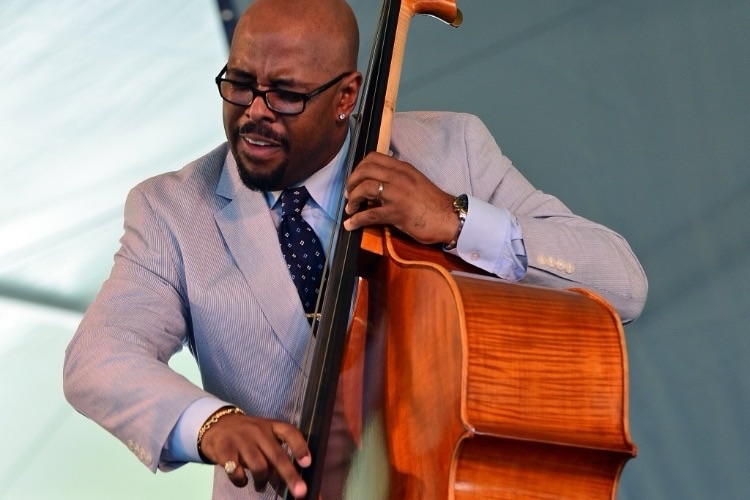

At the 1991 Newport Jazz Festival, an octet of young artists took the stage. Operating under the name “the Jazz Futures,” their title may have seemed more than a bit presumptuous. Who was to say these particular eight twenty-something-year olds would shape the music in an enduring and meaningful way? But, almost three and a half decades later, the label seems prophetic. Pianist Benny Green, drummer Carl Allen, trumpeters Roy Hargrove and Marlon Jordan, guitarist Mark Whitfield, and saxophonists Marlon Jordan and Tim Warfield have left their mark on modern jazz music, as artists, educators, or both. And then there was the bassist, Christian McBride. For those familiar with this site – this is our fifth interview of him, with the others available here – it is probably unnecessary to reiterate McBride’s bona fides. The nine time Grammy winner is regularly in the running for Downbeat’s coveted ‘Artist of the Year’- this year, he finished eighth. He’s played on so many recordings – well over four hundred – of all kinds of music, it is almost starting to become easier to list the significant musicians McBride hasn’t played with than to go through his list of collaborators. But a common thread throughout is his ability to adapt the music’s tradition to the needs of the moment. This ability to carry the torch of the forebears to the present is especially evident on his forthcoming, Without Further Ado, Vol. 1 (Mack Avenue, 2025).
The bassist’s newest big band recording is indisputably in line with the tradition of the large ensemble format. The elegant and intricate arrangements hallmarked by Billy Strayhorn and Duke Ellington. The heavy groove of Count Basie. The sophistication of Artie Shaw. The sheer power of the Thad Jones/Mel Lewis Orchestra. It’s all on the star-studded first volume of Without Further Ado. But McBride’s music isn’t mired in the past. Joined by two-thirds of the Police – Sting and guitarist Andy Summers – the band gives a heavy swing to the new wave/post-punk of “Murder by Numbers.” With “Back in Love Again,” McBride and R&B legend Jeffrey Osborne visit the joyfully bouncy “(Everytime I Turn Around) Back in Love Again” from the latter’s band, L.T.D. McBride’s version somehow hits even harder and is even funkier – afterall, McBride was Brother Mister to the one and only James Brown – than the original, defined by its tight horn and drum hits. On the opposite end of the spectrum is Antoinette Henry, a younger artist who imbues the old standard “Come Rain or Come Shine” with a romantic bluesy balladry. Without Further Ado, Vol. 1 is equally a love letter to the big band form, a provocation for it to move into new terrain, and a glimpse at the setting’s future. It’s also just a damn good record.
But one should not be surprised about McBride’s seemingly effortless ability to find where the past and present intersect. He’s also showcased this on not only his many other recordings but also in his approach to serving as Artistic Director for several festivals and series. His role as such for the New Jersey Performing Arts Center (NJPAC) directly ties to the music on Without Further Ado, Vol. 1 as it was within that capacity that the pieces on the album came together. But his power to tie the contemporary to the tradition is also evident in his work on his forthcoming McBride’s World at Sea Cruise and contributions since 2017 to the Newport Jazz Festival. In this conversation with McBride, we go deeper into it all, including a dive into some of the selections he has made for this summer’s Newport Jazz Festival lineup.
PostGenre: Your new big band recording is fantastic.
Christian McBride: Oh, thank you.
PG: What do you enjoy most about working with a big band?
CMB: Within that setting, I get to fully focus on arranging and orchestrating. That is what most stands out about working with large ensembles, especially my big band.

PG: The title of Without Further Ado, Vol. 1 suggests follow-up recordings. How many volumes do you plan on releasing?
CMB: Only two, volume one and volume two.
PG: How will the second differ the most from the first one?
CMB: It’s mostly different singers.

PG: Both albums seem very focused on incorporating vocalists then. Do you feel your approach to working with singers on your own music has been impacted by being married to one? [ed. Note: McBride is married to jazz vocalist Melissa Walker.]
CMB: [laughing] No, I don’t know how it happened, but I’ve always had quite a prolific recording history with singers. I have also gigged with a lot of singers. This recording specifically came out of the annual gala at the New Jersey Performing Arts Center, where my big band acts as the house band. I noticed that I had a large stack of big band charts from NJPAC that had been played only once, and decided not to let them go to waste, but instead to record them.

PG: One of the pieces is an arrangement of “Murder by Numbers” by the Police. You have two-thirds of the Police – Sting and Andy Summers – on the album. How did you reunite them for the first time since 2009? Was it through your work with Sting?
CMB: Yes, it came through Sting. I had already planned on having Sting on the record, and he had already agreed to be a guest on it. But we were actually planning to do a different song than “Murder by Numbers.”
I happened to be in my car one day, and the original version of “Murder by Numbers” came on. It reminded me of what a great song it is. So, I sent Sting a message telling him what a great song I thought it was. He had assumed from my message that I was suggesting we change the song we had already been working on to “Murder by Numbers.” I never intended to change the song; I was simply recognizing how great the original song was. But then he said that if I wanted to do “Murder by Numbers,” he thought he could talk Andy into doing it with us. So, Sting was the one who sort of volunteered Andy. And while it wasn’t what I had initially planned, I thought I’d be an idiot to turn down the opportunity to do the song with both of them. So, next thing I knew, within the hour, I was on an email chain with Sting and Andy Summers. It was pretty surreal.
PG: Wow. And I think bringing a Police song into the big band context is also a good reflection upon what Without Further Ado, Vol. 1 does more generally. The album definitely ties into the big band tradition and takes things from it, but the music is also very modern and contemporary. In terms of balancing tradition with the contemporary, you also have a cruise coming up that seems to do something similar.
CMB: In January, yeah.

PG: How did the cruise come together?
CMB: Well, for the last decade or so, maybe a little longer, I’ve been playing at the Jazz Cruise. Shortly after the Jazz Cruise started, there was also another cruise called the Blue Note at Sea Cruise and another one called the Contemporary Jazz Cruise, which was more of a smooth jazz cruise. All the jazz-themed cruises essentially took place back-to-back.
The Blue Note at Sea Cruise was probably the broadest, musically speaking. I thought it was a very good combination of the Jazz Cruise – which was pretty traditional, right down the middle, straight-ahead music with no electric instruments or fusion – and the Contemporary Jazz Cruise – where you saw people like Marcus Miller and Kirk Whalum. I felt the Blue Note at Sea Cruise was a great balance of both those cruises. You would see people like Robert Glasper, Kamasi Washington, and Terrace Martin. But you would also see the Clayton Brothers, me, Joe Lovano, and Buster Williams. It combined the contemporary and the traditional.
When the Blue Note at Sea Cruise went away, the gentleman in charge of all of these cruises, Michael Lazaroff, came to me and told me that he thought I had a big enough following that we could do what the Blue Note at Sea Cruise used to be, but using my name. I was incredibly flattered he thought that. We are still selling tickets, so if you know anyone who wants to go on a cruise in January, send them my way. [laughing].
PG: Do you feel your role as the Artistic Director at the Newport Jazz Festival – where you are selecting artists who are both honoring the festival’s rich tradition and pushing the music forward – helps you at all in balancing tradition and modernity in your own music and ventures like this cruise?
CMB: Well, I feel I was doing that long before I became Artistic Director. In fact, I think that’s one of the reasons why George [Wein] felt comfortable turning to me for the Artistic Director role. He had seen that I had a balance of working with many different types of musicians while keeping the jazz chord intact. That certainly ties to what I do at Newport, but I feel like it’s been part of my theme for a long time now.

PG: This year at Newport, you will be performing with both your big band and the Philadelphia Experiment – your group with Questlove, Uri Caine, and sometimes DJ Logic. The latter first came together in 2000.
CMB: That’s right.
PG: Which would make this year the twenty-fifth anniversary of the original record [The Philadelphia Experiment (Ropeadope, 2001)]. Was that something you had in mind in booking the group for Newport, or was the original idea to bring the Roots and, since Questlove was going to be at the Festival anyway, to try to fit in the Philadelphia Experiment too?
CMB: The second one. Questlove is so busy doing so many different things now. We knew we wanted to get the Roots and, once we did, didn’t want to miss an opportunity to do something with the Philadelphia Experiment, too. That’s exactly how it worked out. It will be great to get the Philadelphia Experiment together for the first time since we last played together in 2017, also at Newport.
PG: The presence of the Experiment this year means you will not be presenting a Jam Jawn – an ad hoc group of musicians jamming together – as you have had in most of the last few years. Are you done with the Jam Jawn idea?
CMB: Oh, no, no, no, no, no. It’s just that this year, with the Philadelphia Experiment and my big band, we didn’t really need the Jam Jawn. I’m sure either one of those two bands could organically morph into some sort of a Jam Jawn. But we’ll see.

PG: You will also be part of an aftershow at Newport called “Wein’s Jazz Futures – Now and Then,” which is half composed of musicians who were in the Jazz Futures with you back in 1991 and half of younger artists. How did that performance come together?
CMB: Right. Well, the initial plan was to get the original band back together and have someone play [the late] Roy [Hargrove]’s part. But as fate would have it, at least half the band wasn’t available, so we decided to take who we were able to get and add younger musicians for the rest.
And that seems like it actually works out better anyway. George Wein would have turned a hundred this year, and he was also in our minds when creating the show. It probably would have meant even more to George if we had four original members and four actual jazz futures, as we do. Four up-and-comers, along with the four veterans. George was always keeping an eye out for the next batch of young, talented musicians while making sure not to neglect those who have been making music for a while. So, I think it worked out well. I can’t wait to see and hear Julius Rodriguez, Chris Lewis, Alexis Tarantino, and Brandon Woody with us.


PG: Moving on to some of the other artists performing at this summer’s festival, there seems to be a strong R&B thread that runs through the lineup. Artists like Raye, Thee Sacred Souls, Maimouna Youssef, Samm Henshaw, Willow, Jorja Smith, Carrtoons, and Isaiah Sharkey, for instance, all have at least a foot in R&B music. Was the heavy representation of artists with a tie to R&B an intentional overarching choice to try to emphasize the connections between jazz and R&B, or did your team simply choose the musicians it desired, and they tended to have that similarity?
CMB: I don’t know if the connection was intentional. I think it’s more that our team keeps a close eye on what’s hot out there and what’s contemporary. There are a lot of younger musicians who we’re keeping our eye on. Who we booked seems to be some of the heavier movers and shakers right now. Especially someone like Raye. Or Thee Sacred Souls, whom we actually tried to get a few years ago, but it didn’t work out. I wouldn’t say there is an overt goal to emphasize jazz’s ties to R&B, hip hop, rock, alternative, or whatever, as much as we just want to try to keep our eye on what’s hot.

PG: So, for instance, the decision to book Janelle Monáe was not tied at all to her connections to Prince and his place in the funk lineage? Newport has presented some of the high points of funk music over the years, with James Brown, Sly and the Family Stone, and Parliament Funkadelic, but never booked Prince.
CMB: No, there was no conscious nod to Prince. Besides, I think if we were going to present someone more tied to Prince, we would have gotten Sheila E. I would really like to get her, too. Last year, I tried to get Sheila E for the Jam Jawn, but it just didn’t work out.
But, in general, Janelle has her own thing going right now. She is a dynamic performer. I got to interview her at the Smithsonian quite a while ago. I think it was back in 2018. She’s just so cool and a great creative mind. She is a really big fish for us to get this year.

PG: She is a brilliant artist, no doubt. Dirty Computer (Atlantic, 2018), for one, is an incredible record. But are you at all concerned about some of the lyrical content of her work? Ever since George Wein brought the Jazz Festival back to Newport, it has been, mostly, a family-friendly event. Some of Monáe’s work is rather explicit.
CMB: In terms of selecting artists, there has always been a couple of gambles, you might say. I’m not too concerned about her lyrics. Especially in this modern era, where a lot of hip hop is so mainstream now and also authentically jazz adjacent. But Janelle’s performance will be great and a lot of fun.

PG: To ask you about another R&B-infused group, one that is actually not made of younger musicians, how did Cymande become part of the picture?
CMB: Cymande came across our old [Artist Relations Manager] Becca Peters, who has moved on and is doing some great things in her own career right now. She brought the idea of having them perform at Newport to us last year, and I think it’s going to be fantastic.

PG: So, if you are not considering things like overlap with R&B music when selecting artists, do you consider artistic overlap with the Newport Folk Festival? Every year, at least some artists performing at Jazz are familiar faces at Folk. This year, BCUC is playing both festivals. And LA LOM, Samm Henshaw, and De La Soul each played Folk last year. Is that a coincidence? Or is it an attempt to interest those who might have been unable to attend Folk, to attend Jazz instead?
CMB: Well, [Executive Director of the Newport Festivals Foundation] Jay Sweet has always mentioned to me, and I agree with him, that it would be nice if we could get someone who could fit both festivals. And sometimes we do that. But, generally, I rarely know who will be booked for the Folk Festival. I never really find out that until everyone else does. He might reveal to me, every once in a while, that a particular person is scheduled for the Folk Festival and might work well at the Jazz Festival too. This year, that person was Samm [Henshaw]. We have had people who have played Folk in the past – I think Rachael and Vilray did the Folk Festival in 2018. Brittany Howard is another who has done both. So, to some degree, we’ve kept a conscious eye on people who could do both festivals, but it’s not a top consideration.

PG: To ask you about a few other artists who will be performing at the Jazz Festival this year, how did Flying Lotus become a part of the lineup? It is surprising he hasn’t performed at Newport before, given his relationship to the Coltranes. [ed. Note: Flying Lotus is the stage name of Steven Ellison, a nephew of Alice Coltrane]. As well as his work with people like Thundercat and Herbie Hancock, who have played at Newport several times.
CMB: Sure. We almost had Flying Lotus a few years back. Maybe in 2021. The ink hit the paper on the contract, but for whatever reason, it didn’t work out. I’m a huge fan of Flying Lotus, and it will be great to hear him at the Fort.

PG: What about Jacob Collier?
CMB: Jacob is another person we’ve been trying to get pretty much every year since I’ve been Artistic Director. The difficulty specifically with Jacob was not a lack of interest on either his part or ours, but one of logistics. Since he lives in the UK, it’s difficult for him to just fly over for a one-off performance. It’s the same thing with when we try to book Nubya Garcia, Shabaka Hutchings, or Kokoroko. It’s hard for people who live in the UK to get to Newport if they’re not already on a tour. The issues with visas can be a real drag. We were able to work things out with Jacob, and I’m glad he’s finally coming.


PG: The organ trio setting will also be presented at this summer’s festival between Parlor Greens at the Fort and an aftershow by the Delvon Lamarr Organ Trio.
CMB: Right, right.
PG: Even though the format has a long history in jazz, it seems the organ trio setting is generally less discussed in terms of new music. Do you have a sense as to why that may be?
CMB: I’m not sure. Maybe some people take it for granted. I can remember when the jam band scene first started, and Medeski Martin and Wood, Soulive, and all of these organ-based bands started getting hot. I think maybe people took it for granted and felt there’s always going to be some funky organ trio going on.
As far as Parlor Greens, I’ve known the music of its guitarist, Jimmy James, for a while. He was with Delvon Lamarr before forming Parlor Greens. I also saw him with his own band [, True Loves,] in Seattle a few months ago. But I became hip to Parlor Greens’ music when I was in a record store in Japan. While I was looking around, I heard something over the speaker, and it was funky. Oh my God, it was so funky. So, I went to someone working there and asked what it was. He told me it was Parlor Greens, and all I could say was “Lord have mercy.” I can’t wait to get some of that smoke live.

PG: Of course, you also have living legends of jazz returning to Newport this year as well. 2025 marks the seventieth anniversary of Miles Davis’ famous 1955 performance at the Festival, where his version of “‘Round Midnight” led to a thirty-year relationship with Columbia Records and all of the great albums that came from it.
CMB: Right.


PG: Was that history at all in mind when picking some of the more legendary musicians for this year’s festival, given they include Ron Carter, Kenny Garrett, John Scofield, and Marcus Miller, who each worked with Miles, albeit later in his career?
CMB: Not at all. And next year would be Miles Davis’ Centennial. The thing about Miles is that you can always find some reason to celebrate. There is always some connection to Miles, to somebody who played with Miles, or to somebody who was influenced by Miles. I think we try to be careful when we schedule tributes.
Plus, frankly, George Wein was not a fan of tribute bands. He always said that they felt like a low-ball way of doing things when you could get much further by just presenting new music. And I respected him for that. I remember that in my first year as Artistic Director, 2017, someone was putting together a pretty stacked Miles Davis tribute band and wanted to play Newport. George instead wanted the band to play their own music.

PG: But, at the same time, in some rare cases, you can also craft a band that honors another musician but is more than your average tribute band. Marcus Gilmore’s Centennial Tribute to Roy Haynes at this summer’s festival, for instance.
CMB: Yeah, that performance is a little different because of the personal connections involved. Roy Haynes was very close with George Wein. They were both from Boston.
Though I had hoped to, we haven’t had the good fortune of celebrating any of the living centennials of the music. Last year, Marshall [Allen] turned one hundred, and we had the [Sun Ra] Arkestra performing at the festival, but it turned out he couldn’t travel anymore. It was also my dream to have Roy Haynes come to Newport this year, not to play, but just to have him present. When he turned ninety-nine, I thought he was going to make it to a hundred. We had our fingers crossed that he would, but then he passed away.
But Roy was such a central figure to the jazz community, and we figured that we should celebrate him anyway. It just so happens that his grandson [Marcus Gilmore] is the most heralded contemporary drummer in jazz right now. So, there is no better person to pay tribute to Roy Haynes than his grandson.
PG: As a final question, you became Artistic Director of the Newport Jazz Festival starting with the 2017 festival. 2020 was cancelled due to the COVID-19 pandemic, so this year is your eighth or ninth year in that role. What do you think you have learned the most from serving in that capacity during that time?
CMB: That things keep progressing. You can never get comfortable. There’s always some new stuff popping up. There are always some new players. It’s a little more of a challenge to keep track of who’s coming out and where they’re coming out of than it has been for most of the history of this music. Once upon a time, there were a lot of veterans out there who were leading bands and would bring up the next generation of musicians in their bands. So, finding new talent was often as easy as seeing who was in those bands. You would only need to ask who’s playing in Miles’ band this year. Or in Sonny Rollins’s band. Wayne [Shorter]’s band. Herbie [Hancock]’s band. Or McCoy [Tyner]’s band. With Betty Carter or Art Blakey. So many bad young up-and-coming cats came through those bands. You also had record companies signing all of these younger musicians.

PG: Some of that still exists, with people coming through groups like Stanley Clarke’s or Terence Blanchard’s bands.
CMB: It does, but now, there are so many different ways to discover young talent that it can get overwhelming.
PG: In some ways, the internet makes finding new talent more difficult.
CMB: Exactly right. Sometimes I feel like my wall at home looks like one of those scenes from a 007 movie. [laughing]. It’s like we have a digital map. Here are the hot pics on Spotify. Here are the hot jazz picks on Tidal. Here are the new releases on Bandcamp. Here are the new releases on Qobuz. Or on YouTube. Man, it’s a lot.
PG: Well, it is commendable what the festival has been able to do. There are always surprises in the lineup each year. Yes, you have the legends of the music and those who are younger but well-established in the jazz community. But you also have so many artists who have the same caliber of talent but do not have nearly the same level of name recognition, whether very young jazz artists like the New Jazz Underground or people running in adjacent scenes like Rich Ruth. The Newport Jazz Festival could easily rely upon nostalgia or following whoever happens to be the current critical darling. Instead, it seems like the team works hard to keep Newport growing in scope, as it always has.
CMB: Right, well, I appreciate it, man. If you have that feeling, then our work here is done.
‘Without Further Ado, Vol. 1’ will be released on Mack Avenue Records on August 29, 2025. It can be purchased on Bandcamp. More information on McBride is available on his website. The Philadelphia Experiment will be performing on Friday, August 1st and Christian McBride’s Big Band will take the stage in Sunday August 3rd. McBride will also be providing a workshop with Etienne Charles on August 3rd. You can read more about the 2025 Newport Jazz Festival here. We will be providing live coverage of the event.
Photo credit: T. Jordan Hill, PostGenre Media


