

We continue our conversation with Patricia Brennan on ‘Of the Near and Far’ by delving deeper into her compositional process for the album, writing for strings, graphic scores, and more. You can read the first part of our conversation here.
PG: This is your first time recording your work for strings, correct?
PB: That’s right. It is definitely not the first time I’ve written for strings, just the first time I have recorded something I have written for them. The first time I wrote for strings was when I was fourteen. Back home, at the conservatory I went to, you follow a very strict curriculum assigned to you based on the grade you’re in. By the time you’re in middle school or early high school, you start to take more complex subjects like orchestration, counterpoint, and harmony. When I was in ninth grade – fourteen, about to be fifteen years old – I took my first composition class. For it, I first had to write for a duet of piano and voice. One of the later assignments was to write for a string quartet. So, that was my first experience.
Later, I also took composition lessons at [the] Curtis [Institute of Music]. As an exercise, I had to study some string quartets and write for them. But Of the Near and Far is the first time I had the chance to actually be commissioned to write something for strings. I wanted to use the strings similarly to how I used horns on Breaking Stretch, in that I wanted to do different things besides using them in their traditional role. So, while I do use the strings in a way more conventional for a string quartet on “Lyra”, in other pieces, like “Aquarius”, the strings are used more like a texture; almost like the quartet provides another percussion instrument. With “Antlia,” they also create background textures.
I often gave the strings great freedom as well. I had them either improvise with the graphic score using extended techniques in “Antlia.” On “When You Stare into the Abyss,” the string parts are only written as a line of melody, with artists free to bend the notes ad libitum, allowing them to lean into the next note or add to the one they are already playing. That was another unusual thing in the compositions that you don’t normally find with string quartets. For this piece, I dug a little more into the works of Philip Glass and how he writes for strings. He thinks of sound as texture and color rather than focusing on melodies. His music is more about feeling than melody, and that was definitely an inspiration for this record.


PG: For the specific string musicians on the album, what led you to choose individual players instead of a preexisting quartet – for instance, the MIVOS Quartet?
PB: That’s a really good question. I was going back and forth on whether to use a working string quartet or individual people. I think I ultimately got the best of both worlds of having individual voices who work well together. It is important that the string musicians be compatible musically because there are moments where they must work as a unit. The reason I decided to go with individual voices is because I also wanted to give individual features to each of the string players and work on their strengths. For example, for “Lyra,” Modney and Kyle [Armbrust] improvise together at the beginning of the solo section. I love them as improvisers and how they use their instruments in such unique ways as improvisers. They use a different language all their own – something that is neither jazz violin nor classical violin – and wanted that language featured. Sometimes, with a working string quartet, the emphasis is more about the ensemble than the individual. Those quartets often have amazing players, but their focus is more on the group instead of their own distinct voices. So, that’s why I eventually made the decision to pick individual string players.
PG: Do you think you will continue to work with strings on future projects?
PB: Yeah, I have some other projects in the back of my mind that I would like to do, which would include continuing to write for strings. I also plan on doing more with electronics.

PG: Do you feel having another person playing electronics on this project shaped how you approach using electronics compared to if you didn’t have another electronic voice on the project?
PB: Yeah, definitely. I was a little more tactful and more minimal with my use of electronics.
I had to be very aware not to oversaturate with electronics myself, because then there wouldn’t be enough room for him to work with. So, I was very subtle in my use of them for this record. For “Andromeda,” I really wanted to have the greatness of distortion, and there’s also a lot of dive sounds that I use, especially towards the end of the piece. But even then, I still wanted this piece to have, from beginning to end, a kind of chatter in the background. It was very tricky mixing that piece because there’s so much already happening with the music that is easy to lose the chatter within the sound of everything else.
Arktureye’s electronics were added in post-production. It was an interesting process, mixing-wise. We did three different mixing sessions. We had to do the acoustic parts first, then add the electronics, and then, finally, balance the electronics out with everything else. It was an interesting process. However, when we recorded in the studio, we had to imagine what would happen with his part. That was especially true for me because I had a vision of which sections would include electronics more than the other musicians did. The other musicians knew we were using electronics in post. We had also performed this project live at the Jazz Gallery in December of last year with live electronics. So, the other musicians had an idea of what could happen with the electronics from what we did on our live show. But with post-production, you can do so much more than using live electronics. But, even so, I was still surprised by what [Arktureye] added.

PG: How so?
PB: Well, for example, at the end of “Antlia,” when the turntables came in, I had no idea he was going to do that. I told him I wanted something rhythmically and generally what I wanted, but then he wanted to work with it. When I listened to his first draft for the first time, it was awesome to hear.
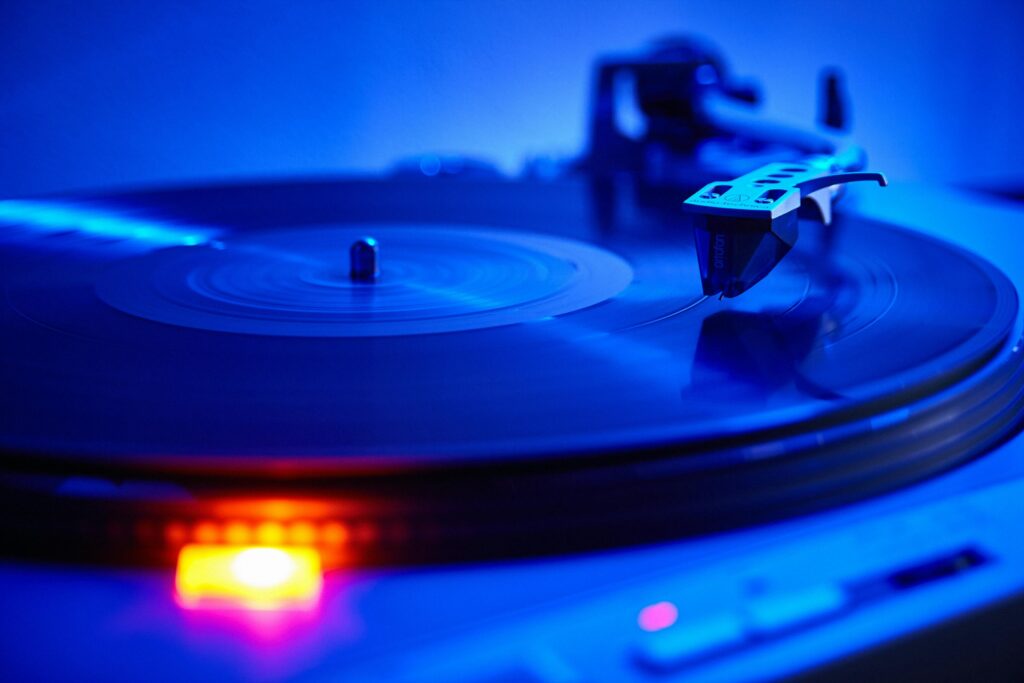
Actually, I got into turntablism because of him. I didn’t know much about it before he taught me on it. I thought turntabling was simply moving a needle on a record, but it’s a real art. I started to get so into it because it’s like drumming. Here in his studio, he has a table of scratches that looks like a periodic table, but each element is a rudiment. There is a single stroke. A double stroke. All these different things can be translated into drum rudiments, which is really crazy. Turntablists learn the language and improvise based on all of the rudiments that they have available. I thought that was really amazing.
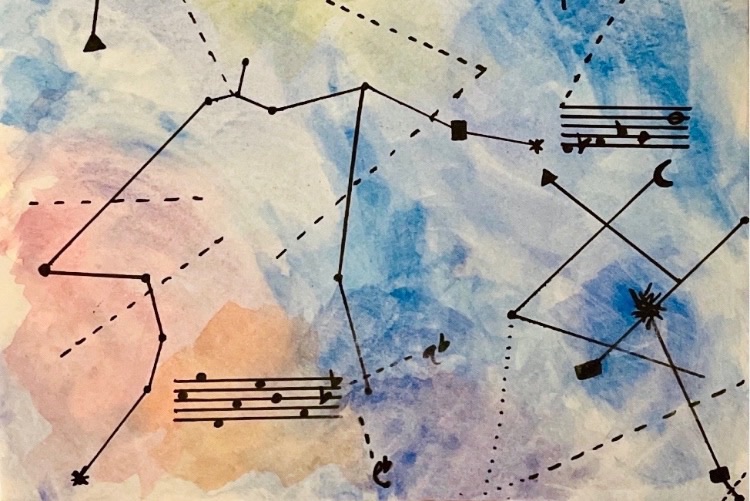
For “Citlalli,” which is the heaviest electronic piece, I created a graphic score, and everybody in the group did different takes on it. We did an improvisation of two violins. We did one of piano and cello. We did maybe seventeen different small group improvisations based on the graphic score, and then did two group improvisations based on it. And that all provided raw material for [Arktureye] to use to build his electronic piece. I had no idea how his part would turn out until he started to show me his draft versions.

PG: What can you share about your graphic score?
PB: There are actually two versions. I did one graphic score that looks like a piece of visual art. I used watercolors and other things to create it. However, I also had a version of it that I had processed through a program that could add an electronic twitch to it. When we performed at the Jazz Gallery premiere, the cover of the program was the graphic score. And in our live show, I picked a group of people- a duo, trio, or whatever from the ensemble – and had them improvise on the graphic scores as interludes between pieces. I think I may do that again at the album release show as well, because I like using the graphic score in that way.
PG: Where did the inspiration for your graphic score come from, and do you feel graphic notation is something you would like to use more in the future?
PB: I would like to do more of it, for sure. This is the first time that I’ve done a formal graphic score. As a percussionist, graphic notation and graphic scores are another part of percussion repertoire. The composer Thierry De May has a piece called “Musique de Tables” where he uses a graphic score to have a percussionist do different things – scratching their nails, flicking their fingers, or using their fists in different ways – to make sound on the top of a wooden table. Of course, [Iannis] Xenakis used graphic notation for percussion as well. I remember doing his “Rebonds” when I was in college, which is a different type of graphic score; he used his own way of music notation. His work also made me think more about how we translate rhythm into math, because he uses square paper and divides it up to show the division into notes.

I like graphic scores because they also help remove the default limitations we place on ourselves by seeing standard music annotation. Using graphic scores really forces you to go outside the box and leaves you no choice but to figure out how to interpret it by yourself. People have asked me if I gave specific instructions to the other musicians on how to interpret my graphic notation. I didn’t. All I gave them was the score and left it up to them to figure out how best to interpret it.
I know some graphics scores provide very detailed instructions as to how to interpret every single little line or shape. But, for me, that defeats the purpose of using a graphic score. I wanted the other musicians to use their musical improvisatory minds without limitation and to see where they go. The score does draw inspiration from the constellations. But how the other musicians want to interpret things like the colors is entirely up to them.

PG: Another interesting compositional inspiration for “Antlia” is the imagery of gears?
PB: Right, so the constellation Antlia drew its name from the Latin word for “pump.” It was named in honor of the air pump, which was a scientific instrument used at the time. The name was chosen to honor the scientific revolution of the time. And, so, I wanted “Antlia” to sound almost like you are inside the workings of a clock, watching all the different wheels move at different rates. And so when the breaks happen throughout the piece, like the strings playing pizzicato, but almost sounding like a drum break, before starting the next section, I call those moments gear changes. It’s almost like when a machine is doing one function and all of a sudden there’s a break, things reset, and then the machine changes functions and goes through a different movement. When you hear those specific breaks, they are usually the strings doing a pizzicato composite rhythm, between all of them. That’s very challenging for them to play. They nailed it, but it was difficult because the rhythms that you hear in the strings have to be very exact to make sure the composite rhythm comes through. It’s like clapping in flamenco. To truly make it feel fluid, everyone must move together perfectly, which can be very difficult.
PG: Which ties back to what you were saying earlier about taking some ideas from Breaking Stretch and applying them to Of the Near and Far. On the older record, you were pushing the other musicians, especially the horns, to the outer edges of what they can play on their instruments. It sounds like you are now doing the same with strings.
PB: Exactly. Exactly. While they are different records and use different palettes from one another, my writing didn’t change. I still approach things from the same place. The rhythmic force from the musical culture I grew up in is still in my music. My music is all about rhythmic layers being imposed together to create a composite. That concept is still there; I just use it differently.
PG: As a final question, do you feel that working with the constellations to produce pitch collections and, ultimately, compositions, has changed your perspective on outer space at all?
PB: I wouldn’t say the experience of working on this project changed my views on the constellations, but it did confirm some of the things I already believed. I always felt there was a beautiful symmetry and balance in space. Writing music for this record confirmed those feelings. But it did so in a way that only served to further increase my interest in the stars.
The whole process of putting this project together was also incredibly overwhelming. And, in a sense, that parallels how I feel when I look at the stars. There are trillions of stars out there, in constellations and galaxies, to the point that it would be impossible to document them all. There are probably still some that we don’t even know about. The vastness of the universe ultimately humbles you. It reminds you of the things that are important in your life. Maybe that’s why I like to stare up at the night sky; it reminds me I am just a small part of a huge universe. It’s great to be recognized for the things that I create, but they are ultimately still just small parts of something much bigger. All you can do as an artist is to grow and continue onto the next step.
‘Of the Near and Far’ is out now on Pyroclastic Records. It is available on Bandcamp. You can also read Brian Kiwanuka’s review of the album here.
Photo credit: Excerpt from graphic score composed by Patricia Brennan


