

Of the world’s roughly eleven thousand bird species, there is something particularly special about the dove family. Dating back to at least the Miocene epoch, twenty-three to twenty-five million years ago, across its history, the dove has developed a unique status as a symbolic creature. Many of these connections first emerged in the Biblical story of Noah and his ark. After a great flood lasting forty days, with nothing but water to be seen, Noah sent out a dove to find land. Without luck, the bird returned to the ship. A week later, he tried again. This time, the dove flew back with an olive branch in its mouth, suggesting land had been found. While it is up to the reader to determine the validity of this story, it is clear that societies have associated certain virtues and elements with the dove because of it: peace, hope, faith, and a search for a new home. Given this backdrop, Patrick Patterson and Steve Scipio’s decision to name their funk outfit Cymande, the calypso word for dove, is both an inspired and prophetic choice.
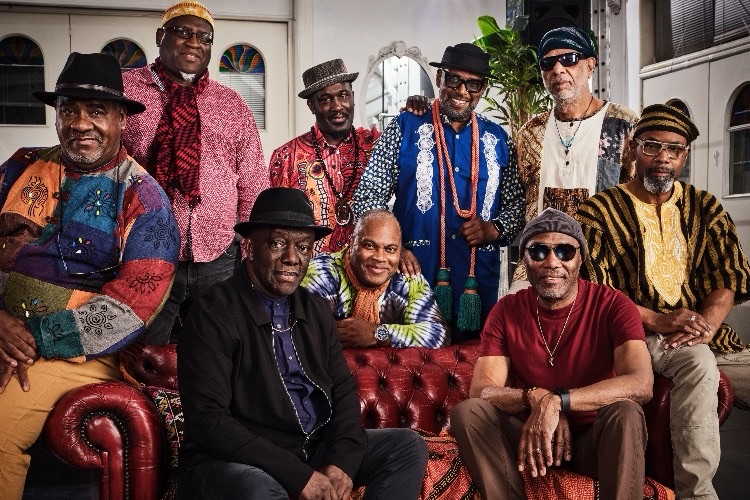
To fully appreciate the name, one must first understand the band’s history. Guitarist Patterson and bassist Scipio first met when they were growing up in London as part of the city’s community of Caribbean immigrants, a subculture often discriminated against by the larger population. In 1971, they formed Cymande with other members of the same community – singer/percussionist Ray King, saxophonist Derek Gibbs, conga player Pablo Gonsales, singer/percussionist Joey Dee, saxophonist Peter Serreo, drummer Sam Kelly, and flautist/percussionist Mike Rose. The group’s mesmerizing polyrhythms and distinctive blurring of funk, jazz, soul, reggae, rock, African music, and calypso quickly brought a record deal with Janus Records. Their first single, “The Message,” reached the Billboard Hot 100 charts, followed quickly by their self-titled debut album (Janus, 1972), another chart placer. Soon, the band found itself touring the United States with Al Green, Ramsey Lewis, and the band Mandrill. Cymande even became the first British band to headline the Apollo Theater. Two more records – Second Time Around (Janus, 1973) and Promised Heights (Janus, 1974) – came shortly after.
But while the band found success in the United States, the raging waters of racism and xenophobia back home kept their recognition overseas. The band would break up by 1974, largely due to their underappreciation at home. Patterson and Scipio left to become attorneys in their ancestral home of Anguilla. Yet, the founders also kept the boat of Cymande – by continuing to write pieces – seaworthy even as their attention diverted elsewhere.
Like the dove carrying an olive branch, Cymande ultimately found a fruitful new land by way of sampling. Starting in the late 1980s, hip hop artists – including De La Soul, MC Solaar, Heavy D, and the Fugees – began using Cymande’s old songs for new creations. In using the band’s pieces like “Bra” and “Dove,” the next generation of artists brought Cymande to new audiences who wanted more. By the mid-2010s, the band reunited, toured, and began recording. That path ultimately led to the current version of the group and its recent recording Renascence (BMG, 2025).
Fittingly named after a “rebirth,” Renascence finds the group masterfully adopting the unique sound with which the band first made waves, including their characteristically hypnotic groove, and updating it to contemporary times. One of the elements that survived in the music, again, connected to a dove, is its inherent spirituality. Songs from their debut record, “Dove,” “Zion I,” and “Rastafarian Folk Song” drew upon Rastafarian concepts to underscore unity, opposition to oppression, and connection to African heritage. Renascence goes one further by proudly proclaiming that all music comes from a higher power on the atmospheric “Coltrane.” The slow-burning “Road to Zion” also speaks of a search for spiritual redemption.
The dove also ties to the quest for political peace and hope. Again, the connotation ties directly to Cymande’s work. Older songs like “The Message” and “Brothers on the Slide” challenged the inequities and violence of the status quo of the 1970s. Renascence continues these critiques through “Darkest Night,” tackling racism head on and “Chasing an Empty Dream” providing a pointed attack on materialism.
But ultimately, what makes Renascence a fascinating work is not merely the messages and themes it shares with the records released five decades ago. The album’s magic comes from its ability to present a band that continues to sound like the group from long ago, of which only Patterson and Scipio remain, without sounding dated. From the tight high-octane late-night fueled funkiness of “Sweeden” to the gentle sway of “How We Roll,” Renascence is designed to move you not only emotionally and spiritually but physically too.
We sat down with Patterson and Scipio ahead of Cymande’s soaring debut at the Newport Jazz Festival to discuss their history, the band’s rebirth, and what audiences can expect from their August 3, 2025, performance.

PostGenre: Do you remember when you first heard of the Newport Jazz Festival?
Steve Scipio: I first heard of Newport back in the mid-1960s from live albums recorded there by people I was really into, like Miles Davis.
Patrick Patterson: I think I first became aware of the festival in my teens. Newport is legendary. It’s been kind of in the ether. Everybody is, in some way, form, or fashion, aware of it. You don’t even have to be a jazz fan to know of Newport. We all know that it’s the premier place for jazz musicians.
PG: Before Cymande, the two of you had a group called Metre, which was primarily a jazz band. Do you feel that jazz lies at the core of Cymande alongside R&B and other music?
SS: When we put together Cymande, I was listening to a lot of jazz. But there was also the soul music of the time and the rock music of the time. I liked a lot of the rock stuff that was being played. I thought it was very inventive. But when Patrick and I decided to put a unit together to play music, our first attempt, Metre, was a jazz group. In fact, we mainly set out to play in many different time signatures, which is where the name Metre came from. And that desire to focus on time signatures other than the standard 4/4 also carried over to some extent on a song we did with Cymande called “Willy’s Headache,” which is in 5/4. The setup of Cymande also gives opportunities for jazz expression in addition to our focus on the rhythmic and percussive elements of music.

PP: The other day, I described Cymande’s music to someone as eclectic. I think that’s a true representation of what it is. I don’t know whether we consciously thought much about the different genres. We might have. But it was so easy for the industry, if it ever took notice of Black music, to pigeonhole you as reggae, jazz, or soul. We were not entirely any of those things. Maybe that’s part of why the industry ignored us for such a long time; we didn’t fit nicely into any of those categories. Yet, our music remains, in part because I think there are no boundaries on the direction in which we can choose to go, particularly as songwriters.
PG: You were both self-taught on your instruments. Do you feel that being self-taught helped you be a little freer in terms of which direction to go, compared to if you had a more formal training?
PP: I’d say no. You can be self-taught and also a great copyist. That’s not where we went. But how we started as individual musicians, I think, speaks a lot for our love of music. To dedicate yourself to trying to learn an instrument, as we and many others have done, you need to fully love it.

PG: To stay with jazz for a minute, Cymande’s new album, Renascence, includes a track titled “Coltrane.” In it, the lyrics state that “Music is the message sent from God to man,” which ties into a spiritual element that has always been a part of this band. What is the role of the musician? Are they a mere conduit to a higher power?
PP: The lyric you just referred to also incorporates Coltrane’s direction. There’s a very spiritual component in his music and the direction he was going. With “Coltrane,” we wanted to touch on some of the bases that spoke to him in those days. He needed to address massive things that he couldn’t approach fully by just sitting down and writing on a piece of paper. There had to be some inspirational thing that came in from somewhere. That line that you referred to reflects the entry of inspiration. As musicians, we are supposed to be storytellers. We need to enable people to use their imagination. To see things from a different perspective. And to be made aware of lots of stuff going on, to which they don’t necessarily give consideration.
SS: I think a musician’s role is especially evident live. Today, much of music is computerized and digitized. However, venues still allow the opportunity for the expression of music. They allow you to express how you feel through music, through your instrument, in a way often lost to technology. That’s one of the reasons I’m so greatly looking forward to playing at Newport. If someone had told me in 1968 or 1969 that I’d be invited to play at the Newport Jazz Festival, I would have said, “You must be crazy.” [laughing].
PP: One of the wonderful things Cymande did in the 1970s was that we were the first British band to play at the home of soul music, the Apollo. More recently, we’ve played at Glastonbury, the home of all kinds of music. Now, we are about to play at the Newport Jazz Festival. And in October, we will play at Brixton Academy, the home of reggae music in Britain. I think that all says something about Cymande’s music and our approach to communicating with audiences.

PG: The way the band has resonated with hip-hop artists seeking out samples does as well. Were you surprised when you first noticed hip-hop artists using your music?
PP: Pleasantly surprised. We will always love what they have done to and for our music by picking it up and taking it to a younger generation. Their doing so provided the opportunity for Cymande to fulfill its purpose.

PG: One of the hip-hop groups who sampled you was De La Soul. They will also be performing at Newport on the same day as you. Have you ever met them before? Also, is there any chance of you collaborating with them at Newport?
SS: In fact, De La Soul was my first introduction to the fact that Cymande’s music was being utilized or accessed by the new generation of musicians. My children were listening to De La Soul at the time and brought a sample of us to my attention.
I’m very much looking forward to possibly having the opportunity to meet with them for the first time and find out what it was about our music that made them decide to access it and use it how they did. Though I agree with Patrick. I think how younger musicians have found inspiration in our music speaks a lot to what we did and the work we put into our material. We recorded most of that music in the early 1970s, and it is incredible how, after such a long period, it still speaks to people.

PG: Do you feel that younger people being more into your music is at all a reflection of how society has changed over the years? The largest reason Cymande did not take off more in the 1970s was primarily due to racism and anti-immigrant sentiment. Those things still exist, but Cymande is obtaining more notice now than ever before. Have things improved in terms of the discrimination that held the band back previously, or is there some other reason behind the increased opportunities for the band?
PP: That is a good question. The fact of the matter is that now the industry has less control over what people have access to than it did in the past. We are now where the straightjacket that lovers of music had been placed in has been removed, not only in terms of listening and appreciating music but also in terms of creativity. The younger generation has shown us a route that says, “forget that industry stuff, man.” We do our own thing and have a wonderful invention called the internet that enables us to speak directly to each other. It lets us create what we feel like creating and communicate with each other much more easily.
SS: Record companies don’t have the same degree of control they did in the early days. Back then, the labels could pretty much control the direction of music. They no longer can. Now, the younger generation has a venue where they can express themselves on what music they want, both as listeners and as artists. So, I think the younger generation can now state what they want, and record companies have to respond to them far more than ever before.

PG: So, if Cymande was starting now, do you think it would have been easier for the band to find its audience, especially in light of the rise of the London jazz scene, which often merges jazz, R&B, Caribbean music, and so many other elements? It is fascinating how essential the Jazz Warriors were to the development of that scene, and one of the Jazz Warriors’ members, Michael “Bami” Rose, was in Cymande.
SS: I think if we were starting now, things would be easier. That is not only because of the change in the market and the control of record companies, but also because more people’s ears are more attuned to hearing different musical expressions.

PG: Going back to the injustices the band faced and tackled in its music, after Cymande broke up in 1974, you both became attorneys. Do you see your work as attorneys as doing the same thing as your music in terms of tackling those injustices?
SS: That’s a very interesting question. I can’t say that I approach law from the same perspective as I did through music. I became a lawyer because I needed to find a job. I had a family to care for. Careers in law ran through my family. My aunt was a lawyer. It runs through Patrick’s family, as well; his dad was one too.
But to some extent, it was not a difficult path to move onto. Fortunately, I think we had the intelligence to go through and learn all the preliminary stuff you needed to enter that profession. But I can’t say that practicing law had any connection to my music. I did help provide an avenue for people out there who may have felt they had not received justice, but it did not feel connected to music.
PP: I think I differ from Steve in that regard. For me, my work in law and music both come from the same passion. Steve and I both came out of an era in the United Kingdom where the Black community was held back. We all recognize what was happening to young Black people in those days. We all recognize the disadvantages the Black community suffered. In that sense, music was a vehicle for us to contribute to try to improve things. I think my contribution on both sides – law and music – enabled me to assist my community while doing the things that I feel are important for me to pursue as a purpose in my life.

PG: And now, you are back to music. Renascence is actually not your comeback record. You released A Simple Act of Faith (Cherry Red, 2015) after a four-decade hiatus.
PP: Yes, indeed. That record was an important bridge between our old records and Renascence. It certainly taught us a lot about where we should place our focus, in terms of musical content, specifically how best to join the old stuff we did so many years ago with our obligations to come back with something that wasn’t just what we did back when. I think with Renascence, we did a good job marrying those two things. It wasn’t easy deciding on the music to put on the record. We had a lot of material to select from, but knew it was important to make something representative of the music we make now.
SS: Yeah, it was quite a process to select material for Renascence. Patrick and I, as the founders and remaining original members of the band, have developed since our early twenties when the band was first together. We have grown and been impacted by life in different ways. And from that, we have different ideas. Trying to find a common ground between us, something with which we would both be happy, can sometimes be quite a process. There’s a lot of material left over from the 1970s that we revisited, and also lots of new material for us to present. Even during our time practicing as lawyers, we continued to write music. So, in putting together Renascence, we had a lot of material to sift through.
PG: What was your process for determining what to use and what not to?
SS: We worked on it together with [BMG A&R scout] Michael [Orchudesch], who was very helpful in that process because he brought a different ear to the music. Sometimes, I would have a strong feeling about certain music, and Patrick would have a strong feeling about certain other music, and trying to find a common ground between our two positions could sometimes be very difficult. Michael was very helpful in that process.
PG: As a final question, you two have been friends for many years now. How do you feel your friendship shapes the music?
SS: Our friendship certainly shaped the music in the early days, when we had more time to be together. I think Cymande very much came out of that friendship. Our music at that time came from us liking the same kind of music, which was fortunate. And when we started to write music, we wrote songs that somehow connected in that way. It was very easy for me to contribute to what Patrick was doing. I think he was doing much the same thing when I was writing.
But fifty years have passed since then, and we have had different influences in our lives during that time. Now, things are probably not as easy because we haven’t had the opportunity to write music in the way we did back when we could meet up and share ideas more often and develop songs together. I mean, “Bra” came about because I started with the bassline, and then Patrick added ideas to it. It was the same thing with “The Message.”


PG: Was it the same thing with “Dove”?
PP: We recorded that song in 1972 and probably wrote it in late 1971. As far as how it came together, that question takes us back to how music is a message sent from God to man. With some of the music, you don’t know exactly where it comes from. But, fortunately, the music continues to move us.
SS: The melody was Patrick’s idea. I came up with the bassline first, and Patrick developed the melodic idea. And when I heard what Patrick came up with, it seemed perfect for the song. We had a very simple bassline, and the melody greatly added to it.
PP: It created a particular atmosphere.
SS: Yeah, because the bassline was very atmospheric. It struck me that it needed to be an atmospheric song and didn’t need too much happening under it. And once the melody had expressed this, we started developing it further, and it became more expressive rhythmically. And then, towards the end of the song, it reverted back to that melodic expression. But, to go back to the earlier question, yes, we aren’t able to spend as much time together as we once did, when one of us would come up with an idea and then we would develop it together.

PP: I think our friendship has shaped musical creation. As Steve said, we’ve certainly changed as both people and songwriters over the last fifty years. So, when we get together, things are different. Now, as older men, artists, and songwriters, it is expected that we would have a different approach to creating music together. Our friendship has been a great help in managing our process, and I think you can hear it in our music, both then and now.
Experience Cymande at the Newport Jazz Festival on Sunday, August 3, 2025. More information on the Festival can be found here. We will be providing live coverage of the event. More information on Cymande is available on the band’s website. ‘Renascence’ is out now on BMG. It can be purchased through the label.
Photo credit: Dean Chalkley


