

With our review of the second day of the 2024 Newport Jazz Festival – read day one here – we continue to draw parallels between the musical greats of the past and the artists with us today. This analysis is not intended to minimize the distinctive individualism of either the legends no longer with us, nor to overlook the contributions of those who continue to push the music forward; instead, it aims to examine the threads that unite them. Applied to August 3, 2024, we visit Riley Mulherkar, the Legacy of Wayne Shorter, Terrace Martin, Acid Jazz is Dead, and Stanley Clarke N4Ever. No, history does not repeat itself. But sometimes it rhymes. And, when it does, the couplets can be beautiful.
Riley Mulherkar and the Miles Davis Quintet (1955)
Saturday’s festivities at the 2024 Newport Jazz Festival started at the Harbor Stage. The smallest of the festival’s three major stages was the ideal venue for the intimate music of Riley Mulherkar. Surrounded by drummer Jason Burger, upright bassist Russell Hall, and pianist-sound designer Chris Pattishall, the leader presents his horn in a way different from most trumpeters. While exerting a clear prowess on his instrument, it is clear that the horn is but a tool. The brashness and brazenness stereotypically, perhaps unfairly, associated with the trumpet are put aside, with its bell serving primarily as a megaphone for Mulherkar’s beating heart, which he has revealed and left open for the audience to hear.

The opener, “Chicken Coop Blues,” was a great example of Mulherkar’s nontraditional approach to the horn. Starting slow and sparse, the piece builds to a hauntingly echoey trumpet solo that opens a steady beating rhythm. Pattishall’s role is essential in presenting the trumpet in such a new light as he allows things often lost or hidden in live performances, like breath and the tapping of a foot, to rise to the fore—a particularly impressive feat outdoors at lunchtime among bustling crowds.

And if one somehow missed the subtleties, the emotional importance of the performance – his first as a leader at Newport – on Mulherkar was also evident in his words. He first noted that Newport is a sacred space and that it is always an honor for him to play there. Later, he noted how the Festival meant the world to him. And, finally, he dedicated Hoagy Carmichael’s standard “Stardust” to his daughter on the occasion of her seventh birthday.

The performance of “Stardust” also tied Mulherkar to the rich lineage of jazz trumpeters, as everyone from Louis Armstrong to Wynton Marsalis has covered the standard. Same with a rendition of “King Porter Stomp” earlier in the set. Mulherkar took the core melody of the Jelly Roll Morton tune as made famous by King Oliver and recontextualized it. Adding an accented backbeat and a slow, cool groove, the piece seemingly drew electronica into the offering as well. Additionally, the vocals of special guest Vuyo Satashe on “No More” at times recalled the field hollers that formed the original roots of so much of the music we now call jazz.

In taking the history of the music and recasting it, Mulherkar drew parallels to Miles Davis. Throughout his career, Miles pushed compositions into new perspectives and novel terrain. However, one of Miles’ many performances at Newport is particularly apt; his date in 1955 with Thelonious Monk, Zoot Sims, Gerry Mulligan, Percy Heath, and Connie Kay.

In taking the history of the music and recasting it, Mulherkar drew parallels to Miles Davis. Throughout his career, Miles pushed compositions into new perspectives and novel terrain. However, of Miles’ many performances at Newport one is particularly apt; his date in 1955 with Thelonious Monk, Zoot Sims, Gerry Mulligan, Percy Heath, and Connie Kay. On the evening in question, the impromptu ensemble closed with “Now’s the Time,” a tribute to his once colleague, the late great Charlie Parker. But, before that, the group’s pianist brought two of his own compositions that are now standards – the up-tempo “Hackensack” and the darkly beautiful “‘Round Midnight.” The latter found the Dark Prince of Jazz pressing his horn up to the mic. Like Mulherkar generations later, Miles laid bare his soul for the audience to experience firsthand. It was more than just air through brass. It was an intimate beckoning to somewhere emotionally deeper. In the process, just as the younger trumpeter does with pieces like “King Porter’s Stomp,” he completely recast the song in his image.

Legacy of Wayne Shorter and the Wayne Shorter Quartet (2001)
Next on the Fort Stage was a performance dedicated to one of Miles’ greatest saxophonists, who would later go on to become one of the music’s finest composers. But this was not just any tribute band. Instead, the set honoring Wayne Shorter came from a deeply personal place. One-half of Shorter’s long-standing quartet – Danilo Perez and John Patitucci – congregated with another longtime collaborator – Terri Lyne Carrington – and saxophonist Ravi Coltrane. Together, they visited the man of honor’s incredible songbook with pieces originally formed throughout his incredible career.

The opener, “Infant Eyes” found Coltrane’s soprano’s playful searching atop a fairly off-kilter rhythm section. The group captured the innocent wonder and beauty of Shorter’s Speak No Evil (Blue Note, 1966) while giving a deeper glimpse into the surrounding turmoil of the adult world. Gone were the serene, slow-moving surroundings of the original, allowing the melody’s beauty a further depth.

A flurry of notes on Perez’s keys formed into the melody of “Lost,” in which Coltrane’s yearning tenor, Patitucci’s steady lines, and Carrington’s building crashes created a more laid-back and airier atmosphere than that found on The Soothsayer (Blue Note, 1979). By contrast, the follow-up “Witch Hunt” was far looser and wilder than ever initially conceived.

The closer, “Miyako,” is a piece Shorter wrote for his daughter as a slow ballad on Schizophrenia (Blue Note, 1967). In the quartet’s hands, further space was left between the notes, more silence left to fill the gaps. Although the entire set was filled with Shorter tunes, there was something particularly special about this tune. In the many times this artist had seen Shorter perform, there was always some ineffable quality in his sound that was contradictorily equal parts grounded and of the cosmos. Somehow, the quartet masterfully evoked this magic even without the master magician physically on stage. It sounded shockingly like a Shorter performance, though his body was nowhere to be found. His spirit emanated and resonated throughout the piece.

As part of a performance in his honor, the ties to Wayne Shorter’s many performances at Newport are self-evident. However, his 2001 performance is particularly apt. One of the earlier performances in his first fully acoustic quartet’s two-decade life, there were no guarantees and no safe zones. The space was left entirely open, similar to this quartet performing with Coltrane for the first time at the 2025 Festival, for risk-taking. And, as with the tribute group itself, most of such experimentation was over some of Shorter’s longstanding tunes, those he continued to refine and revolutionize throughout his career, including “Sanctuary,” “Masquelero,” and “Ju Ju.” In essence, he was reaching for new places using only his old thoughts as a building block, much as the quartet in his honor would do years later.

Terrace Martin and Mos Def (2009)
Back in the Quad, Terrace Martin took the stage with a quintet featuring keyboardist Chaz Fautch, drummer Trevor Lawrence, Jr., guitarist Nir Felder, and bassist Dominique Sanders. The group was not the one initially booked for the Festival. When first announced, Martin was set to appear with long-overlooked soul jazz guitarist Calvin Keys. However, when the eighty-two-year-old Keys unexpectedly died of a sudden heart attack, the game plan changed.

While what would have resulted from the set as originally envisioned remains to be seen, though The Neart North Side (Sounds of Crenshaw, 2023) leaves some hints, the final version allowed the saxophonist-leader to lay heavier into his dual roles as a jazz saxophonist and a hip-hop producer. As to the latter, he is particularly known for his work with Kendrick Lamar. Songs like his original “Valdez Off Crenshaw” underscored the connections between the two forms of music and R&B by sounding like it could fit in all three camps.

To further drive the point home, Martin made several statements from the stage which made it clear, to him, there was truly no difference between these musics we often force into categories. An opening piece heavy with a scorching electric guitar and vocoder was quickly met with the statement that Martin wanted “to feel like classic Newport with Coltrane, Ellington, and others.” He also drew a clear historical line from his favorite album of all time, John Coltrane’s Newport ’63 (Impulse!, 1993), through the neotraditionalism of the Young Lions to the music he makes today. He specifically called out Jeff “Tain” Watts for being “so important to the culture of hip hop and jazz.”

Martin’s set showed how far along we have come in terms of a cultural conception of jazz and hip hop as a singular music. He stated that if it were not for Watts, Kenny Kirkland, Wynton [Marsalis], and Branford [Marsalis], no one in the band would be where they are today. This is a particularly controversial claim in some circles, given Wynton’s past crusade against any music the overrated Stanley Crouch deemed invalid. Even as many as fifteen years earlier, the idea of Newport booking a hip hop musician was contentious. In 2009, Mos Def, now known as Yassin Bey, took to the Fort Stage to present the music of The Ecstatic (Downtown, 2009), a distinct blurring of hip hop, Afrobeat, jazz, soul, Eurodance, reggae, Latin, and Middle Eastern Music. Not everyone was enthusiastic, but open-minded listeners could sense its importance. The Boston Globe called the performance “a bold fusion,” and JazzTimes noted it was a highlight of that summer’s festival. In an even more important sense, however, it set the stage for Martin as well as the later bookings of everyone from the Roots to Common to De La Soul.

Acid Jazz is Dead and the Duke Ellington Orchestra (1958)
Remaining at the Quad Stage after Terrace Martin, audiences were exposed to another side of where sampling and jazz intersect: acid jazz. Born of the London clubs decades before the city’s current musical wave, acid jazz is a term often used but just as frequently misunderstood. In the 1980s, acid jazz was a movement of disc jockeys and producers who added percussion and electronic beats to jazz tracks from the 1960s and 70s. Over time, this approach evolved into new music that more deeply emphasized groove, while allowing for improvisation on top. In this case, the Acid Jazz is Dead performance was a special one-off date by Adrian Younge and Ali Shaheed Muhammad. As Younge explained from the stage, “acid jazz took records, added a drummer, and formed its own genre.”


Both gentlemen are, of course, well known for their Jazz is Dead series, which takes overlooked heavyweights of the music – people like Lonnie Liston Smith and Ebo Taylor – and tries to expose their brilliance to new generations of audiences. Calvin Keys, who was supposed to have performed with Martin, was someone perfect for this series if they had gotten to it. Back in 2022, the JID group gave a standout performance with Henry Franklin, Doug Carn, Gary Bartz, and the band Katalyst. The Acid version was pared back to solely both of the leaders performing DJ duties, crate digging through a rich collection that ranged from George Duke to Jamiroquai. Often, the artists would pause to let the audience sing their favorite tracks along the way.

In the process, the DJs turned the center of the fort into a massive dance party. The standing room only performance had audience members grooving and moving all over the space. In essence, the artists confirmed that there was some validity to the craze that was Acid Jazz. The music can still resonate, even if it is no longer discussed. The power of sound itself remains.

And in underscoring the continued vibrancy of the music, the Acid Jazz is Dead performance had an unusual connection with Duke Ellington’s famed 1956 performance at Newport. By the mid-1950s, the Ellington’s career was faltering. Rock and roll ruled the airwaves, and the once massive crowds that attended big band performances had dwindled. Rumors spread that Ellington would need to disband his orchestra because it could no longer make ends meet. Newport was his last chance at a revival. With Festival commission funds, he asked his longtime collaborator, Billy Strayhorn, to pen a suite specifically dedicated to the occasion. Once at Freebody Park, however, the new suite mostly fell flat. It was only once the Orchestra combined two almost twenty-year-old pieces – Crescendo in Blue” and “Diminuendo in Blue” into one that the audience began to rise. The music so greatly stirred dancing audiences that the festival’s organizers briefly worried about maintaining order. And, from that, Ellington’s career became revitalized. As the man himself later stated, “I was born in 1956 at the Newport Festival.”
Now, no one is claiming that the Acid Jazz is Dead set had the historical significance of Ellington’s 1956 performance. It didn’t. But there is something inherently common to both performances. There is something special about the power of older music that is all too often forgotten to the ages. The things that once pulled audiences into the music can continue to do so generations later, when placed in the right hands. The magical elements still remain, they just need the dust brushed off. Both performances show this masterfully.

Stanley Clarke N 4Ever and the Miles Davis Quintet (1966)
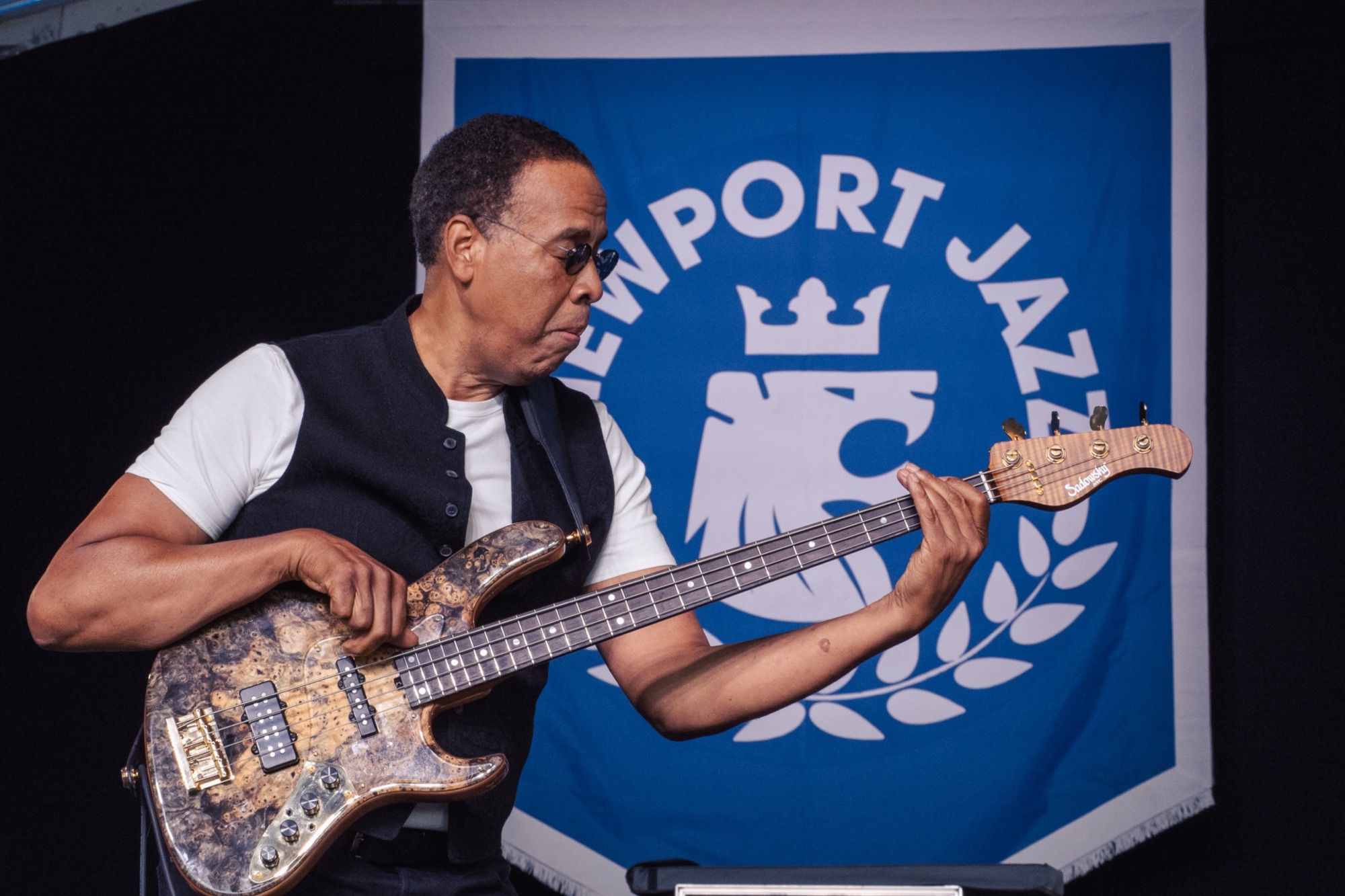
Closing the Harbor Stage was Stanley Clarke’s N4EVER. With the band, the bass legend surrounds himself with a much younger collective of artists – tenor saxophonist Emilio Modeste, guitarist Colin Cook, pianist Beka Gochiashvili, and drummer Jeremiah Collier. Together, they visited several pieces that were both new and evolved versions of old classics.


To give you a taste of the former, the set began with a medley of Return to Forever pieces, including “Romantic Warrior” and “Hymn of the 7th Galaxy.” While retaining their exotic funkiness, they also adopted a renewed vibrancy. Old fans of the originals would not quibble with these new versions, it was also clear the man who made doubling on acoustic and electric commonplace was no longer musically in the same place he was decades ago. Even using the same compositions as a core, he has grown and expanded his conceptions beyond the classic recordings.

The band also was not afraid to visit even older songs and make them their own, as shown by the second piece of the set. A heavy plucking version of Charles Mingus’ “Goodbye Pork Pie Hat” ultimately went atmospheric, leaving room for a slow simmering of intensity led by a vibraphone-like sound on keys.

As to the new pieces, they included a stirring samba where the leader brought out his upright bass. It was wildly different from the old fusion songs with which the group began the set, but no less compelling. It would ultimately open up to a shuffling guitar theme over which the soprano saxophone freely soared. It was structured yet incredibly loose and free.

Not to go back to Miles Davis, yet again, but the performance was, in some ways, reminiscent of the 1966 Newport Jazz Festival performance of the man who once tried to hire Clarke. While the music of the two groups sounded markedly different – among other things, Miles’ was fully acoustic and Clarke often electric – there are two essential shared commonalities between the two. First, there was the taking of older songs and trying to move them into new directions. In Clarke’s case, these were the Return to Forever pieces, whereas with Miles, it was “Stella by Starlight” or “All Blues,” but both artists stretched the pieces far beyond their original conception. And where the bassist had his intoxicating samba, the trumpeter had “The Theme” and “R.J.” The key to both explorations of the tried and true and the novel comes from the fact that both masters took a mentoring role for younger artists who had cutting-edge ideas on where the music could go next. The older group was, of course, full of musicians who invariably shaped the music over the years themselves – Wayne Shorter, Herbie Hancock, Ron Carter, and Tony Williams. It remains to be seen where Clarke’s pupils will go, but the university on the bandstand concept is alive and well and essential to the preservation and growth of the art, something both Miles and Clarke understand well.

Stay tuned for our thoughts on day three of the 2024 Newport Jazz Festival

Watch the legacy of the past, the power of the present, and blueprints for the future all come alive at this summer’s Newport Jazz Festival from August 1 to 3, 2025 at Fort Adams in Newport, Rhode Island. More information is available on the Festival’s website. We will be providing coverage live from the event.
Photo credit: T. Jordan Hill


