

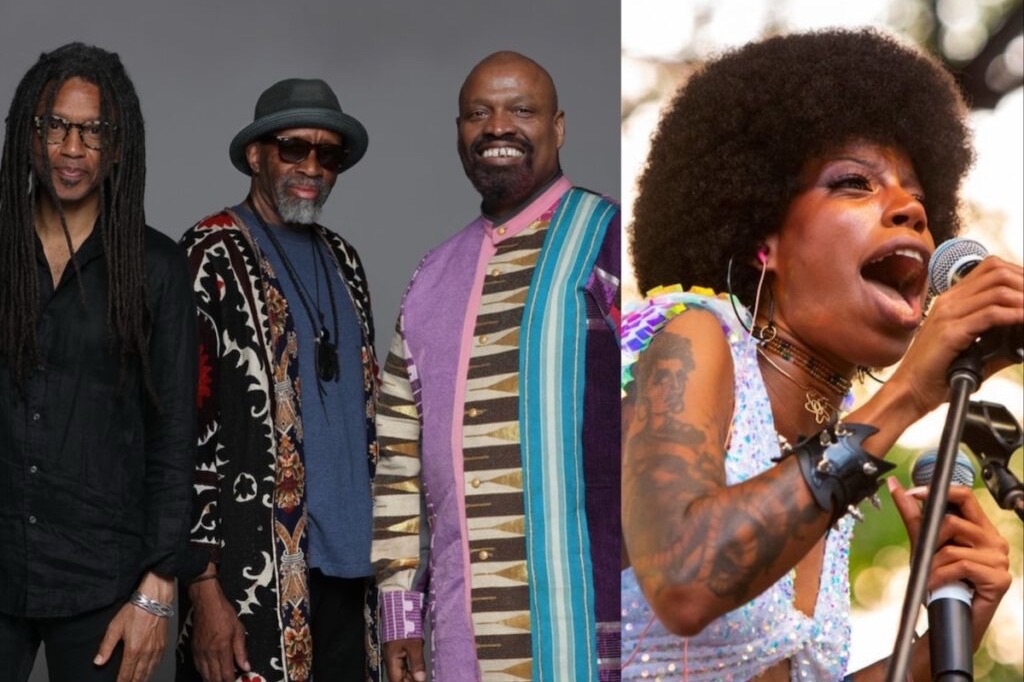

Freedom is an inescapable part of the history of Black American music, as the yearning for such is an essential part of the experience that forged such art. Much of the music now identified as “jazz” and its various branches grew from the tree rooted in the drum circles in Congo Square, celebrating slaves’ weekly brief respite from grueling work. Songs like “Oh Freedom,” “Steal Away,” and “Swing Low Sweet Chariot” doubled as both religious experiences and aspirations of a better life. The musical yearning for freedom has continued since, through Max Roach’s We Insist! (Candid, 1961) to Kendrick Lamar’s To Pimp a Butterfly (Top Dawg/Aftermath/Interscope, 2016) and beyond. But what is often glossed over in discussions on the topic is that while the music calls for freedom, each artist has a different perspective on how that freedom is reducible to sound. Duke Ellington and Billy Strayhorn’s cleanly polished extended suites are sonically removed from Albert Ayler’s raw cries. Prince’s extreme layering stands in stark contrast to Julius Eastman’s minimalism. Despite this, there is often a perception of how “free music” sounds. Emphasis is put more on an aesthetic quality than on the more significant meaning of the music itself. Electrical Field of Love (Pi, 2026), the first collaboration between the band Harriet Tubman and Georgia Anne Muldrow, confronts the listener and forces them to look deeper.
Each of the artists on Electrical Field – guitarist Brandon Ross, bassist Melvin Gibbs, drummer J.T. Lewis, and vocalist Muldrow – also brings in their combined decades of experience in creative music. Yet the album does not, generally speaking, underscore the screeches, sputters, skwonks, and off-kilter rhythms often associated with such music. Instead, they aim for the true essence of their time with masters like Ornette, Ronald Shannon Jackson, Wadada Leo Smith, and Henry Threadgill – the desire to stretch beyond the sonic status quo in any way possible. As a result, Electrical Field does not merely sound unlike the stereotypical “free jazz” recording. It actually sounds unlike anything else in existence. Its distinctive blend of sounds that are usually labeled by words like “jazz,” “funk,” “electronic,” “doom metal,” “dub,” and “soul” is certainly unique. But it is all done while acknowledging the wide range of inspirations that came before. “Isom Dart Was,” for instance, provides a meeting place for deep P-Funk nastiness, 70s Miles global expansionism, and a Gibbs-driven Sly and Robbie heavy dub groove.
Central to Electrical Field’s success in carrying the legacy behind it forward while burning down its own path is inherently tied to the near-telepathy the musicians hold with one another. To some extent, the strength of their communications is to be expected. Harriet Tubman has operated as a band for nearly thirty years, since 1998. The connection between Gibbs and Lewis actually goes back to even a decade earlier. But the truly awe-inspiring revelation on Electrical Field is how well their newest collaborator fits into the overall ensemble. The hallucinatory vocals on the opener, “Flowers,” propel Ross’s distorted, soaring guitar even higher while adding an edginess to Lewis’ grounded heartbeat like drum pulse. Her prayerful meditations on “Is No Match For You” bring out a deeper reflection as acoustic guitar swims around her words, sounding like a gentle harp. Muldrow sounds as though she has been part of the band for years, a tightly woven thread in the entire tapestry.
The combined ensemble’s pieces come from an approach often insufficiently dubbed “improvisation.” Such a term minimizes what the artists are able to do in the moment, as if they make things up on the go. But as our conversation clarifies, their process is actually one of both the receipt of messages from each other and a higher power and the creation of their own. This richer and fuller approach to songwriting not only allows them to create a music that is truer to themselves but also represents a broader historical lineage of which they take part. And this aspect expands beyond the audible to broader inspirations. It is no coincidence that “Isom Dart Was” is named after a Black cowboy and “Assata” a Black Panther.
Harriet Tubman, the abolitionist, freed over seventy people and helped liberate another eight hundred at the Combahee River Raid. In part, her role as liberator came by way of music. “Wade in the Water” signaled to fugitives to travel to avoid hunting dogs. “Go Down Moses” was a coded message on the safety of their paths. Over a century later, an augmented version of the band bearing her name is again using song to try to guide the listener to freedom. In an era in which Artificial Intelligence increasingly challenges what it means to be human, Electrical Field of Love masterfully plugs in to proclaim that society has not always extended such respect to all to begin with but all we can do is continue to push forward. The revolution still won’t be televised. But, at this point, everyone is streaming anyway.

PostGenre: This collaboration between the band and Georgia Anne is fantastic.
Brandon Ross: I have to say, it’s been a very easy fit for us to collaborate with Georgia Anne. It was actually suggested to me by our booking agent here in the States, Maurice Montoya. I was on the phone with him one day, and he said, “Yeah, you guys should do something with Georgia Anne Muldrow.” At that time, I wasn’t up on what she was doing. But I had another project with the violinist Charlie Burnham and the late drummer Warren Benbow. I was on the phone with Warren at some point and told him how our booking agent thought we should collaborate with this artist named Georgia Anne Muldrow. He goes, to my surprise, “That’s my niece.” I asked him for her number, and I ended up calling her and introducing myself. But before I could get through with introducing myself, she told me she knew who I am and that she loves Harriet Tubman. She saw us playing when she was going to the New School and living in New York City. We had a month-long residency at this place in Williamsburg. She was walking down the street one night and heard our music. She went inside and saw us playing, then came back every week. It was kind of fated for us to connect.
Georgia Anne Muldrow: I discovered the band when I was a dropout. [laughing]. I first heard the band when I dropped out of the New School.

PostGenre: What do you feel most drew you to the band? And now that you have worked with them, do you feel that is what still pulls you in, or has it changed?
Georgia Anne Muldrow: Ain’t nothing changed. Ain’t nothing changed. I think that’s the part that really blows my mind. When I first heard the band, I could hear everybody playing the blues for me. Everybody in the band is so absorbed in their listening skills. Very advanced listening skills. Razor sharp and responsive. That’s what I experience with them. And their willingness to be everything beautiful. Their willingness to not box themselves in and just let their Blackness set them loose. And nothing’s changed. Well, one thing’s changed. Now they know I’m one of them. [Laughing].
PostGenre: Harriet Tubman has been playing together for almost thirty years now, since 1998. How do you feel you have changed most as a band?
J.T. Lewis: Well, Melvin and I go back even further. We met with Joe Bowie and Defunkt back in the late 80s. So, we’ve been playing together on and off since then.
Melvin Gibbs: That was the early 80s, bro. That first Defunkt show was ‘81.
J.T. Lewis: So that’s how far back we go. There’s a lot of unspoken language that doesn’t even need to be spoken when we play. It’s all been irrigated throughout the decades of us playing together. Now, when we have an idea, a musical idea, we don’t even talk about it. We just start playing and let it develop organically by itself.
Brandon Ross: Actually, I was telling Georgia Anne in rehearsal the other day how periodically there’ll be this moment where I might say, “Hey, Melvin, what’s the harmony you’re in there? What are you actually doing?” And we realize that we each hear something different. There are three different conceptual and perceptual frames. It’s fascinating. It’s not destroying the integrity of this thing by trying to dig around in a certain way. And, at the same time, it’s all a highly developed quality of insight in the Harriet Tubman process.
Melvin Gibbs: Yeah, it’s a question of allowing people to see what they see and hear what they hear. All that matters is that the music keeps moving; that you let it keep moving. I mean, peanut butter is the same word in different languages, right? We can’t let language get in the way of what we’re doing. You just let the music keep happening, not try to force it in one direction or another.
J.T. Lewis: And after a while, the music tells you what to do. You don’t tell the music what to do. The music tells you what to do. And you let it flow because it’s an organic living thing.
[bandcamp width=100% height=120 album=3335237659 size=large bgcol=ffffff linkcol=0687f5 tracklist=false artwork=small track=798144421]
PostGenre: Of course, the only way you can make the music flow that way is to leave it open for “improvisation.” But the term “improvisation” is problematic as it seems to minimize what the artists actually do creatively. Do you feel that racism is behind the minimization of that mode of creation by many people, even though it’s such an integral part of music, especially Black music?
Melvin Gibbs: I’ll jump in here. A couple of years back, I wrote an article for JazzTimes as part of their series where they asked a few musicians, “What is jazz?” I actually spoke to Georgia Anne for it. And she talked about the fact that when you’re Black in America, your life is an improvisation. The music just reflects that experience.
And I remember when I was writing that article, somebody mentioned something that Richard Bona, the great bass player, once said. He noted that “Jazz is not really improvisation. Improvisation would be what happens when you run into a lion in the jungle.” My response to that is that as a Black man, I’m running into the lion every freaking day.
J.T. Lewis: Absolutely. Absolutely. The other thing too is that even if improvisation provides a piece, tomorrow we have to play it again.
Georgia Anne Muldrow: Right.
J.T. Lewis: And the day after, we have to play it again. So what is that? I’m still asking that question because even if all of our songs are made in an improvisational mode, what makes them work the next time we play it? What is it that we take out of each song to make it work? It’s beyond improvisation.
Brandon Ross: It’s a reverse process.
Melvin Gibbs: Yeah. In that same article, Ambrose [Akinmusire] says – if we’re going to use these words – that the difference between “improvisation” and “composition” is tempo. With what is called “improvisation,” you are composing in real time as opposed to, say, sitting in the bathtub and reflecting on the universe or whatever. But it’s all composition. As J.T. said, it’s all structure. You need to understand what the structure is.


Brandon Ross: We’ve all worked with Wadada [Leo Smith], and I ascribe to his move to the word “create.” It makes perfect sense to me, for what our band does and what I’ve been doing for quite some time now, in a shift to working within an intervallic material context for writing music. And that connects with what Melvin was talking about. Melvin, did Ambrose mean tempo or time? Tempo is not time, but it’s correlated.
Melvin Gibbs: To be precise, it’s time. You’re composing in the immediate moment as compared to over a longer period of time.
Brandon Ross: Yeah. So, in terms of the idea of “create” or “creating”, the way that happens for me is about intention and statement, which I think our band does. We construct. Creation, for me, is in the moment. Where that happens is in the space of running into a lion in the jungle. Or in being Black in the United States or in many other places in the world. And that is also inherent in the story of how the band Harriet Tubman began. Melvin, J.T., and I walked into a room together. They connected about their past and how they hadn’t seen each other in a while, and the three of us started playing. And we haven’t stopped.
J.T. Lewis: But here’s the thing, too. When we improvise a piece, give it a name, and then play it again the next night or even weeks or months later, is that still improvisation?

Georgia Anne Muldrow: Right. It’s active composition, I believe. There are a lot of things going on because I feel like, even from when Melvin interviewed me about improvisation, I was fully thrown into it. I was in search of unifying my life into being every day. I think what we do can be called all types of different things. I think it has something to do with us being in the African diaspora and fusing with indigenous communities.
It is called putting out your antennas. It’s called becoming ultra sensitive and using your good sense to communicate. You fully function as a transceiver; you receive, and you transmit. I feel like that’s also what birds do. That’s what lions do. It’s the song of the lion. And it’s very hard to control. I’ve tried different things where I say, “What if this isn’t improvisation? What if it means I’m trusting God with every note that’s about to come out?”
J.T. Lewis: Absolutely.
Georgia Anne Muldrow: And then, the next day, like J.T. said, what is it then? It’s a record of trusting God. This is the receipt. This is the fruit. It’s the fruit. It’s the harvest. I love the idea of “create.” I love the idea of “compose.” But creating music is also about receiving its harvest. You’re panning for gold. Every musician does. Everybody has this active inner forest.
One thing I would add is that when we create or receive, it is a seamless communication between minds. And what that actually is has happened as a result of constantly being in front of a bear in the wild. Or a lion in the wild. That seamless communication is what happens when you’re constantly exposed. You become hypervigilant, and your instincts change. They get very sensitive because they have to be very sensitive, as Mel was saying.
Your head has to be on a swivel, as we say. But it can’t even be that big of a move. I hear this. I hear that. Behind me. Ahead of me. I know where I’m at. And you can’t stop that if you really bring everything you have to the music. I mean, the first time I experienced this harmonic communication, it came from when I was in New York around 9/11. That experience came from being hypervigilant. It came from trauma. It was from seeing the planes and the collapsing buildings, realizing that the only thing that will bring people together after something so horrible is music. I believe music is a record of our hyper vigilance turning in and mutating into mutant gifts.

J.T. Lewis: That’s beautiful. There’s one more thing I want to add, which is that there’s form in chaos. Scientists and quantum theorists have said that. And there is structure in improvisation.
Melvin Gibbs: That’s right.
J.T. Lewis: It takes hypervigilance to really understand what’s going on in what we call improvisation. It might sound like chaos and freedom, but there is structure inside of it. There are things that you have to grasp onto to understand how to do it again the next day.
Georgia Anne Muldrow: Right.
Brandon Ross: Yeah, that’s there. See, what I have a problem with are things like a hierarchical notion about music. And yes, it is racist. Georgia Anne very beautifully stated an image of how one can be within any given context.
One of the things I think about all the time is how to actually be myself. How do I actually do that? Is it a result of something? Or does it begin from an unadulterated state, and that is the state that I am inviting myself to be in, to participate in?
We rehearsed last night for a concert we will be doing tonight. And to say what we are able to do together is amazing is both an overstatement and an understatement. The creation that happened in that context, which was laying out a kind of framework, will be different tonight. But last night, what we did could have been a new record than the one we put out. There’s an intentionality when you have a collection of people who can do that. Not everyone can do that either in a musical context or a live context. And that’s okay. They’re involved in their stage or process of what is important to them at that time. What I feel fortunate about is, again, being with these people – J.T., Melvin, Georgia Anne, and other people in my world who can do that.
We adopted the name Harriet Tubman for our band after our third day being together as a trio. I had invited Butch Morris to come hear us in rehearsal. After hearing us, he asked what we were going to call ourselves. J.T. came up with Harriet Tubman because he said he feels free when we play together. I do too. And that’s huge. Actually, the longer I sit with that, the more incredible it seems. And I can think of musicians right now who reject what we do for various reasons.

J.T. Lewis: It’s scary.
Brandon Ross: What we do is scary to them. There’s that. There are the instruments we play, what we use, and what we do. We’ve talked about tools of creation and the specific tools that we use. Technology has always been changing, from the inception of the piano to AI. We’re constantly navigating these things now. And, yeah, there’s an aspect of that which we could call racist. But maybe there’s a bigger, better thing; a better way of dealing with that, that doesn’t need a name or a term. It’s being right with your personal North Star if that’s taken to a clear place. I find it personally challenging to be non-referential in my life. And that keeps me quiet, keeps me humble. That keeps me going. Keeps me moving forward.
Stay Tuned for Part Two of our Conversation with Harriet Tubman and Georgia Anne Muldrow.
‘Electrical Field of Love’ will be released on Pi Recordings on March 27, 2026. It can be purchased on Bandcamp. More information on Harriet Tubman and Georgia Anne Muldrow can be found on their respective websites. The combined group will be performing at the Big Ears Festival in Knoxville, Tennessee on March 28, 2026. More information can be found on the festival’s website.




Leave a Reply