

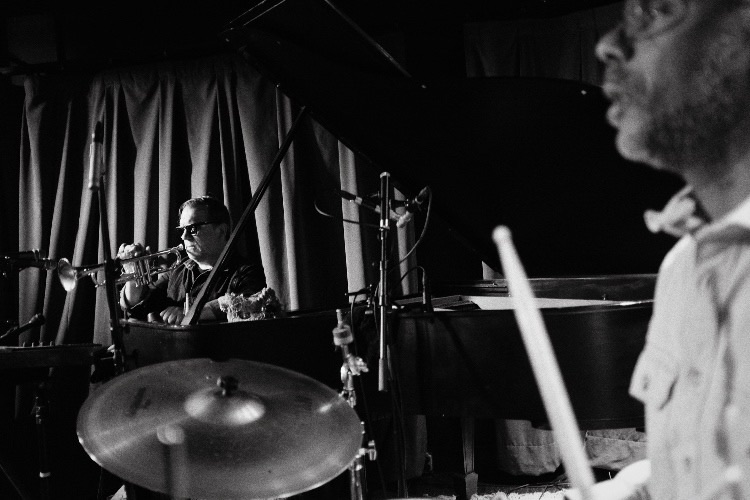

There is a particular power in the creation that comes out of long-term artistic relationships. While there is an excitement in the novelty of working with new collaborators, often it is within the comfort of the familiar that artists are most able to expand and conquer new realms. It is within this space with a comfortable baseline that artists are generally most ready to present a group that is larger than the sum of its parts. All of that is certainly true with the Chicago Underground Duo. Formed by multi-instrumentalist Rob Mazurek and percussionist Chad Taylor in 1997, the group has spent almost thirty years honing a distinctive voice that often disguises both the group’s small size and its instrumentation. However, that is only part of the story behind the duo’s great eighth duo record, Hyperglyph (International Anthem, 2025).
Taylor and Mazurek’s creative connection actually goes back to a whole decade before the Chicago Underground Duo’s formation. At the time, the former was only fifteen years old. In the years since, they have collaborated on countless ensembles of varied sizes – trios, quartets, and even full orchestras – in addition to their duo. Thus, even when there is an eleven-year gap between Chicago Underground Duo recordings – as is the case between Locus (Northern Spy, 2014) and Hyperglyph – the duo’s communications remain fresh. The two artists continue to maintain and strengthen their quasi-telepathic ability even as their music moves into unpredictable terrain. Their projects away from one another add additional vibrancy as well. In Mazurek’s case, these experiences include his own São Paolo Underground, collaboration with Bill Dixon, and an electric tribute to John Coltrane. For Taylor, they have included projects with jaimie branch, Peter Brötzmann, Marc Ribot, and James Brandon Lewis.
Musically, their path together as a duo remains wide indeed. The freedom of avant-garde communities both in the Windy City and beyond, African rhythms, musique concréte, drone, electronic glitchiness, ethereal soundscapes, and hues of jazz-rock fusion hybrids all find a home on Hyperglyph, with each flowing seamlessly into the next. Mazurek’s distorted yet powerful horn melody and Taylor’s hypnotic drum-circle-like groove on “Click Song” throw the listener straight into action. The following title track keeps the energy insanely high while diving deeper into electronic textures, chants, and unwieldy keys before becoming so hot it self-destructs. “Contents of Your Heavenly Body” conveys a punkish edge with echoey drums and horn, a synthesized bassline, and the lyrics of a disorienting poem. The three-part “Egyptian Suite” is a mystical camel ride through the desert, full of both sparse terrain and rich mirages. It all leads to the closer, “Succulent Amber,” a gorgeous dream-like meditation on kalimba and keyboards that invites silence to enter the room as the artists leave.
In all, Hyperglyph is a fearless expedition through sound, the kind capable only from two artists who know they can trust each other’s creative impulses wherever they may lead. We sat down with Mazurek and Taylor to discuss their working relationship and the story of Hyperglyph.
PostGenre: Where did the title Hyperglyph come from? It is defined as something that enhances perception in a three-dimensional space. How is this concept reflected in the album?
Chad Taylor: Well, we are very particular about our titles. We always have been, all the way back to the first Chicago Underground Duo record. That is true not only about record titles but also song titles. We collaborate to come up with them. Often, our titles come from literature. Or they come from art. Or science. For this particular record, we started bouncing different names and titles off each other, and finally came to hyperglyph.
Rob Mazurek: Yeah, it just came from our research. Researching different titles brought us to the term “hyperglyph,” which is not something you will find easily online. It is a very particular thing with a glyph being a symbol. There are so many symbols, points of data, or things that you are confronted with daily. At some point, if you look and deal with this immense amount of material for a time, it becomes its own symbols; in its own thing. I thought that was very reflective of the spirit of the record. But it also represents the spirit of the way Chad and I work in combining disparate elements in our music. And once we had the idea, everything else came into focus.

PG: The two of you have worked together for many years, across several different groups and projects. Why do you feel you work together so well?
CT: Rob was one of the first jazz musicians I ever played with. Playing with him is like going home for me. He is the person I have collaborated with the most and for the longest period. To put it another way, I learned how to play music with Rob, and that solidifies our relationship. Plus, we’re just good friends.
RM: That’s beautiful. Yeah, we’ve been playing together a long time. We first started playing together when Chad was fifteen, I think, right?
CT: Yeah.
RM: We started as a trio with a great bass player from Chicago named Dennis Carroll. From there, we continued through – as you mentioned – not only with Chicago Underground groups, but also our own separate projects. We completely support what each other does outside of Chicago Underground projects. Obviously, that also contributes to the richness of our experiences together. So, even with eleven years between Chicago Underground Duo records, we’ve kept working together. That comes into Hyperglyph.
CT: Another thing I would add is that I’ve met many musicians through Rob, and he has also met many through me. We’ve very naturally created this pool of existence around us that keeps us all connected, as well.

PG: One of the projects you worked on together in the eleven years between Chicago Underground Duo records was Pharaoh & the Underground, where you had Pharaoh Sanders joining a group that combined the Chicago Underground Duo and the São Paulo Underground. How did that project come together?
RM: Chad and I have done some really grand and beautiful gigs in Brazil. My friend Rodrigo runs an amazing and well-funded organization in Brazil called SESC that produces shows. Rodrigo and the director of SESC have done more than a few very successful shows there with Chicago Underground, Exploding Star Orchestra, and Exploding Star Orchestra with Roscoe Mitchell. After we had a great concert by Exploding Star Orchestra with Roscoe, the director of SESC asked me what I wanted to do next. Rodrigo threw out the idea of working with Pharaoh Sanders. I paused for a second when he did. I knew it would be amazing to work with him. Of course, Pharaoh is a huge influence on both of us; I just didn’t know if Pharaoh would be into it. The idea became us putting together Chicago Underground and São Paolo Underground and calling it Pharaoh and the Underground. But, again, we didn’t know if Pharaoh would be into it. He was very selective in what projects he decided to do. Incredibly selective. And to our amazement, he was into it. And then the project lasted two or three years. We played maybe ten shows, or so.
CT: For me, it really was a full circle moment to play with Pharaoh. The first time I ever heard the mbira, which is the main type of thumb piano that I play, was when I saw Pharoah Sanders play at the Jazz Showcase. His bass player, Steve Neil, picked it up during a bass solo. When I saw it, I thought, “Wow, what in the world is that?” And that moment is what truly started my fascination with the mbira. To be, fifteen years later, playing the mbira with Pharaoh myself, was absolutely incredible.

RM: The whole experience of working with Pharaoh was mindblowing, to be honest. And I remember Pharaoh was so into what we were doing, man. He was going around with us. We only did a few shows, but it was all so memorable. He would vocalize and dance while we played, and made the ladies in the audience in São Paulo lose their minds. It was a very special, wonderful experience. And we kept going until he unfortunately passed away.
PG: So, is that why it took eleven years to release another Chicago Underground Duo record; was it solely because you were both busy with other projects?
RM: That’s a good question. We’ve said to each other numerous times in the last eleven years that we should record a new one when it felt right. It doesn’t feel like eleven years have passed. It feels like yesterday that we recorded the last one. But the beauty of that gap is that we bring the experience of eleven years of other projects into the fold. But it felt natural to record a new one now.
CT: And we had a duo performance in Italy about two years ago that further made us think about how we should release a duo record. The involvement of International Anthem also led to the new album. I don’t think we were interested in doing another Chicago Underground Duo record for Northern Spy [Records]. We didn’t have another record label ready to go. But we were ultimately able to work with International Anthem. Did you reach out to them, Rob, or did they reach out to you?
RM: I think I told them that we were going to record a new Chicago Underground Duo album and asked if they wanted to be a part of it. If they didn’t, we weren’t going to release one. At this point, we both have a relationship with International Anthem. Actually, the label’s first record [Alternative Moon Cycles (International Anthem, 2014)] was one of mine. I’ve also released stuff with the Exploding Star Orchestra and other projects with them. And Chad has also worked with jaimie branch and others on the label. So, we both had a relationship with the label, and it just seemed like a perfect fit and the perfect time to make this duo record happen in this particular way.

PG: There is a symbolism in the Chicago Underground Duo recording with International Anthem. You both started in Chicago and now live elsewhere – Chad in Philadelphia and Rob in Marfa, Texas – and the label also has Chicago roots, but has expanded to release music from elsewhere, including some London based artists. Both of you and the label retain a Chicagoness even while working outside the city.
RM: Some people ask us why we still have the word “Chicago” in the duo’s name when neither Chad nor I still live there. But our roots are so solidly from Chicago. It is great to be affiliated with a label that also has that sensibility and the same roots, but is also open to the rest of the world. And that element is also an important part of this record.
PG: Tied to the idea of location, where does Egypt fit into Hyperglyph? The record has both a three-part “Egyptian Suite” and a piece titled “Hemiunu,” which is named after the architect of the Great Pyramid of Giza.
RM: The very first movement of the “Egyptian Suite” led to the rest of the suite. It was based on a scale I was working with on the piccolo trumpet that is loosely – not exactly – based on an Egyptian scale. It is a synthetic Egyptian scale. I played that scale for a long while. When we went into the studio. The rest came naturally. Chad started playing a rhythm – on the record, Chad is using very specific African rhythmic ideas from various regions of the continent – and it felt like it was perfect for the scale I had been playing on the piccolo trumpet. I played the first phrase of the first movement, which I had put together before going into the studio, and it all fit together so well. And after the first phrase, I improvised even though it all felt composed because I kept doing variations on the theme. I think we did the whole first movement in only one take.
CT: Probably.
RM: Then we moved onto the second part of the suite, where Chad uses a very specific bow technique on the cymbals to create a slower movement. I tried to match what he did, and play with and against his long tones on the cymbals. And when he moved from the cymbals to the drums, that improvisation happened naturally and exploded at the very end of the third movement. There, I reiterate the almost Egyptian scale from the beginning. The whole suite just flowed out.

PG: So, the Egypt references were not a nod to Sun Ra’s Chicago years?
RM: Those influences are always in what we do. There are so many influences in our music, from all over the place. There is also that great Art Blakey record, Indestructible (Blue Note, 1966), with a song called “The Egyptian.” But I don’t think we ever do anything where we’re trying to imitate what someone else has done or consciously do something as a nod to someone else. Instead, our influences just come through. In this case, Chad had a rhythm, I had a little scale idea, and it naturally exploded into a three-part suite.

PG: Is that typically how the two of you write for the Chicago Underground Duo? One of you comes up with an idea, and you each build on it together?
CT: That’s one way. But we use multiple ways of composing. Sometimes I’ll have something I precomposed and bring it to the table. And then Rob will hear something to add to it.
RM: The Egyptian Suite is a nice example and so is “Hyperglyph.” But we also have a few compositions that Chad wrote beforehand. “Plymouth” and “Hemiunu” were both Chad’s compositions.
PG: The duo often sounds like a much larger group than solely two musicians. That aspect is especially evident on Hyperglyph, but it is on your other recordings, as well. Do you consciously try to sound like a larger ensemble, or is that just a function of what you hear?
CT: I feel that aspect has always been a part of our sound. It’s not something we have ever specifically intended, but it has always been part of the Chicago Underground Duo’s sound. On a bunch of the duo’s early records, I used to play the vibraphone and would do it simultaneously with the drum kit. We even recorded it simultaneously. When people would review our music, they would talk about how we overdubbed the vibraphone. Even though there were no overdubs with the vibraphone. There is other stuff where we do layer and use overdubs, but we have always had a very full sound.
RM: There would be takes like those Chad is alluding to, where I would use a sampler along with trumpet. We did it all together most of the time. Not only would it be drums and vibes at the same time, but also trumpet and synthesizer. We just devised a way to do it both live and in the studio on a few things. Of course, we would do some overdubs. But I think the history of the group has always been based more on live playing than things like overdubs.

PG: You definitely did some post-production work on Hyperglyph.
RM: There’s some, yeah. Especially on a piece like “Hyperglyph,” where we are not playing all of the instruments at the same time. But of course, now we have to figure out how to play the music live without those overdubs. We have a pretty good grip on how to do that, but there is still some more work to do.
CT: One thing that sets Hyperglyph apart from our other records is that when putting together an album, we would typically have two or three days in the studio followed by two or three days of post-production. We would normally have almost a whole week to make a record. But, with this particular record, because of all the other projects we had going on. I could only be there for one day of tracking in Chicago before I had to go back to Philly. So, we did all of our post-production work in two different places. So, Rob would do something, call me, and ask me what I thought about it. I would give some suggestions and we would go back and forth on things during the post-production process.
To be completely honest, I was terrified about doing post-production remotely because we had never worked that way. In the past, we always had multiple days to do it all together. I was nervous that it wasn’t going to work, but it ended up being just as good, if not better, than if we had more time together.
RM: Yeah, Chad was in Philly, and [engineer] Dave [Vettraino] and I were in the International Anthem studio [in Chicago] trying to work with all of the tracks while also communicating with Chad. At some point, I wasn’t sure it would work out. But we just kept working on production, and by the third day of working on it, we realized how absolutely beautiful it all sounded. Everything clicked, as it always has. We always go through a little bit of panic because of all the elements going on in our music, needing a lot of arranging. But it helps that, because we have such a long history of working together, we sometimes have an almost telepathic way of doing things.
CT: We have a lot of respect for each other, so we are not afraid to make suggestions to one another. Sometimes, we will try the most outlandish things and then later either reel it in or maybe even take it further.
I remember that for the track with Rob reading a poem, “Contents of your Heavenly Body,” the recording sounded amazing to my ears. But something was also missing. We had never done a record with lyrics or vocals before.

RM: Well, we had some lyrics on Ace of Energy (Northern Spy, 2013) on “It’s Alright.” But there, it was just me repeating the phrase “it’s alright.” “Contents of your Heavenly Body” was certainly the first extensive use of lyrics for the duo, though.
CT: Right. The original version of “Contents of your Heavenly Body” did not have vocals. But in listening to that version, I felt like it needed something. So, I told Rob that we should add some vocals to it. Rob just happened to have finished writing a book of poetry. He found the poem we ended up using for the piece, and it worked perfectly.

RM: I was considering adding someone like Damon Locks, who is in our group of people and uses lyrics all the time. But I decided to try it myself. I might not have even told Chad initially that I was going to do it. But when I tried it in the studio, I thought what came out was really amazing. It worked out beautifully.
CT: And that connects to another way we compose for the duo. Sometimes, like on the last piece on the album, we’ll both create something in the moment.
PG: That last piece, “Succulent Amber,” is a gorgeous pairing of kalimba and keyboards that leaves room for space, and by the time it ends, you can hear silence filling the room. Was that all made in the moment?
CT: Yes. Actually, originally, we had another song that was supposed to end the album. But after listening to that piece, I realized it would be a much more impactful ending than if we had another piece after it. Rob agreed, and that is how the album ended that way. Rob also did a lot of work getting those incredible tones on the keyboard.
RM: We worked for a while to get the right tone on the keyboard. I played it on one of my favorite keyboards, the RMI Electra-Piano. It is the same instrument Chick Corea played on Filles de Kilimanjaro (Columbia, 1969), the album that marked Miles [Davis] starting his electric period. The instrument has such a distinct sound. The whole piano melody in “Succulent Amber” is improvised, even though it sounds composed. When we came into that last phrase on the piece, and I did a little ascending line on the end that doesn’t resolve, we kept it open. I think the original idea was to resolve it on the next track. But since that was the last one, it is left hanging in the clouds, to be continued. It turned out so beautiful.
PG: So, do you think it will take another eleven years until that phrase resolves on a new Chicago Underground Duo album?
RM: That’s a good question. We don’t have definitive plans yet for our next duo record, but anything’s possible if it feels right. Chad and I are constantly composing and thinking of new ways to present music. But I don’t know. Chad has so many new projects coming up. He’s probably gonna take all the good material. [laughing]. Just kidding. Just kidding. Hyperglyph was a fun record to make on so many levels. But it’s really difficult to say when and where something happens next. It could be next week. It could be while we’re both in wheelchairs and walkers. [laughing]. We’ll see.
‘Hyperglyph’ is out now on International Anthem. It can be purchased on Bandcamp. More information on Rob Mazurek and Chad Taylor can be found on their respective websites.
Photo credit: Mikel Patrick Avery


