

|
Getting your Trinity Audio player ready…
|
Here is a fun exercise for a reader’s consideration. Consider these two quotes: “[It is] just a bunch of notes thrown together without melody or soul—hardly what I’d call music” and “[It’s] not music… [it] doesn’t require musicianship….” What genre of music are they referring to? Here is a hint- the music grew organically through the hard work of artists – overwhelmingly young, Black men from urban areas – who stretched existing forms, while incorporating improvisation. So, what is it? Well, it is a bit of a trick question. The first quote is from a jazz critic deriding the birth of bebop. The second is Stanley Crouch attacking hip hop. The fact that Crouch is rallying against music that did not fit his shallow perspective is hardly a surprise; the man practically made a career out of deriding music he was too poor a drummer to make and about which he maintained an intentional ignorance. But the juxtaposition of the two quotes is fascinating. Even someone as narrow-minded as Crouch would not dare to question the artistic integrity of bebop. Instead, it is coined – partly due to Crouch’s work – as a part of “America’s classical music.” Of course, part of the gradual acceptance and acclaim came from the passage of time. A lot can change in the half-century between the emergence of bebop and Crouch’s bloviations. But now that we are equidistant in time from DJ Kool Herc’s back-to-school jam at 1520 Sedgwick, where does that leave hip hop? While sampling and rapping have permeated the social status quo, their artistic recognition remains … varied. Kassa Overall’s CREAM (Warp, 2025) is an essential entry into the enduring conversation.
Of course, the meeting of jazz and hip hop is hardly new. But historically, the invitation to mingle largely came from the latter. The earliest samples were of musicians like Donald Byrd. By the 1980s and 1990s, groups like A Tribe Called Quest, De La Soul, Gang Starr, and Digable Planets further deepened the connections through samples. Some – as with Guru’s Jazzmatazz series – used live instrumentation as well. There were also jazz musicians showing an interest, Miles Davis, for one, but often they were simply jazz pieces with some samples, beats, or rap added on top, not a full integration of styles. While the Twenty First Century would bring more collaboration – with Roy Hargrove and Robert Glasper as some early leaders – this trend of “hip hopping jazz” largely remained the norm.
CREAM flips this predominant approach on its head by starting from the opposite end. The album eschews the electronic trappings of drum machines, samples, or overdubs to let the heart and soul of these works to more discernibly emerge. But CREAM is not simply one of many works that try to turn hip hop acoustic. Instead, the album takes hip hop songs – with a particular focus on ’90s recorded output by Notorious B.I.G., Wu-Tang Clan, and Dr. Dre, among others – and pulls their compositional structures in new directions while allowing ample space for improvisation.
Of particular importance, though perhaps unsurprising for a drummer, is Overall’s approach to rhythm. One of the greatest composers of the last twenty years was James Yancey, better known as J Dilla. Like Charlie Parker before him, Dilla’s life was cruelly short, but he made such revolutionary steps in the little time he had here. Perhaps most important was his development of a third school of rhythmic thought: rhythmic time-feel. This concept is addressed at length in Dilla Time: The Life and Afterlife of J Dilla, the Hip-Hop Producer Who Reinvented Rhythm (MCD, 2022) by Dan Charnas, who also contributed liner notes to CREAM. However, a short explanation is that the concept aims for a unique off-balance groove by combining straight and swung time. While this rhythmic time-feel approach is a common influence in jazz-hip hop hybrids, Overall’s use to explore hip hop classics in a fully acoustic setting is rare indeed. He still swings hard, but the adoption of time-feel gives the music a distinctive swagger as it moves forward.
The result is songs like a laidback balladic version of Juvenile’s “Back That Azz Up.”A flute-led samba through Biggie’s “Big Poppa.” Or the furtively mysterious allure of Dr. Dre’s “Nuthin’ But a ‘G’ Thing” that recalls Wayne Shorter’s “Sanctuary.” In the process, Overall and his bandmates – saxophonist Emilio Modeste, keyboardist Matt Wong, bassist Jeremia Kal’ab, and percussionist Bendji Allonce – expose the beauty and compositional ingenuity at the core of the original hip hop classics. At a time when questioners of the form are already losing ground due to things like Kendrick Lamar winning a Pulitzer Prize, CREAM leaves them to face an undeniable truth: Not only is hip hop an inescapable branch off the tree that created “America’s Classical Music,” but its artists’ works are every bit as artistically significant.
Overall is especially well-suited to make such a bold assertion. The once child prodigy went from making beats on an MPC and ASR 10 from a police auction to being nominated for a jazz Grammy. A leading figure at the frontlines of where jazz and hip hop meet, his prior albums like I THINK I’M GOOD (Brownswood, 2020) and Animals (Warp, 2023) not only blurred the space between genres but did so while aptly tackling such heavy topics as mental health and racism.
We caught up with Overall on the road – a thirty hour drive with his cousin Jeremiah from Seattle to Chicago – to learn about the origins of CREAM and the importance of taking the artistry of hip hop seriously.
PostGenre: CREAM goes in the opposite direction of most music exploring the connection between jazz and hip hop in that it does not add beats or samples to acoustic music but instead takes well-known hip hop songs and finds ways to stretch them out and explore them acoustically. Where did that idea come from?
Kassa Overall: There were a bunch of events that led to the album becoming what it is. Little things mostly.
For one, the Grammys asked [my band] to do a video for Grammy.com where we were to pick any song that’s been nominated for a Grammy and cover it in our own way. We ended up doing a version of [Snoop Dogg’s] “Drop It Like It’s Hot” where we freaked it out. We put in weird new chords, odd time signatures, and different things. We had fun with it. What we did was very easy for a jazz musician [in terms of technique]. We started playing the song in live sets, and people were really connecting with it. Even if what we were playing was the simplest and most obvious concept, we started to think that maybe what we were doing was unique.
But I think I would actually go back a little bit further to when I first started my first record, Go Get Ice Cream and Listen to Jazz (self-release, 2019). I remember having frustrations – as a hip hop maker and hip hop lover, and as a jazz maker and jazz lover – of how everybody seems to always approach putting the two together in the same way. Take a couple of chords from jazz songs, put a beat on it, and that’s it. Why do we always have to dumb down our skill set to make a hip-hop flavored jazz song? It didn’t make much sense.

And maybe part of why it didn’t make sense to me was because I’ve delved so deeply into hip-hop and jazz. I’ve gone so deep into the drums and Elvin Jones and independence. So deep into producing and making beats and chopping samples. From all that, I know that there are so many different ingredients and different things to play with. So, I made it a mission to find other ways to connect jazz and hip hop.
So even on the first record, for “What’s New With You,” I took Ahmad Jamal’s “What’s New” and rapped over it. Since then, I’ve kept finding other little ways to mix jazz and hip hop that weren’t the standard way. I think CREAM is a natural progression of that idea because I don’t want anything to become homogenized and standard.

PG: You recently did post-production work on Gerald Clayton’s Ones & Twos (Blue Note, 2025), which deconstructed and reexamined turntablism and DJ culture. Do you feel there’s something in the current moment right m that is causing musicians to go back and recontextualize hip hop and sampling?
KO: Yeah. I think there’s a natural cycle that is like a life cycle. There was a moment of excitement over the walls coming down between jazz and hip hop and being able to mix things. I think I personally had that excitement from when I worked o [Theo Croker’s] Escape Velocity (Okeh, 2016) until about 2024. It was a period where I realized I could mix the jazz and hip hop genres – they actually come from the same culture anyway – and come up with really interesting things.

But you get to a point in the life cycle where just mixing things starts to become monotonous, cliché, or obvious. I think we hit that point and are now experimenting with the different tools in the laboratory without the same level of hype about the forbidden nature of it. We’re not freaking out anybody by mixing jazz and hip hop anymore. Now, all the jazz festivals want a band that will mix the two and give you some new jazzy hip hop thing. It’s actually more diffiult now to book a gig as a straight-ahead musician than one mixing jazz and hip hop, unless you’re already well established as an artist.
Now, I think we can actually do some more serious work because we can look at the meeting of jazz and hip hop from a more patient perspective. The hype of mixing the two has passed. But I think the exciting thing is like what somebody like Gerald Clayton would do or what Sullivan Fortner does when he messes with synthesizers. It’s a different level of interest.
PG: Do you feel that timing on the lifecycle is perhaps why the approach you take to hip hop songs on CREAM isn’t more common?
KO: For one, there are only so many people who can play “jazz” in the real old style of cymbal beat-based jazz, where time comes from the cymbal. It has time fluctuating and undulating. There are only so many people who even make that kind of music. So, somebody who does that and also loves and studies hip hop is part of a pretty small group of people. Kariem Riggins could do it, but not too many other people could.

PG: Related to that is the story that when you were a student at Oberlin [University], you had a confrontation with one of the professors because they loved your jazz work but were not very approving of your beat-making. Do you feel there’s still a kind of otherness perpetuated by the jazz community towards hip hop, even as the music is increasingly merged on recordings?
KO: Absolutely, yeah. And I think it’s also from an issue within the culture that says you can go as crazy as you want, but to make sure it’s all within a certain line. As long as you’re within this line, go wild. Everything is merging [together musically] with people making this “new jazz” and all kinds of hybridized music. But there are all these little subtle requirements imposed by the industry or society, and if you overstep those little requirements or try to push them, what you are doing will face more opposition. The attitude of the community is sometimes, “we accept you and you can come in here, but put a suit on.” I’m actually not against that by itself.
But there are certain things that will discredit you in the jazz world. Auto-tune, for one. Also, if you are getting up and rapping, generally, people don’t want you talking greasy on the mic. And that’s one of the reasons I covered songs like “Nuthin But a ‘G’ Thing” and “Back That Azz Up.” They’re not jazz adjacent songs. But I wanted to put those on the album because sometimes I feel like if you really want to make a connection, you need to accept the whole of somebody. If you think of hip hop as a person, you have conscious rap as part of the picture. But you also have mumble rap. I don’t really fuck with mumble rap, but you still have to acknowledge it as part of the family. It’s your crazy uncle who is still part of your thing. So I wanted to tie into that.

PG: So, when selecting songs for the album, did you intentionally try to avoid those that are a little more jazz adjacent?
KO: No, it wasn’t a conscious choice. But I was consciously trying to flip things. I don’t think I was drawn much to songs using jazz samples because using those felt less three-dimensional. Taking a jazz approach with songs that originally used jazz samples would be too much like going back to the original sample.
I was listening to the album yesterday and noticed something interesting. In my opinion, two songs on it have a full-on hip hop groove. One was the Tribe Called Quest track [“Check the Rhime”] and the other was “Freedom Jazz Dance.” I was thinking about that and wondering why I put more hip hop grooves into those two. I realized that [the original version] of “Freedom Jazz Dance” doesn’t have a hip hop groove on it. And the Tribe one felt like the closest to a jazz sample. It was almost like I could bring hip hop beats in on those because it felt they needed more of a tie to hip hop in a way. But you’ll notice that, throughout the record, there’s not a lot of actual hip hop grooves. I’m staying away from like jazzy hop. I wanted the album to also showcase where the music actually comes from, not the hybridized version of it.
PG: By arranging hip hop works, you are partly arranging someone else’s changes to and arrangements of an underlying sample. There seems to be more layers to work with than is typically the case when arranging someone else’s music. Did that aspect make it a little more difficult to arrange the music for this project?
KO: I think it added additional complexity, but it gave me more colors to work with because some of the arrangement work was already done by the hip hop producer. They already found the fly part in the original and figured out how to utilize it in a hip hop context. It was then up to me to determine if I wanted to venture further into the originally sampled material or utilize the existing hip hop arrangement. A lot of the time, I utilized the hip hop version because the producers really know how to take a song and make it like super hit. Like Jay-Z said, “you made it a hot line. I made it a hot song.” That’s the thing. Part of the genius of [hip hop production] is that they can find that moment that they know is like a viral moment. They can find that part. So, I let their work inform me a lot. And then, if I need it to vary, there’s a whole other version – the sampled song – that I could pull from.


PG: So, what was your process for selecting the songs you wanted to use for the album?
KO: I really tried to utilize my personal nostalgia and experience. So, a lot of these songs are from my formative years. Like I remember when I first heard [Notorious BIG’s] “Big Poppa,” my homie hopped in the car and said, “put this on.” I remember driving around and listening to [Outkast’s] Aquemini (Arista, 1998)] for like a year and a half and feeling like the world had changed. So, most of these songs I chose were those that had a moment for me. To be honest, there are a lot of people who have had their own experiences with a lot of these songs, too. I just tried to pick ones that gave me that little emotional feeling [and] take me back to something. When you’re working with material that gives you an emotional trigger, it’s easier to spark the creative.
PG: This may also explain why – other than “Freedom Jazz Dance” – all of the songs on the album are from the 1990s, when you were growing up.
KO: I would say that once we started making the album – we did three recording sessions – and the philosophy of the album started crystallizing, I started fine-tuning the era of songs I was arranging. I could be wrong, but I think “Check the Rhime” is as old as the songs on the album gets. [ed note: Tribe Called Quest’s Low End Theory, which features the song, came out on Jive Records in 1991]. We didn’t go past that. To really fine-tune the air, I tried to keep the songs within my particular coming-of-age era.

I’m sure I could have found something hip from the late 1980s or 2010s. I could have thrown something on there from [Kanye West’s] Graduation (Roc-A-Fella, 2007) or something that would have been wild. But the whole idea was for the album to have an autobiographical element to it.
PG: And because of that focus on ‘90s hip hop, you reflect not only yourself as an artist but also the Millennial generation, since so many of us grew up with that music. We can recognize the old versions that give us another connection and perspective on the music.
KO: Yeah, I mean, a lot of us have families and stuff now. A few years ago, I was walking through Bushwick [, Brooklyn] and having a nostalgic moment. I put on [Snoop Dogg’s] Doggystyle (Death Row/Interscope/Atlantic, 1993) and was walking around publicly with the phone up to full volume. Snoop started rapping, and I was like, “Oh my God, I can’t play [these lyrics] with kids around.” Even though I grew up with it and went through puberty with this music. That’s insanity, bro. That’s crazy. That’s wild. But there’s still a lot of beauty in that music. I feel like CREAM will be great for people who are now really too old to take that shit seriously in terms of being an influence on the brain. I mean, Snoop was only nineteen when he made that album. I was in the fifth grade, so I thought nineteen was thirty-five, but he was really just a nineteen-year-old kid. He wasn’t really the super thug that I thought he was when I was in fifth grade. And that’s cool. But I’m just saying that I’ve grown up since then, and Snoop did too.

PG: Perspectives and priorities certainly change over time. On Doggystyle, Snoop uses language some critics have called out for sexual violence and sexism. Jump forward thirty-two years, and he is worried about what his grandkids are seeing in a Disney movie.
KO: [laughing] Yeah, yeah. They’re about to start calling him MAGA Snoop soon. [laughing]. You know what I mean? He’s about to be the guy next door from Dennis the Menace.
PG: Do you think that some of the lyrics are why some people don’t take hip hop more seriously? Even as there are brilliant hip hop recordings and it has become such a part of mainstream culture in many ways, some people…
KO: Yeah, they write it off. And that’s also part of the mission of CREAM. I don’t like that hip hop is played with in that way. It’s like we take it seriously, but only as a joke. It’s not a joke. It’s some real stuff, but it’s often put in this box of entertainment that’s over there. The attitude is that we can kind of laugh hip hop off and not think about it as serious art. And somebody like Kendrick [Lamar] made that view complicated for people because he’s making masterpieces. He’s coming to the music with an elevated emotional intelligence that they can’t write off.
But, yeah, I do think you’re right that some people write off hip hop because of the lyrics. But I also think that when they realize there are also these elite performers who can do storytelling as an art, many times it changes their perspective. They can create a landscape and make you feel like you’re inside it. That’s actual mastery of a craft. I do think part of the lack of appreciation also has to do with the othering of different cultures and peoples. People feel like they cannot be as invested in the same way because they don’t connect with the culture.

PG: Since you mentioned Kendrick, do you see any connection between what you’re doing with CREAM and what he did on To Pimp a Butterfly (Top Dawg/Aftermath/Interscope, 2015)? In some ways, it seems like you may be looking at the same thing but from different directions. He was taking hip hop and pulling in jazz elements with live musicians, and you’re pulling hip hop into jazz.
Cousin Jeremiah: The realism and realness of the music, to an extent, connect both albums. We’re in an era where musicians are coming back. I think Kassa is showcasing that in his music by showing something elevated. Mumble rap has been going on for so long that now real artists- real musicians – are the things that people are seeking. So when I hear [CREAM] and compare it to To Pimp a Butterfly, I get that same emotional connection.
KO: Yeah, I feel that. I don’t think I had that thought when making the album, but I think the through line with To Pimp a Butterfly is that Kendrick was also trying to pull every resource he could to create something that’s unquestionably art. And that was a fight with jazz back in the day, too. There are many interviews with jazz musicians from back in the day where they are very clear that they are not entertainers. Instead, in the club, while you’re drinking your drinks, we’re making art. This is extremely serious art, and we dedicate our whole lives to it. Please take us seriously. I’m not a trope. I’m not one of these tropes. And I think that Kendrick successfully was able to create a work – I mean, all his works do this, but To Pimp a Butterfly especially – with all the finest fabrics and to make it high art connected to Black culture and street culture. One of my goals with CREAM was to make you think twice about these original rap records and what they are in terms of art versus entertainment.
All too often, if I’m hanging out with some people and a rap song comes on, it’s treated like a joke, you know? It’s like, “OK, let’s play gangster. Let’s play pimp.” Whatever. As much as I get it, I also understand these artists and the labels in the industry, and everything was done intentionally. It’s been sold in such a way. It’s not like I don’t understand how it got there, but the music is still real. These are real stories. This is real people’s real trauma. People are rapping about shit they are never going to fully get over. And so, maybe if you hear it in this other way, as we do in CREAM, it may make you think about what goes into it.

PG: It sounds, from your comments earlier, that you do not see terms like “jazz” as being forced on you but instead have some substance behind them. A lot of musicians – your former teacher, Gary Bartz, for one – seem to see labels as lacking substance and solely forced by the music industry.
KO: Well, I’ll say that the basis for where Gary’s coming from is a good place, and he’s correct. A lot of people don’t use the “jazz” term anymore. I’ve thought about that, and in terms of how artists are being affected, their comments are all true. But I think we all also have to figure out how to describe things on a very basic level. A drummer, like Elvin Jones or Tony Williams, comes out of that jazz language. So do more contemporary drummers like Nasheet Waits or Marcus Gilmore. Cymbal beat drummers and Brian Blade do too. All of that. And then you have a lot of drummers that come out of the church. They have a lot of chops and technique, but they also really studied. And they’re also interested in bringing their style and superimposing it into the jazz thing. So, from that in and of itself, you have these two different types of drummers within this jazz genre.
For me to say, “Well, there’s actually no difference, and it’s just the market forcing us to be a certain way,” is not true. As an artist, you have to figure out a way to explain yourself. Explain what you’re doing. Or understand that there is a language you are using. Just as English, French, and Spanish are all different, we are using different languages through music. There can be a new language that comes out – maybe a hybrid of French and a different indigenous language – and that can become a new language. But that’s just natural human stuff. Just natural jungle shit right there. You have the natural way that humans from different cultures come together through love or war or whatever. That’s all just part of our humanity.
But then you do have this capitalist structure. That forces versions of certain things. We’re supposed to be figuring this stuff out, not being programmed and fed division. We’re one family, and divided we fall. United, we’re stronger. So, Gary’s right, but I also think it doesn’t solve the problem to say, “Well, I just play music.” I respect that perspective and appreciate it if you decide that’s your way to navigate through it. Same if you say that you play Black American Music. I understand and respect that as a good way to counteract capitalist programming. But it doesn’t solve the fact that we still need to identify what we do and where it comes from.

PG: As far as tying back to the origins, what drew you to open CREAM with “Freedom Jazz Dance”? While it has been sampled often, so have many jazz compositions. So, why this particular one?
KO: That’s hella funny. There are a few reasons, but it was almost by accident. The [record] label didn’t want me to make it the first song because, obviously, it’s not the catchiest. It’s also not the song that most people are going to know compared to the others on the album.
What led us to the song “Freedom Jazz Dance” is really trippy. The melody of the Busta Rhymes song, “Put Your Hands Where My Eyes Could See,” lines up rhythmically with “Freedom Jazz Dance.” Actually, I have a track on my first Shades of Flu (self-release, 2020) mixtape where I lined them up. My band did that live for a long time, too.

But as a piece of art, there is a very important reason it is first on the album. Having the song first represents the elder influence or maybe the elder blessing for the project. By having a jazz tune open up the gate and it says, “all right, come on, y’all, come in. Let’s see what you do with this”, you know? And so it’s the first tune that opens the gate.
PG: The lineage is particularly interesting with this song, too. Even though Eddie Harris wrote “Freedom Jazz Dance,” the most famous version is on [Miles Davis’] Miles Smiles (Columbia, 1967). Towards the end of his life, Miles got into hip hop too with Doo-Bop (Warner, 1992). We can debate whether that is a good album or not..
KO: [laughing] Yeah, yeah.


PG: But regardless, he was clearly interested in approaching hip hop from the jazz perspective. And Miles’ heir apparent was Wallace Roney, who was your mentor. So, there is almost directly a line drawn from Miles’ version of the song to yours on Cream.
KO: That’s right. Yes, that’s right. And this next tour I’m about to do is with four people who played with Wallace. Emilio Modeste was Wallace’s last sax player. Rashaan Carter played bass with Wallace for years. And percussionist Shakoor Hakeem, who is also joining us, played with Wallace for years, too. Us getting together all happened supernaturally. I didn’t plan for all the other musicians to have had a history with Wallace; everyone just randomly popped up.
But there is also a spiritual element to this all. I feel the presence of a lot of the elders – Wallace and Geri [Allen] and other people that come before us – and am trying to make something that they would vibe with too, you know? We’re not trying to totally reinvent the wheel and make some shit that they couldn’t get with. We’re making something that if Wallace walked into the club and sat in with us, he would go nuts on these songs. Or Coltrane would shut it down on these songs. My music doesn’t come from thin air, and it’s incredibly important that it not only connects to its roots but also keeps them growing.
‘CREAM’ will be released on Warp Records on September 12, 2025. It can be purchased on Bandcamp. More information on Kassa Overall can be found on his website.
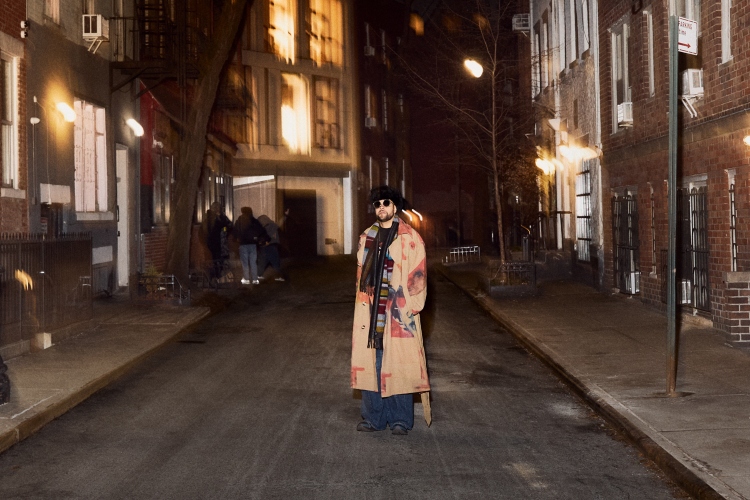
Photo Credit: Erik Bardin


Leave a Reply