

In making sense of the story of jazz, historians often craft a narrative that neatly divides into different generations and schools of thought. Revolutions in composition, improvisation, rhythm, and instrumentation each producing a distinctly novel area of music. While this perspective has some truth to it, the dividing lines between each era are often far more theoretical than factual. The contributions of the greatest artists usually span multiple generations and approaches. That is certainly the case with Roy Haynes. The graceful swing of Lester Young, the revolutionary bop of Charlie Parker and Bud Powell, the outward explorations of Eric Dolphy and both Coltranes, the electrified fusion of his own Hip Ensemble, and the modern refinements of Pat Metheny and Chick Corea; Haynes was a part of it all. And that is before even getting into the thirty-two albums under his own name. It is impossible to imagine the development of jazz across the last eighty years without Haynes. But he was more than a great jazz musician. He was a revolutionary drummer whose contributions touched all modern music. In the words of Questlove, “Roy Haynes is the blueprint. Every modern drummer owes something to him, whether they know it or not.” Much of the debt is due to Haynes’ vastly explorative heart.
The patriarch of a musical dynasty – his sons, Graham and Craig Holiday Haynes, have forged formidable careers on cornet and drums respectively, and his grandson, Marcus Gilmore, has taken his lead and sits at the stool as well – the eldest Haynes made sure to instill his virtue of artistic openness among his offspring. As a trailblazer, it is easy to assume his shadow looms large over the family who followed him. But while his influences are undoubtedly felt, he seemingly worked hard to let them each find their own paths. His response when an interviewer asked what advice he gives a young Marcus is particularly telling: “What advice do I tell my grandson? I listen to him.” In so doing, the man sometimes referred to as Snap Crackle allowed the generations that followed to flourish on their own behalf. Emphasizing freedom over narrow preservation of legacy also made the music itself richer as a result.
In the case of Gilmore, the emphasis’ on openness has led to his becoming one of the most in-demand drummers today. Over the last two decades, Gilmore has been called to serve as a sideman for Pharaoh Sanders, Chick Corea, Ambrose Akinmusire, Flying Lotus, Zakir Hussain, and Roy Hargrove, to name only a few. Most recently, he has played trio with Brad Mehldau and Christian McBride. Another excellent three-person group comes later this year by way of Trio of Bloom (Pyroclastic, 2025) with Nels Cline and Craig Taborn. But Gilmore had not released an album as a leader. Until now.
Journey to the New: Live at the Village Vanguard (Drummerslams) finds the drummer at the storied institution with an unusually instrumented ensemble providing a wide range of textures. The music evolves slowly and deliberately, gently allowing the listener to enter a unique sound world. The entire album moves with marked fluidity. The opening “Voltaire,” for instance, uses the harmonics of Emmanuel Michael’s guitar to craft an atmosphere of seeming weightlessness, one in which light, by way of David Virelles’ keys and Morgan Guerin’s Electronic Wind Instrument (EWI), slowly filters into the room. Gradually, an intricate dance of brightness and darkness ensues, with space contouring the edges of each.
Across Journey to the New, the music is thoroughly modern yet not unmoored from tradition. In the leader’s solos, you can easily hear the lessons carried from his grandfather, Tony Williams, and the other revolutionaries who came before. But in remaining true to himself, Gilmore honors his grandfather’s legacy more than mere mimicry ever could.
Given Haynes’ contributions to the music during his lifetime – he died last November, only a few months short of his hundredth birthday – it is predictable that musicians will dedicate performances to the legend’s honor. But Gilmore’s Centennial Tribute will be far more than yet another cover group. The all-star artists he has drawn into the performance – Danilo Perez, John Pattitucci, and Kenny Garrett – would never allow that to happen anyway. Instead, the set will unquestionably be a heartfelt and endearing statement on both the extreme artistry and self-determination of the man he knew so well. It has the potential to be one of the most memorable performances of the entire weekend.
We sat down with Gilmore to discuss Journey to the New, the enduring legacy of his grandfather, and how he plans to celebrate at Newport.
PostGenre: When did you first become aware of the Newport Jazz Festival?
Marcus Gilmore: My earliest memory of Newport is probably from the John Coltrane album, Newport ‘63 (Impulse!, 1993). I caught wind of that album when I was fairly young, probably about ten or eleven years old.

PG: That one has your grandfather on drums, right?
MG: It sure does. And from there, I started asking around about Newport. People told me about how it’s a legendary festival and all the great artists who have played there. A few years later, I started seeing footage from Jazz on a Summer’s Day (Galaxy Attractions, 1959) and pictures from all the different years. I also heard many other recordings from there. The first time I went to Newport was probably when I was still in high school. I started going fairly consistently, as an audience member, starting at the end of high school. I probably went three times in five years or so. And eventually, I started playing there.

PG: When was your first performance at Newport, in 2009 with Vijay Iyer?
MG: I’m not entirely sure but that performance with Vijay was pretty early and might have been my first Newport performance.
PG: This summer will be your first time performing at Newport as a leader.
MG: Yes, yes. Over the years, I have performed at Newport quite a bit with several different people. But this will be my first time as a leader.

PG: What does it mean to you to be leading your own group there instead of performing as a sideman?
MG: It’s pretty great. It’s a great opportunity. I enjoy being in the position of working not solely with a drummer’s mind of making the music sound good while supporting all the other band members. As a leader, I also get to work with the producer mindset of knowing how to structure the set in terms of what types of pieces to perform and who’s playing what part. I’m very fortunate that this performance will feature some of my favorite musicians. People I look up to. Getting a group together with them is very special for me.
PG: Who will be performing with you?
MG: John Pattitucci, Kenny Garrett, Danilo Perez, and myself on drums.

PG: Wow, that sounds incredible.
MG: It will be particularly special because I’ve witnessed pretty much all of them with my grandfather quite a bit over the years. It will be very special to play with them. And obviously, the fact that it will be as a tribute to my grandfather is very special as well.

PG: Have you done many performances that are tributes to him?
MG: I’ve done a couple in the last year. We did one for his induction into the [Ertegun Jazz] Hall of Fame at Lincoln Center last October. There was also something as part of their Unity Jazz Festival in January of this year, where we put together another pretty incredible group of musicians. We had multiple rhythm sections. Terri Lyne [Carrington], Lenny White, and my uncle Craig [Holiday Haynes] were on drums. On bass, we had Dave Holland and John Patitucci. On piano, Kenny Barron and Dave Kikoski. DeeDee Bridgewater sang. Jaleel Shaw played sax, and my uncle, Graham [Haynes], was on cornet. It was pretty cool. But Newport is going to be different.
PG: Why is that?
MG: Well, being at a festival means you usually don’t have a lot of time for things like sound checks. You just have a quick line check. It’s great, but it’s quick. With the other performances, I had a little more time and fuller checks.
PG: As far as Newport, did you approach the Festival team with the idea of presenting a tribute there? Or did they come to you to perform, and you decided to do it as a tribute?
MG: [Newport Jazz Festival Artistic Director] Christian [McBride] pitched the performance to me and gave me a lot of freedom to select who would be a part of it. He asked me who I would pick if I could pick anyone at all for the group. So, I started thinking about people I grew up watching play with my grandfather, and that is who I came up with. It also helps, I think, that they are all playing at Newport with different groups this summer anyway. But that was basically Christian’s pitch to me; that if I could figure out how I would most like to honor my grandfather, he would see what he could do to make it happen. Luckily, it seems like it all worked out.

PG: I think the fact that you were able to pull such an impressive group together is a testament to both the faith the other musicians have in you as an artist and how much your grandfather means to them. Assuming it is even possible, if you were to step out of your role as his grandson, what do you feel is your grandfather’s greatest contribution to the music?
MG: Ohh, I don’t know. It’s hard to say. He did so much for the music. But I will say – because of where his contributions start and the timeline and trajectory of the American trap set drumset – that too many people don’t fully appreciate how much he actually contributed. They have often limited his contributions to the jazz category, as if his work did not reach music outside jazz. But the reality is the drum kit was still fairly new when he came onto the scene, and there were many things he did on the instrument that helped all drummers.
My grandfather was one of the first drummers to use a smaller twenty-inch bass drum. That is the size considered normal now. Not only was he the first to use that drum consistently, but he was also one of the first to figure out the type of vocabulary to use on the instrument. He was also one of the first to develop the vocabulary of the ride cymbal. One of the first to develop vocabulary on the high hat. So, for me, these contributions are almost unquantifiable, but they’re pretty massive.
PG: What do you feel you personally learned the most from your grandfather?
MG: Probably the most impactful thing I’ve gotten comes from simply being around him. Not necessarily even from talking to him, but just watching how he would navigate his life. He was a true original who was completely comfortable with who he was. He was sincere, genuine, and unapologetic. He was very much himself. And that was huge for me to see and witness. Truly one-of-a-kind.

PG: Earlier, you mentioned that the first time you encountered a Newport recording was one where your grandfather was playing with Coltrane. Do you remember the first time you ever heard a recording with your grandfather on it?
MG: I’m not sure about a recording but I had heard him play live from a very young age. I was listening to him even before I knew that I was interested in music in any serious way. In the early 1990s, probably even in the late 1980s, my grandfather would bring the family to his performances when they were at family-friendly venues in the New York area. Sometimes he would even bring out all of their grandkids. So, I saw him play long before I ever intentionally asked to go to his performances. I was just around his music.
But I do have a very vivid memory from when I was, probably, around four years old. My grandfather was performing at Jazzmobile [, the longest running jazz concert series in New York City] at Grant’s Tomb. I remember all the food vendors from Harlem. I remember the smells. And I remember the sound of the music. At some point that evening, I realized that there was something very special happening on stage. That was the first time I remember focusing on music in a meaningful way.
PG: He also got you your first drum kit when you were ten years old.
MG: He did. It was a Ludwig kit that he had already used, which, for me, was even better because the instrument was enchanted. He toured with it in the late 1980s or early 1990s and gave it to me in 1996.

PG: When he did, do you think he sensed that you were going to be a professional drummer?
MG: I don’t think he knew. Not at that time. Maybe he did a year or so later. In the beginning, it took some convincing on my mom’s part to even get him to realize that I was serious enough to get a kit. I knew I wanted to play drums from the time I was seven, but my mom had to keep reminding him of it. At that time, I didn’t really have anything to practice on. I just had some bongos at home. I started playing bongos in the choir at church, and my mom realized that I had a natural affinity for playing. And once I was sure that was what I wanted to do, she started talking to my grandfather about it.
Being able to see my grandfather play was the most inspiring thing to me growing up. It helped me realize that it was a viable career and lifestyle to play drums. It just took time to convince my grandfather how much playing them meant to me. Kids say all sorts of things, and you never know if they’re truly serious about something. Something that interests them at one moment might just be a fad, and they’ll move on to something else. But at some point, I guess he realized how consistent my request for drums was and how serious I was about it. So, when I turned ten, my grandfather came over and brought over this enchanted drum set.
PG: What made it enchanted?
MG: Because he’d been playing it, the heads were kind of worn in, but with the best type of feeling. It was the same as if you got a cello that was kind of old, and you knew that it belonged to your mom. Every nook and cranny in it is kind of sacred.

PG: Coming from such a prominent musical family – not just because of your grandfather but also your uncles- do you ever feel pressure to do things a certain way musically?
MG: No. Never. That’s one of the great things about the dynamic that I had with my grandfather. He never put pressure on me musically. He just knew how serious I was and saw how things were developing naturally and organically for me. He wasn’t so hands-on, but was very supportive. He would come out to my shows and everything. He wouldn’t say much in terms of the music but he was always there for me. I never felt pressure from him or any other musicians in my family, to be honest. They’re all pretty encouraging.
PG: The last time we spoke was for the Jazz Gallery back in 2020. At that time, you were writing a lot of music but had no plans to put out a new album. You just released your first album as a leader, Journey to New: Live at the Village Vanguard. What led from the choice not to record to creating the new album?
MG: I have been writing a lot of music over the years and have even been recording. So, there will be a lot more recordings coming out in the future. But this Vanguard one felt like the one I should put out first. The way the music developed was very organic. I’ve played the Vanguard many times as a sideman but not as a leader.
In the Summer of 2022, I was invited to play at the Vanguard as a leader when, at the last minute, Maestro George Cables couldn’t make it. I was asked if I could put something together only a few days before the performance, and, thank God, the people that I wanted were in town. So, we had a trio with David [Virelles] and Rashaan [Carter]. And that went very well. It was the first time I got to play six nights with my own ensemble. It was a litmus test of sorts. And it felt like something I could fully develop. So, the next time I came back, I added a couple of more instruments because I had a specific sound in mind.

PG: Was that the sound that ended up on the album?
MG: It was very similar to what we have on the album. The second time had everyone on the album except for [guitarist] Emmanuel [Michael]. The way the music developed every night felt very inspiring, and I decided I needed to record it as soon as possible. So, when I went back to the Vanguard the following year, I did the same thing with the same guys, but added Emmanuel because [bassist and sound designer] Burniss Travis couldn’t make one of the live recording dates. It just felt like everything kept building organically. And it felt like something I had to capture because it was very special to me.
PG: What made you decide to have two basses in the group?
MG: There were a couple of things that I had in mind. It ended up being Burniss playing only electric bass and Rashaan playing only upright bass. But with that, there are a lot of textural combinations I could get, even before Emmanuel was added to the group. Burniss can get a lot of different kinds of sounds that don’t sound like an upright bass. Honestly, if the Vanguard stage were bigger, I probably would have had two upright basses for some songs and an upright paired with an electric for others. It is all about finding different textures. And adding a guitar brings a whole string component. I like having multiple sounds within the band. Multiple permutations when you add different duos within the band, or trios within the band. You can get a lot of different sounds out of that one group.
PG: You also have Morgan Guerin on Electronic Wind Instrument (EWI). Morgan plays many different instruments…
MG: He plays pretty much everything. He’s like a musical Swiss army knife.
PG: Interestingly, while he played saxophone and flute at the Vanguard date instead of EWI, the record has only pieces where he plays EWI. Was it a conscious choice to release only the pieces where he is on EWI, or did it just end up that way when you were piecing the album together?
MG: Yeah, that is just how it turned out. There were a couple of pieces on the album where he would always play on the EWI. But there were also other ones where he would play other instruments. Somehow, it just worked out that everything that I wanted on the album ended up being him on EWI.
PG: As far as the pieces on Journey to New, most are written by members of the band: you, Burniss, Morgan, or Emmanuel. However, there is one piece, “Open Handed Reach,” by Geri Allen. What made you decide to cover one of her compositions on an album of otherwise original pieces?
MG: Well, I knew I wanted to focus on original compositions from everyone in the band, including myself. But on pretty much every Vanguard run, I’ve always done at least one Geri Allen composition. The one on the record is particularly fresh because I had heard it for the first time, on a record of hers, only a few months before we went into the Vanguard.

PG: On the duo album with Kurt Rosenwinkel [A Lovesome Thing: Live in Duo at the Philharmonie de Paris in 2012 (Motema, 2023)]?
MG: Yeah, that’s the one. And I love the piece. I love all our compositions, but that one in particular was very special.
PG: A little earlier, it sounded like you recorded more of the Vanguard run than what ended up on the album.
MG: Yeah, in total we recorded four performances over two nights.
PG: Do you think you will ever release some of the performances from those sets that did not make it to the record?
MG: Maybe. Now that I have released my first record, I have so many more to come. Some are similar to this record, and some are wildly different. Some with electronics. Some without. I’ve only just begun.
Catch Marcus Gilmore Presents: A Centennial Tribute to Roy Haynes at the Newport Jazz Festival on Saturday, August 2, 2025. More information on the Festival can be found here. We will be providing live coverage of the event. ‘Journey to the New: Live at the Village Vanguard’ is out now. It can be purchased on Bandcamp.
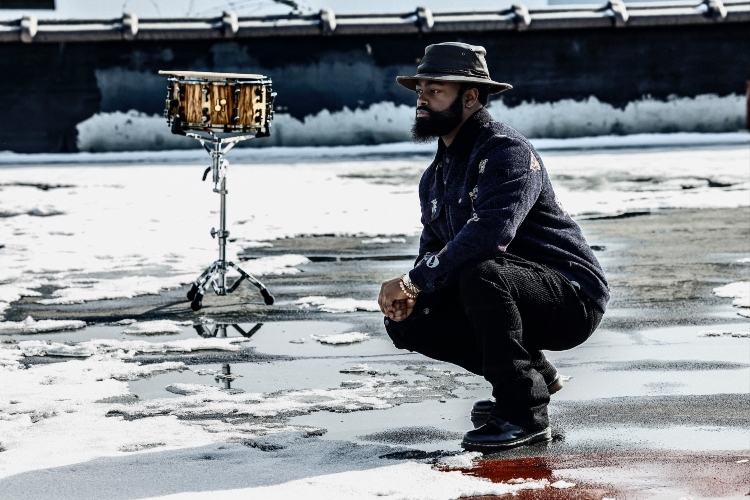
Photo credit: Ogata


