


|
Getting your Trinity Audio player ready…
|
On December 12, 2025, the world lost a truly innovative voice. When any accomplished artist passes, there is a natural inclination to list the other artists that person once called collaborators, as if to provide necessary context to the loss by reference to names perhaps better known. Certainly, one can write a piece about Marilyn Mazur that focuses solely on her work with people like Miles Davis, Gil Evans, Wayne Shorter, or Jan Garbarek. But those statements by themselves inadequately describe what made her work so extraordinary.
For one, Mazur was an unquestionably valiant warrior for gender equality. Back in 1978, she formed the Primi Band. Practically unheard of at the time, the all-female ensemble pushed the edges of experimental music. A decade later, she became the first – and only – woman to join Miles Davis’ band. And by the Twenty-first century, Mazur started a spiritual successor, of sorts, to Primi Band, Shamania, consisting of ten of Scandinavia’s most respected and groundbreaking female musicians. Given this background, it is easy to think that Mazur focused on gender, but as she reveals in our conversation, she focused primarily on the artists themselves as individuals.
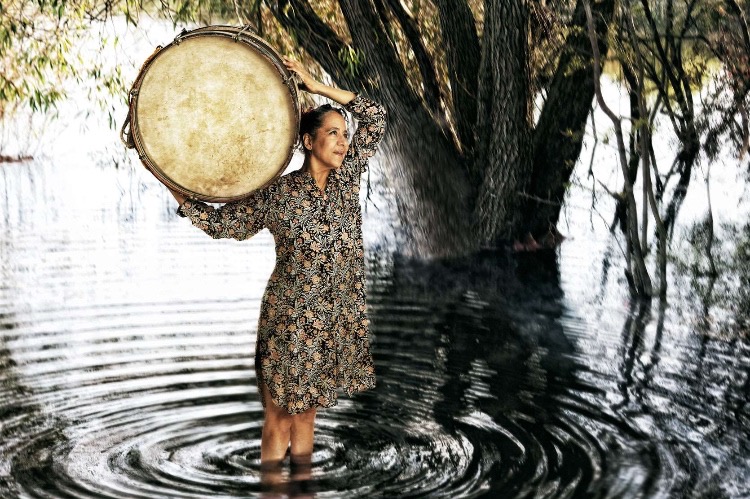
And this gets to the core of what held her two great all-female ensembles together, the idea of “urkraft,” a primeval power or primitive force. Throughout her career, Mazur was a shamanistic invoker of sound. She tapped into something bigger than the instruments in her hands. Although ostensibly a percussionist, her approach to music has always been broader than that of a rhythmicist. Before the inspirations of Al Foster, Airto Moriera, and Alex Riel brought her to the drums at age nineteen, she started on the piano. It is worth noting that the piano itself is, arguably, a percussion instrument with keys triggering the mallets that hit a string. Far too often, however, most people do not identify it as such. Mazur never drew such arbitrary lines, instead placing equal emphasis on melody and harmony as on rhythm. To her, a stick or mallet was really not too different from keys or a string, and you can hear that throughout her music. She also could not help but see the connection between the vibration of sound waves and the movement of artists themselves. She would frequently dance while performing, underscoring a unity of self with her sound.
What follows is a conversation – edited for clarity and flow – with Mazur back in April 2021. The piece was originally designed as part of a long-form series defending the often unfairly maligned 1980s work of Miles Davis. It is this author’s longstanding belief that there is significant merit to the trumpeter’s work of that period that is far too often pushed aside as a casualty of the ideological wars in jazz during that period. Miles’ music did sound different than what he had done before, but he was also chameleonic in his approach to sound. For various reasons, the piece for which this conversation was initially envisioned did not come to pass. In light of Mazur’s recent passing, it felt like the right time to brush off this conversation and celebrate her as an artist. The only reason for mentioning this piece’s history is to note that the predominance of questions about Miles Davis is more a reflection of its origins than any intentional choice to overlook the other incredible projects throughout Mazur’s career. This author was fortunate to have talked to Mazur and wishes the circumstances allowed for a deeper dive into works under her own name, projects like Small Labyrinths (ECM, 1997) with Future Song, an octet with trumpeter Nils Petter Molvaer, vocalist Aina Kemanis, saxophonist Hans Ulrik, guitarist Eivind Aarset, pianist Elvira Plenar, bassist Klavs Hovman, and drummer Audun Kleive. Or perhaps Celestial Circle (ECM, 2011), a quartet date with vocalist Josefine Cronholm, pianist John Taylor, and bassist Anders Jormin. However, it is hoped that even this shallow exploration into Mazur’s oeuvre will inspire the reader to dive deeper into the great work she has left behind for us.

PostGenre: After Miles Davis received the Léonie Sonning Music Prize, Denmark’s highest musical honor, in December 1984, the Danish composer/trumpeter Palle Mikkelborg composed a suite for Miles that was ultimately released as Aura (Columbia, 1989). The recording, with the Danish Radio Big Band, is widely regarded as one of the greatest moments of Miles’ final decade. As someone on the recording, what is your memory of those sessions?
Marilyn Mazur: I remember the recording sessions as a wonderful chance to work creatively with Palle Mikkelborg’s music and with Miles. I was not a regular member of the DR Big Band. Instead, I was an extra guest invited specially to perform on the Aura project after Miles won the Sonning Prize. I really enjoyed some of the evenings in the studio with Miles and Palle, when all the wind instruments would be sent home, and part of the rhythm section continued working in a more experimental way, leaving the written parts. The bassplayer, Bo Stief, encouraged – really, dared – me to tell Miles that we wanted to play live with John McLaughlin, who added his solos to the whole band’s recorded takes. So I went into the control room and told Miles this. We didn’t actually get to play with McLaughlin, but I at least got to show a bit more courage than I felt then!
PG: You indicated in another interview that the first time you had truly heard jazz music was when a friend turned you on to Bitches Brew (Columbia, 1970). What was it like to actually play with the artist who opened your ears in that way?
MM: Of course, I had heard jazz before Bitches Brew, but that album was a revelation and a turning point for me. Playing with Miles fifteen years later was like a dream coming alive, and it felt like a dream, too.

PG: It is fascinating how Palle’s main theme for Aura took the letters M-I-L-E-S-D-A-V-I-S as notes then then applied ideas from Olivier Messiaen and Charles Ives to the big band and fusion context. What were your thoughts on the music for Aura at the time the record was made, and what are your thoughts on it now?
MM: I was a great fan of Palle’s music at the time we worked on the record, and was very proud to be a part of Aura. Aura was perhaps more static in its expression than where I was musically at the time. But I continue to think it’s a great work and enjoyed being a part of it.
PG: Marcus Miller indicated in an interview that he thought one of the reasons Miles’ 1980s works were treated more harshly by some critics was because they shifted their focus from European-based melodies and harmonies that were present in a lot of Miles’ older works to more African-originated rhythms. As a percussionist who provided some of these rhythms, do you agree with that assessment?
MM: To me, African rhythms have always been an important element in jazz and later forms of “rhythmic music” as we call it here in Denmark. Of course, “European” harmonics were also part of many stages of Miles. Ultimately, I think that many of the critics mainly wanted Miles to stay in the jazz sound of his earlier times, not experiment with rock, pop, freeform, or play electric.
I personally love Miles’ music from the ‘70s. In a way, I felt like I joined Miles’ band ten years too late music-wise, as he had left the more experimental path and played his kind of “pop.” But there are probably many different opinions about iconic Miles.

PG: After Aura, Miles asked you to join his touring band. What do you feel you learned the most from your periods in Miles’ band?
MM: Touring the world and playing for Miles’ gigantic audiences was a strong experience that gave my playing focus and presence. It gave me more solid grooviness and stamina. Miles was an inspiring and powerful leader and had a great way of communicating with his musicians to bring out the best in us. During those years, I also realized more about which elements I find most important in my own music and ensembles, which are quite different from Miles’ band in the eighties. He definitely planted some seeds in several of his musicians.

PG: As the first, and only, woman in one of Miles’ band after decades of only male sidemen, do you feel like you were treated differently – by Miles or others in his band – due to your gender?
MM: Hmm, that’s difficult to answer- different from who and by whom? I didn’t focus on being the only woman in the band. Growing up in those times as one of the very few female musicians, I’ve always been a kind of outsider anyway. So, it felt natural – although shocking and fantastic – for me to join Miles’ band as the “strange woman from Denmark.”
For the band, it was perhaps a bit challenging. Miles liked for us to dress up for the concerts, and suggested to me that I should show my legs in short skirts! Apart from that detail, Miles always treated me respectfully, giving me lots of freedom musically, and the music was what it was about.

PG: While it was not your primary focus, during your career, you have made great strides in trying to eradicate the longstanding gender gap in jazz. How has that shaped your projects, like the Primi Band and Shamania?
MM: I have always been into exploring the intuitive communication in music, searching for alternative ways of playing together rather than rooting myself in the established jazz norms. So, while I did not focus too much on gender, and instead on individual artists themselves, I did also create female groups to find mutual expressions and feel the special bond between us.

PG: You have led many different bands throughout your career. Which do you feel most proud of and why?
MM: Through the years, I have created many bands. One of my most important bands has been Primi Band, which was very unique and daring in its time, with all the experiments, dances, bodypainting, strange instruments, and homemade musical inventions. Another was Future Song, my longest-lasting group, that really had a wonderful collective way of playing together and perhaps some of my best compositions. Also, Percussion Paradise, a very special, groovy, and popular percussion/vocal group that shared my vast sound-collection with strong younger female instrument-collegues in Denmark. And, finally, Shamania, my present version of Primi Band, with ten Scandinavian profiles, where I can experiment further with a large-scale “tribal” female gathering of sounds and freedom.
I also have several loose projects I am very happy about. There is the Brande Intern Music Workshop 1996, where I composed for and conducted the international full big band and a choir; my fourteen-piece ensemble when I received the Jazzpar prize 2001 for the live recorded album All the Birds (Stunt, 2002); my solo and duo album with Jan Garbarek, Elixir (ECM, 2008); and my residency at Molde Jazz Festival 2008, where I created several ensembles, such as Celestial Circle.
It is easier for me to tour with smaller groups, so, of course, I also enjoy being able to play a lot with my regular trios and quartets. One of these, MM Special 4, sometimes works with British singer Norma Winstone, which is a wonderful experience.

PG: You had just mentioned your work with Jan Garbarek. You were also a part of his band for fourteen years. What did you learn most from that long-term working relationship?
MM: With Jan Garbarek, we played lots of long concerts and world tours, and I developed a high level of consistency and intensity. And that also strengthened my ability to fine-tune the clearness and beauty of the music.

PG: In addition to your own bands and sideperson roles, you have also done several solo performances. How did you start doing solo performances, and what do you enjoy most about them?
MM: I love playing together with other people, so playing solo concerts mainly came from being invited to do so. Now, I actually also enjoy these dialogues with my instruments as a kind of alternative variant of musicians. My solo concerts are largely improvised. It is a nice challenge to have the total freedom in being alone on stage and the sole responsibility for the dramaturgy of the concert.

PG: Performing solo percussion is probably also more feasible when you approach percussion as melodic instruments. Do you feel your background in classical piano- an instrument that uses mallets to produce harmonies and melodies- has influenced your melodic approach to percussion instruments?
MM: Growing up as a pianist and with classical music has meant that I often think a lot in melodies and harmonies and “epic painting” when I compose. Knowing the tonal language well, compared to “only” thinking as a drummer, expands my ears and spectrum for both composing and playing. I also work melodically on my percussion instruments, and think that piano-playing has given me the desire to have many percussion sounds to play on, to still have a broad tone palette.

PG: You also dance as part of your performances. How do you feel your dancing has shaped your musical ideas and vice versa?
MM: I envision music as movement. Dance and music are just two aspects of the same energy to me. Words, movement, or even melody all have rhythm as an important element. Playing percussion and drums is also physical, and it’s good to have some body consciousness as a musician. Live concerts also have visual aspects that are worth considering. Ultimately, for me, dancing is a part of playing.
More information on Marilyn Mazur can be found on her website. But, even more importantly, explore the incredible work she gifted us all while she was still here with us.


Leave a Reply