

As nonsensical as it may seem in the abstract, sometimes ideological wars are a necessary step towards a renewed and invigorated community. This is certainly the case with the so-called “jazz wars” of the 1980s. After decades of further sonic expansion, one side came with a zealous desire to return the music to its roots. One of this army’s most decorated generals, Wynton Marsalis, perhaps summarized their perspective best in a 1985 issue of Jet Magazine: “Jazz has got to retain its integrity, its spirituality,” and that could only be done through a return to its swinging and blues roots. The opposite side of the battlefield, a team of hip hop heads, avant-garde firebrands, and electric explorers who pushed for the music’s continued growth further beyond its roots. In the words of Herbie Hancock, “[The music is] not exclusive, but inclusive, which is the whole spirit of jazz.” While the skirmishes between these two factions were once very public, eventually the metaphorical musket smoke cleared, and the battle flags gradually lowered. And the music is now richer for it. The past two decades have seen a renaissance in jazz music, largely due to younger artists who learned to balance the positions of both sides. It is hard to find a better example than the New Jazz Underground, which will perform at the Newport Jazz Festival on Saturday, August 2, 2025.
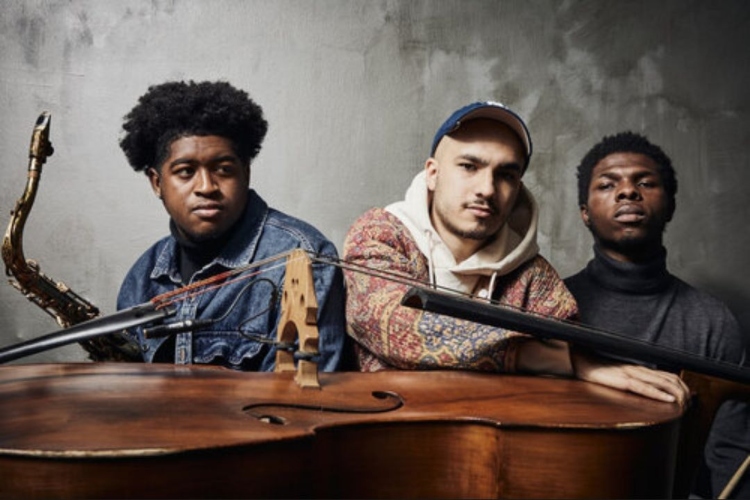
The New Jazz Underground originates at the Juilliard School, Marsalis’ alma mater. As students at the esteemed institution, bassist Sebastian Rios, saxophonist Abdias Armenteros, and drummer TJ Reddick formed the group that became the New Jazz Underground. The trio’s chordless instrumentation is a clear evolution of the novel structure established by Sonny Rollins in the 1950s. And the Underground undeniably swings. Hard. They take influence from the blues form. Marsalis gives the band his seal of approval. The New Jazz Underground has also worked closely with the House that Wynyon Built: Jazz at Lincoln Center. But that is only part of the story.
All under the age of thirty, the musicians of New Jazz Underground are of a generation that stereotypically prioritizes technology, economic pragmatism, and an emphasis on self-expression. These virtues are an inescapable part of the group as well. Where Wynton’s music tried to find new audiences in classical concert halls, the New Jazz Underground has emphasized viral and virtual content. Some of their earliest performances together took place in parks and streets in a lockdown-era New York. But it is online where they truly found an audience. Performing songs with provocative titles like “they can hate but we still swingin”, “f**k/s**t/c**t/jazz”, and “sad boy jazz” found many listeners who aren’t exactly inhabitants of the Real Book. In the process, they gained a following of over a hundred thousand subscribers on YouTube.
But the New Jazz Underground’s divergence from the neotraditionalist ideal expands beyond the venues in which it performs. Growing up in an age where finding different styles of music comes by merely a click or a tap compared to having to walk to a different part of a store, the trio’s music is inevitably more open to other artistic impulses. Hip-hop and pop music permeate the group’s work. They have even dedicated recordings to the works of Kendrick Lamar and MF DOOM. The New Jazz Underground is much more sonically expansive than the perspectives pushed by Stanley Crouch, but, again, swing and the blues are paramount. The trio does not stake a place in wars past or relitigate old disputes. Instead, it finds ways to narrow any remaining gap between them, learning equally from both sides.
With the New Jazz Underground, the music born in Congo Square, developed under Louis Armstrong, and continued to grow through Duke Ellington and Miles Davis all the way to Ambrose Akinmusire, is indeed left in good hands. As the trio prepares to release its debut full-length album, we sat down with bassist Rios to discuss the group and their upcoming Newport performance.

PostGenre: Do you remember when you first learned about the Newport Jazz Festival?
Sebastian Rios: You always hear about it. I remember, back in middle school, seeing the picture of Miles [Davis] wearing sunglasses at Newport [in 1958] and hearing a version of “Bye Bye Blackbird” by him from there. I also used to listen to Duke Ellington’s “Festival Junction” suite that [Billy] Strayhorn wrote for him for the 1956 Newport Jazz Festival. And the famous version of “Diminuendo and Crescendo in Blue” from that same year. I love that album [Ellington at Newport (Columbia, 1956)]. It is so great. The story behind that record is such a legend in jazz, and the recording is such an important moment. Man, it’s a blessing and honor to play at Newport. Even just the festival’s history is crazy. It’s so cool. I love jazz history. I’m not the most educated on it, but I do know some stuff. It’s an honor to be in a continuum with that history.
My teacher is the great Ron Carter, and he is tied to so much of that lineage, too. I never think of myself through my own art. I don’t care much about what people think about my music. I’m glad they’re enjoying it, but I’m still like a little tadpole in this giant ocean of jazz music. So, to touch something so important, whether Newport or learning from Ron, is incredible.

PG: Part of what makes New Jazz Underground interesting is how the band finds ways to make jazz appeal to those who may not be so closely connected to that music. For instance, your Kendrick Lamar [Dying of Thirst (self-release, 2025)] or MF DOOM [the MF DOOM SUiTE. (self-release, 2023)] tribute EPs view both artists’ music through a jazz lens, but appeal to those more attuned to hip hop, and maybe not as familiar with jazz.
SR: Yeah, it all depends on where you’re at. It depends on who you are. It depends on what your cultural background is. I think the fun part of what we do is to try to make references to things most people would know. Our projects, like the MF Doom thing and the Kendrick Lamar thing, mostly came from us wanting to make something that we would listen to. As Gen Zers, we’re constantly online. We thought it would be great to make something that’s very accessible and palatable. Something that someone would want to listen to if they stumbled upon it on YouTube. But, at the same time, something that will contain all those things that make jazz music jazz. We wanted to have a standard for the music and knew exactly what, as jazz musicians, we wanted for the project.
It has been a lot of fun to have shows, especially after putting out the Kendrick EP, and seeing the reaction of young cool people having a blast. I remember a show we had in San Francisco where all these beautiful young ladies were dancing to our music. They were recognizing the songs we were playing and excited to hear them. To have young people responding to jazz in that way is very exciting and fulfilling for me as an artist.
But we are also working beyond our covers. We just signed a deal a couple of days ago to make a record that will focus on our original music.
PG: That new album will be called Hoodies, right?
SR: We’re not a hundred percent positive yet, but I think so, yeah. That title seems to represent our music well.
Hoodies is about being in the street. Being a young person, a young man, in these times, so many things are dictated to you. You are told about what you are supposed to do; what’s cool and what’s not. And the street is where it starts. Hoodies is about being out there. It’s about being present. It’s about being culturally minded. What you wear is the most superficial thing, but hoodies are also part of this generation’s identity.
There is also a double meaning to Hoodies when you consider people like Trayvon Martin. A close friend of mine from high school, Israel Hernandez-Llach, was an artist who worked under the name “Reefa.”

PG: He was a graffiti artist.
SR: Yeah, yeah. He was a great young artist, and he got killed. He had tagged some graffiti and was running away from the cops. They caught him, tased him, and gave him a heart attack. They killed him. Horrible.
But those cruel sorts of things are also part of who we are as young men of color in America. Our band basically started in the streets because we had no place to play during the [COVID-19] pandemic. We would play in the streets of New York City. If we were lucky, we would make enough money playing to buy a pizza for dinner that night. If we had a very good day, maybe we would get Chipotle. But the street is entirely where our sound started coming together, and it is in the spirit of everything that we do as a group.
That is one of the things we are trying to do with Hoodies; we are trying to make a music that sounds alive. Trying to take all the things we learn and love about our culture and seeing how they translate into sound. In the streets, we can focus on the basics – harmony, melody, and rhythm. The key is to try to get those bare essentials, onto the record in a way that sounds like they do in the streets.

PG: Is it easier to capture that feeling live than in the studio?
SR: Of course. But Hoodies was recorded in the studio, and that’s how it’s going to come out. Even in the studio, however, I think we did capture the essence of our sound in a very beautiful way. It sounds incredible. On the album, we worked with some very great people and in some very great studios.
That being said, however, I think the next album will most likely be us recording in our own space with our own equipment. I mean, that’s how we rose to popularity; through recordings in our living room. Again, essentials and basics. We’ll probably take it song by song as opposed to the classic jazz album recording session, where you go in and have an album in two hours. I know that Ron [Carter] used to go to Rudy van Gelder’s Studio, record all day, then do a mix and mastering session that night of what he had done. Boom, album done. That’s similar to how we approached Hoodies but, I think, the next time around, will approach things in a much more DIY way because you can get a great sound and capture those magical moments especially well when you’re not on a clock; when you’re not worried about the time to put it together or money spent on it. In a situation like that, it’s just us and the music. I think the next album will be more songs, mostly shorter two to four-minute ones.
But Hoodies is going to be very jazz-focused. It is very modern. It is our vision of modern jazz and what this music says it could be. It is a very pure representation of young positive masculinity and jazz, and we are trying to make an impact with the little resources that we have. We also greatly wanted to get to approach the trio sound in a new way, something I feel hasn’t been done in a long time.
PG: Is the music on Hoodies what the trio will perform at the Newport?
SR: Mostly. At the festival, we will be playing for only forty minutes, and some things are up in the air. But a large portion of the record will be presented at Newport. We might play our Blues Suite. I was commissioned by Jazz at Lincoln Center to write that one. We love Jazz at Lincoln Center. They’re even sending us to China next month, actually.

PG: So, the trio’s song “they can hate but we still swingin…” is not directed to Wynton [Marsalis] ’s narrower view of jazz?
SR: [laughing] No, we come in peace. The hilarious thing is that Wynton loves that song. He’s like our uncle or something. We love him. Because he’s the king of a certain thing – I’m not saying he’s the king of jazz, but he’s a king of a certain thing in jazz – a lot of people like to swing at him. But he’s cool. Our saxophone player, Abdias Armenteros, even goes on tour with Wynton. He’s the youngest member of the Jazz at Lincoln Center Orchestra.
But, no, that song wasn’t directed towards Wynton. I’m not sure it was even directed towards anyone in particular. It was just something silly. We’ve been lucky in that we have not had a lot of haters. But the haters also often don’t show up until you are further on. By saying that, it’s almost like I’m manifesting hate. [laughing]. But if you reach a certain level and don’t have at least a couple of haters, you’re probably not doing things right. Some people will always call you overrated at a certain point.
PG: That’s true. But back to the Blues suite.
SR: Yeah, I used a hip hop way of composing it where I sampled old field recordings of Delta Blues singers, mixed and matched them, and created compositions out of what came out of it. In writing the suite, I was trying to take directly from the source of these authentic melodic Blues resources and create a context around it that was built around modern jazz rhythm. I tried to put it all together in a way that made sense. Using that approach, I crafted a five-piece suite – well, really, six piece – where we try to weave in and out of tradition and modernism. And actually, Abdias sings the Blues in the second movement of it. The suite is the longest piece I’ve ever written, and we will most likely play at least a couple of passages from it at Newport.

Another piece we may do is called “Pseudo Latin Vibe.” It essentially comes from the fact that I’m pseudo-Latin. Genetically, I’m a mutt. I’m half Chilean, half Italian. If I went to Chile, they would call me gringo. I would come back here; they call me chili bowl. You get no love. Abdias is also Latin – Cuban – and, like me, from Miami. The song is complex and uses many different rhythms and big grooves. I feel like that song is the most accurate artistic statement of what sound is for us. We modeled ourselves through it and came up with this style of playing that I don’t think anybody else specifically sounds like.
Another song we may be playing is one I recently wrote that basically asks what it would be like if John Coltrane sang and played [Jimi Hendrix’s] “Hey Joe.” Abdias can really sing and play. You can hear our love of hip hop, R&B, and all different styles in what he sings. Man, I don’t even know how to describe his vocals, but it’s like catharsis. Then he lets everything out on the horn.

PG: As far as bringing ideas from other music into your original compositions, do you feel arranging the music of Kendrick and DOOM on the EPs we discussed earlier has helped you in terms of writing your own music?
SR: Well, for example, with the MF stuff, we did a cover of “One Beer.” I had written chord changes to another original song of mine called “Same Thing,” and for our version of “One Beer,” I reharmonized those changes. On that suite, there is a New Orleans modern jazz kind of thing.
I’ve always been a writer, but I have developed that skill quite a bit over the last ten years. I like to use the tools that I already have, incorporate other stuff, and make it recognizable. I like to use cultural touchpoints as references. It’s all about references. That’s post-modernism.l; everything’s referential. And even those hip hop artists, especially MF DOOM, often sampled technical jazz records. There’s so much reverence there, not only from DOOM, but also from people like Madlib who did Madvillany with him. If you listen to Madlib’s rapping under the name Quasimoto, he talks about Sun Ra, Ahmad Jamal, and all these jazz cats. And now I am referencing people like Madlib and DOOM. We are in a never-ending loop of people inspiring each other to make another form of music.


PG: That loop has been going on for a very long time, though. Even for Madlib specifically. His Blue Note album [Shades of Blue: Madlib Invades Blue Note (Blue Note, 2003)] came out more than twenty years ago. It is interesting that some people still seem surprised that those connections between jazz and hip hop exist.
SR: Right. All that stuff is in the history of the music. Being a Gen Z kid and just a younger person in general, I don’t really distinguish MF Doom from Thelonious Monk. To me, they’re all just great music. Is the music good? That’s what we care about most, not what you want to call it. To go back to Wynton, our trio loves him and studied him, but don’t take his viewpoint as dogma. His perspective is just one resource among many. It’s a vital and important resource that we care for a lot, but to me, it’s just as valid as the hip hoppers work.
PG: Well, as to the general thought that what matters most about music is whether it is good, that lines up with Duke Ellington’s embrace of the phrase “beyond category” to describe his own music. So, not to diss Wynton, but where does that focus on a narrow view of the music come from?
SR: Well, a lot of it’s about money. We all love Wynton. His music is so transcendent. Some of his work is so influential on me. The Abyssinian Mass (Blue Engine, 2016). Blood on the Fields (Columbia, 1997). The Ever Fonky Lowdown (Blue Engine, 2020). Black Codes (From the Underground) (Columbia, 1985). All of his work at the [Village] Vanguard. That is all gospel to us. But that is only one aspect of Wynton’s genius.


The other aspect is his business mind and ability to approach the arts world in a way that gets recognized the same way as classical music. He found a way to make the symphony model work for the big band. And he’s done so well at it. Some people overlook the accomplishments of this man because he has a specific view of jazz that is narrower than that of some other people. But he codified some standards so people view Dizzy [Gillespie], Duke [Ellington], and Mary Lou [Williams] on the same level as [Johann Sebastian] Bach and [Johannes] Brahms. Jazz needs that status to ensure it is financially sustained by contributions from the social elites. It’s very hard to keep them on board for donating, especially for jazz. Nobody else has ever done it the way Wynton has. It’s crazy to think about the millions of dollars he has been able to bring to Jazz at Lincoln Center. Especially since a lot of that came twenty years ago, when the dollar was worth more. So I understand the importance of his business skills.

But I also want to say that Wynton, as an individual, isn’t how some people portray him. During my first year at Juilliard, my class had an insane amount of talent in it. It had Immanuel Wilkins, Isaiah Thompson, Micah Thomas, and many other people in jazz who are doing great things today. There was one kid named Nick Lee who is an incredible bebop trombone player; one of the best I have ever heard. But he didn’t care too much for the trombone. He wanted to do production work and started getting into producing pop music. I remember that all of us, all of his peers, tried to convince him to play the trombone and put the production work aside. His production work was cool, but he was so great on the trombone. And Wynton was actually very supportive of him going that route. He wasn’t trying to change Nick’s mind or otherwise invalidate the music Nick was making.
I think Wynton is very sincere in his views on the music and in his convictions. But when it comes to actual interpersonal relationships, you’re not gonna get that vibe from him. And Nick went on to be like a top billboard charting producer. He produced Lil Nas X’s “INDUSTRY BABY.” He’s killing it now as a producer. The problem isn’t Wynton. It’s when young people get totally enraptured by a view of music and then all sound the same way.

PG: One could also say the same thing about music that combines jazz and hip hop, that often they produce a music that sounds the same.
SR: You know, Dizzy used to use the term “generic bebop.” If you are scrolling Instagram, you might get that one ad that says “improve your bebop.” I feel the same thing has happened in jazz and hip hop fusion. It is often a low five-beat thing where it all sounds kind of the same and has a similar vibe. There are some very good musicians who we respect and like as people, but make some of that stuff.
With New Jazz Underground, I have always wanted to make a group that plays acoustic jazz. Not everything has to be acoustic, but the acoustic instruments give you a certain texture, just as chamber music has a certain texture. When you start whipping out electric instruments, things get a little loud. That’s cool, but I think it stops being jazz. It’s not that jazz shouldn’t be loud. That’s also not to say that music using those instruments is bad music. I respect a lot of those guys who use those instruments. But sometimes using them makes music that loses its intentionality. That’s part of why I love swing. It’s very direct and intentional. Swing is so immediate. Hip hop is more about vibe and feeling. Sometimes basslines aren’t actually in time. Sometimes, drums are weird. It’s all a vibe and a groove. That’s the special thing about hip hop and sampling.
PG: So you do not see sampling as having much overlap with jazz?
SR: Sampling was a huge innovation. I feel like jazz musicians don’t utilize sampling as an actual technique of hip hop, but they should. Many jazz musicians only utilize the clichés of hip hop. They use the backbeat and the big loud bass. But I think sampling is what makes hip hop, hip hop. Even MCs are very referential to each other, and the same thing happens in jazz, but it’s something else. Someone like [Robert] Glasper is often making more instrumental R&B than they are jazz. They are making an instrumental R&B that is way cooler than smooth jazz, but is connected to smooth jazz at certain moments.

PG: It’s interesting to hear you refer to smooth jazz as instrumental R&B. It definitely is, but most people seem to overlook that description and insist on calling it a type of jazz.
SR: I like smooth jazz. It has an interesting vibe. It makes me feel like I’m at an aquarium or something. It uses an interesting sonic palette. I like all these different styles and genres. I’m looking at them as things that have existed before me and are just references. I don’t have a negative judgment of smooth jazz or Glasper or anything else. It’s all about what people do within the spaces of music that those people create. There are interesting ways to present those types of music within the jazz context that people haven’t tapped into yet.

PG: So, who do you feel is tapping into those things more fully within a jazz context in a way that may have shaped New Jazz Underground?
SR: As a trio, New Jazz Underground is deeply inspired by the people in jazz culture, like Ambrose Aminmusire, who play in a unique way. We listen to the music of people like Ambrose constantly, though we don’t transcribe what they play. Instead, we came up with our own way of playing modern jazz. It was our own negotiation of the last few years to figure out how to play in a more straight style that’s modern. Ambrose listens to jazz but also trap. If you look at his Spotify Wrapped playlist, you will see things like Lil Wayne. Abidias, TJ, and I grew up listening to Chief Keith. You can hear that in Ambrose’s music too. Ambrose is so modern.

I look at somebody like Chris Botti as this perfectly plastic thing. All the curves of his music are defined. Ambrose isn’t like that. He’s like Earth. He’s elemental. Instinctual and patient when he plays. He’s conscientious and very present and has all that history in him. We saw Ambrose recently as a duo with Sullivan [Fortner] at SFJazz. They were honoring Louis Armstrong and Earl “Fatha” Hines and did a version of “West End Blues.” I’m so used to hearing Ambrose in his own context. But if you bring him into a more traditional one, he shows his pedigree too. He knows how to sound traditional when he wants to. He sounded like Wynton. It was weird. Crazy. Then he can go into his own thing. With him, there’s no brakes. Everything is gas.
You can see him processing what he’s hearing as he’s playing it. With his lines, there is almost no clear end or clear start. Everything comes in waves. It’s this wonderful flow, and he can be fully present the whole time. It’s unreal. He takes you to that place beyond thought. His presence is supreme. It’s crazy. I’ve never seen anything like it. He’s making pure art, man. You can’t categorize it as anything else. And that’s kinda like jazz itself. Jazz is the only music where you can play a different thing each gig and the audience goes along with you. Jazz means you can play whatever the fuck you want.
New Jazz Underground will be performing at the Newport Jazz Festival on Saturday, August 2, 2025. More information on the Festival can be found here. We will be providing live coverage of the event. More information on the band is available on its website.


