

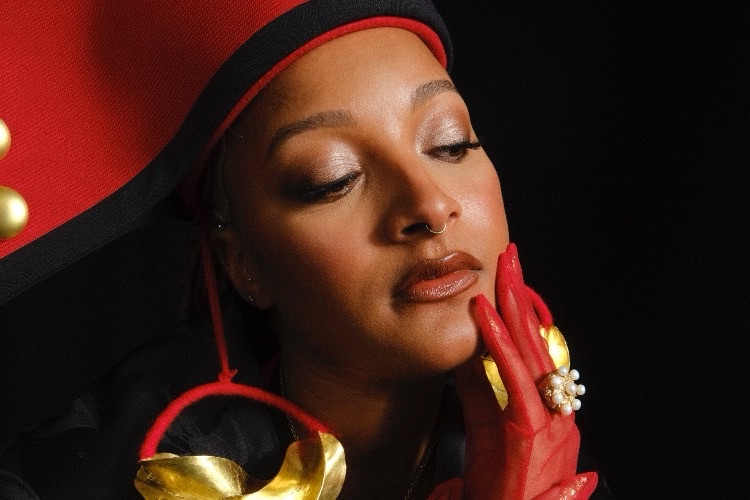

In 1963, Gunther Schuller coined the term Third Stream to identify what he saw as “a new genre of music located about halfway between jazz and classical music.” Third Stream was more than merely tacking strings onto jazz pieces or improvising in otherwise classical scores. Instead, it was intended to be a musical style that combined both lineages into a cohesive whole. Predictably, some critics decried that combining jazz and classical somehow lessened the power of both. Over six decades later, Nubya Garcia’s Odyssey (Concord, 2024) boldly challenges both Shuller and his most ardent detractors. One can hear such rebellion at the Newport Jazz Festival on Saturday, August 2, 2025.
Some of today’s most compelling music emerges from a fresh and vibrant music scene in the United Kingdom. In some ways, the London scene mirrors the cross-cultural roots that initially birthed jazz in New Orleans. In the Crescent City, the drum rhythms born in Africa and developed in Congo Square met the church, European brass and marching traditions, and the calls of the field. Modern London, a cultural melting pot like New Orleans before it, takes these roots and those that grew off of them over the years and grafts them to other sounds from around the globe. Close communities and collective conversations are essential to the scene, further expanding its grasp. Even so, certain figures inevitably stand out. For a music built on the democracy of ideas, jazz has a fascinating history of assigning titles of nobility to its most notable voices. A pioneer who directly mentored Louis Armstrong was a “King.” One of the greatest composers, a “Duke.” And another powerhouse bandleader, a “Count.” Across her work with bands Nérija and Maisha, albums under her own name, and collaborations with Moses Boyd, Theon Cross, Nala Sinephro, and Sons of Kemet, no one stakes a stronger case for coronation as Queen of the blooming London scene than Nubya Garcia.
Trained in jazz, Garcia cites Sonny Rollins as one of her chief inspirations. In many ways, it is easy to see why. Newk – who, like Garcia, played the tenor saxophone – drew significant influence from the music of the Caribbean. In his case, the calypso of his upbringing added an inescapable bounce and groove to songs like his anthem, “St. Thomas.” The child of a Guyanese mother and British Trinidadian father, Garcia’s musical experience has inevitably drawn in music from the region as well, with sounds from reggae, dub, calypso, and soca surging throughout her music. Her uncle, linguist John Rickford, further exposed her to funk, R&B, hip-hop, Afrobeat, and highlife. As an artist coming up in the internet age, where all music is available at the click of a button or tap of a finger, these interests only further deepened, incorporating electronic elements along the way. Much like the artistic community she represents, Garcia fuses all of these ideas organically into a cohesive whole.
By adding the strings of the Chineke! Orchestra, Odyssey integrates classical music into her already distinctive sonic ecosystem. There is a long line of recordings of saxophonists recording with strings. Far too often, however, they fall into one of two pitfalls: they either use their new orchestral friends as mere backdrops to their own music or they push themselves more towards the classical realm. Garcia deftly avoids both shortcomings by craftily composing string parts that are more than mere background but instead another thread to weave into the sonic tapestry. You can still feel the grandeur and majesty of the strings. Despite the claims of Third Stream detractors, both the jazz elements and classical ones are enriched by each other’s presence. But the record also reveals the flaws in Schuller’s definitions. Where his thoughts on Third Stream focus solely on jazz and Western classical music, those are but two of many colors with which an artist can paint. A true artist will rarely stay within narrow stylistic lines. Rather, they will push for music, the beauty of which reflects the diversity of their being, not artificially imposed labels. In Garcia’s case, the addition of strings allows things like the raw edginess of punk (“The Seer”) or the deep groove of dub (“Triumphance”) to unexpectedly rise to the fore.
We sat down with Garcia ahead of Newport – her second performance at the storied festival – to discuss Odyssey and how her music continues to develop and grow.
PostGenre: You previously performed at the Newport Jazz Festival in 2022. Was that your first time at the festival?
Nubya Garcia: It was my first time performing there, but not my first time at Newport. About ten to twelve years ago, I went there as an audience member; as a punter, as we say in the UK. I have very fond memories of both playing there and also the first time I ever went. The very first time I went was while I was at uni. We took a trip from New York on the bus, and it was incredibly special being there. I’m very happy to have been given the opportunity to perform there for a second time this summer.

PG: Going back to before your first time as an audience member, do you remember the first time you ever heard about Newport?
NG: Yeah, I think it was from an album. Probably Miles [Davis]’ Newport album [At Newport 1958 (Columbia, 2001)] back when I was a teenager. I hadn’t been to America before I’d heard that. So, I didn’t know where Newport was or anything about it. But once first you see the name Newport, you start seeing it pop up everywhere on albums and sensing how important it is in the history of jazz in America. The recorded history was my first instance of understanding the scope and deep legacy of the festival.
PG: Then what was it like actually going from being an audience member at Newport to performing there?
NG: Pretty crazy. Pretty crazy. I feel like there was so much wrapped up in that experience. I think most people don’t understand how difficult it is to come from the UK – or, really, anywhere else outside of America – and get a visa to get there. And then, to have these opportunities, take them with both hands and then get your band over there, there’s so much logistically that stands in the way.
But I was kind of buzzing with energy to be able to be part of a festival where countless legends have recorded albums. It felt quite surreal. And in those moments, I just try to be present and mark them in my mind. To put them in my memory. It was a deep, deep experience. And to just walk around and see your heroes – some of whom I’ve met before, some of whom I hadn’t – sometimes you go mute. You don’t know what to say. And other times, you have lots to say, but you don’t want it to be weird. So, it was a whole spectrum of things for me.
It was also an incredible experience walking around the festival and meeting people who knew who I was or were familiar with my music. It will always feel a bit nuts when you’re that far away from home, at a place that has so much history, and people know what you do.
I think Christian McBride has done an incredible thing in continuing to move and grow the legacy of the festival and bring people from all walks of life to the audience. That includes bringing people who may not know all of the previous live albums that were done at Newport and making them feel welcome. I think that brings a really beautiful energy to the festival.

PG: This summer at Newport, you will be presenting music from your album, Odyssey. On that album, you have esperanza spalding with you on “Dawn.” As she is also performing at Newport this summer, is there any chance that she might be playing with you?
NG: I didn’t even know that she was going to be at the festival. Fantastic. Thank you for letting me know. As far as her joining us, it all depends on logistics, but I think she’s absolutely wonderful. It would be a dream to perform together live because we haven’t yet.
PG: Since releasing Odyssey, you had your first headlining tour of the United States. Do you have any sense of how the music from the album may have grown or changed the most from when you recorded it through your playing it live?
NG: I think one of the most obvious changes is that we’re not touring with strings. But yeah, the headline tour in the US was my first. To work up to being able to do a headline tour there as a British musician is huge, and I’m really glad that this is the album to do it with. I’m also glad the album has been so well received and brought into the fold of so many people’s lives. Again, it’s very special to me that, so far from home, people have filled venues to hear my music live. Even more, they have brought their friends who didn’t know me. It’s a whole beautiful thing to witness people gathering in a space to hear something you’ve made; to be in the spirit with you for that evening. I am incredibly proud of this album and where it’s taken me, so far. Odyssey has been in the world for only around seven or eight months – though I’ve lived with it a lot longer – but I’m very excited to continue to give it the life it deserves outside of people’s individual listening habits and homes. That is a whole other side of music. I don’t want the album to disappear into the modern world in the blink of an eye; for people to talk about it for about a week and then ask what I am onto next. I want the music to grow more organically, and having new listeners is an important part of that.

PG: It’s unfortunate that modern society often treats a particular piece of art as something temporary until the artist’s next project arrives. Sometimes, musicians spend months or even years on a specific project, and the audience seems to move on way too quickly.
NG: Yeah, it’s such an interesting concept for me. But I think I’m gonna do everything within my power to constantly challenge people’s attitudes. Jazz is one of the most beautiful genres because it can grow more organically. You can tour an album for many years, and people still wanna hear it. People still wanna hear things like [Herbie Hancock’s] Maiden Voyage (Blue Note, 1966). I’m very thankful to be in a musical world that appreciates and continues to love on the music that reaches them and resonates with them.

PG: As far as finding new listeners, do you feel the time you spent opening for Khruangbin in 2022 at big venues like the Radio City Music Hall [in New York City] helped expose you to a different group of audiences beyond those who would typically seek out your music?
NG: Oh yeah. It’s really interesting. There is an intense crossover in London and the rest of the UK and Europe. To be given the opportunity to do that differently in a different world in North America was truly incredible. I had many people I met on my headline tour tell me they first saw me when I opened for Khruangbin. A hell of a lot of people came back to see me. And when I opened for Khruangbin, it was a few years ago. But it felt amazing to understand and know what made people find me.
It is amazing to know that you can reach people who didn’t initially even come to hear you. No one really talks about how hard the support role can be. The venue might be half empty when you take the stage. People are talking and catching up before their favorite band comes on. But I generally found that when I opened for Khruangbin, the audiences were so receptive and inviting. And the band itself was incredible to tour with. I’m very grateful for being opened up to a whole new group of people listening.
PG: A minute ago, you mentioned how you are not currently including strings on your tour. But how did they become a part of Odyssey to begin with? Your first instrument was a violin, and later, you moved into the viola before starting the saxophone. Was the decision to incorporate strings partly intended as a reflection upon your own musical voyage from the strings world to the music you make now?
NG: No, it was actually an accident that the connection existed. I was a terrible string player. I also absolutely hated – perhaps hate is too strong a word, but certainly strongly disliked – playing strings. I stuck with the violin and viola until I reached grade eight only because my mum made me. Also, some of my best friends were in the orchestra.
After I found the saxophone to be my calling, I never thought I would get involved with strings again. Having strings on the album just started from one line on one tune and grew from there. I thought it would be amazing to have this texture on one tune, and then I wanted to harmonize, arrange it, and change things. And my use of strings just grew from that. It grew exponentially. I had never written for a twelve-piece section before. So, I had to learn to do that, to orchestrate, arrange, and conduct a group of that size. But it was wholeheartedly not because I was a young and terrible violin and viola player.
PG: Though, presumably, that background did help in writing the string parts.
NG: I am grateful because I understand the violin and viola – not at a professional level – in terms of what’s possible, what’s impossible, what I wanted, and what effects I wanted. My background allowed me to have a closer relationship with the orchestra I worked with while we were recording.
I’ve also worked with a million conductors in my lifetime. So, I know a good one from a great one and a bad one from a worse one. Understanding that role and knowing what I could achieve as a beginner, it was exciting to learn a new skill. I think we should all continue to challenge ourselves to head towards where we feel called. This was the area where I felt I was being pushed in by some unknown force in my brain.


PG: As far as working with conductors, one project you were a part of was Nu Civilisation Orchestra’s performance of the music from Stan Getz’s string album, Focus (Verve, 1961). What interested you in exploring that album?
NG: It was chosen for us by [Dr.] Gary Crosby [OB], who co-founded and continues to work with Tomorrow’s Warriors. When I joined Tomorrow’s Warriors about fifteen years ago, he knew I was a string player, told me about the Getz album, and recommended I check it out. He was especially drawn to how the strings are used on the album. It’s not just jazz with strings in the background; it’s very different. We talked every few years about doing the music from the album, and he really wanted to do it. He started building up the strings section of Tomorrow’s Warriors. He got professional string players deep within Tomorrow’s Warriors to be part of it. Then, a few years ago, he asked me to do it, and I agreed. I hadn’t sat with Getz’s album as much as he had. He told me it was one of his favorite records, and I’ve never really been drawn to Stan Getz as much as many other musicians that have influenced me. So, I sat with the music, and we got to rehearsal. And it’s funny when you sit with an album and try to play it because you quickly realize how difficult and different recreation is from the active listening process. But it was a very enjoyable experience. It was incredible to learn from the conductor – Scott Stroman – and his way of rehearsing and engaging in that practice. It uses such a difficult score. In terms of the string parts, it’s insane, and we had two very short rehearsals. It was kind of mad. But it was very interesting to see how we got it all together.
PG: You mentioned how Focus uses string parts meaningfully rather than just background. Odyssey takes a similar approach in terms of using strings. Was that something you focused on while writing string parts?
NG: Yeah, one hundred percent. I’d never want something to be in my music just for the sake of it being there. If that is the case, there’s no point in it being there. The part could instead be on another instrument. Sometimes, I want the strings to be leading instruments. Other times I use them for texture. But, ultimately, I followed my ears. I followed my natural instinct. I didn’t over-study. I didn’t try to emulate anyone else. If I’m honest, I wanted to learn who I am as a string writer and find my musical voice before I added other elements and other studies. I’m so excited to get deep into other composers‘ strings writings and analyze them differently. But I’m really glad that I got to meet myself as a strings arranger and composer with this project. And, for me to do that, the question has always been what the music needs. What the music is calling for. That thought leads you out of an ego-driven creation.
PG: It sounds as though you plan to do more work with strings going forward.
NG: I definitely do. I have learned so much in putting together Odyssey that I can also apply to many contexts, both with and without strings. The experience of putting the album together taught me so much more than I thought it would. It was a real learning experience. Stepping into it and being a beginner at something again at this age is incredible. It’s quite humbling as it challenges your ego in the best way. It shows that I still have so much more to learn as a saxophone player, as a bandleader, and as a composer. There’s so much for me to learn, and I’m glad I had the space to do that in a way that felt comfortable and safe.

PG: Perhaps somewhat tied to conducting, at least in terms of leading musical direction, you are also a DJ, correct?
NG: Yeah, not so much anymore, but I was. I see conducting strings, playing my saxophone, and being a DJ as limbs of the same body. As a DJ, you weave together a story through different landscapes. That is what I love about that role. You have to decide things like how you get from salsa to soca to dub to a spoken word piece. There are so many things that exist out there, and you’re the curator of the journey. It’s a deep skill to traverse across different landscapes smoothly in a way that doesn’t feel jarring to your listening experience and your movement experience.
I think of it in the same way as when you’re planning a set or on stage and determining what the audience and the music needs. It’s like conducting but in a way more figurative and less literal than I did with strings. I don’t know how to describe it, but they feel both similar and different to me.
PG: You mentioned the different styles of music you would cover when you worked as a DJ. Your music generally, whether as a DJ or behind the horn, covers ideas from many different genres – jazz, classical, R&B, and dub, to name a few. Do you see huge differences between these things?
NG: No. To me, it’s all music. Growing up, I was exposed to a myriad of sounds. I had all the sounds going on in London in my formative years. I had the music played at home. The music I heard when I went back to Trinidad in the Caribbean. The music I hear during carnival every year in my house. It’s all in my mental library. Yes, I studied jazz, and that has given me so much facility to employ all the sounds in a particular way. But they all feel like one thing in my brain.
It’s always quite interesting because we love to separate stuff so other people can understand things, identify with things, relate to things, or reject things. But I’ve never felt the need to do that with music. I think the music I make is there to encourage challenging the stereotypes of how to describe it. I’m a musician employing everything at my capacity and facility under my fingers and in the deep recesses of my brain. That is not confined by labels but by my own experiences that transcend them. My musical conversation and journey will always explore those things.

PG: Do you think that breadth of ideas in music is built into jazz itself, or is it something particularly coming out of the London scene?
NG: I think it’s both. Within the last hundred-plus years that jazz has existed, it has been ever-changing and ever-moving. That’s part of the spirit, going from swing to bebop to hard bop to spiritual, to free, and everything in between. There is always this argument about what is jazz. And, well, I’ve never really been that interested in defining it. I think the decision not to try to define it has let me incorporate the other sounds in my head with the music that I made in the way I wanted. You make what you are, I think. And I’m the many different kinds of music I listen to and grew up within. It’s all in the makeup of my being.
In terms of London specifically, the city is one of the most multicultural places on this planet. I think that mix of culture – music, dance, fashion, cuisine, poetry, literature, everything- is here on your doorstep. You could have a million different types of neighbors from a million different places who love different things. Stereotypes are challenged here. I think growing up in that kind of realm, especially in Camden Town, which is another epicenter where you have lots of different people existing and coexisting- teaches you that the possibilities are endless. It teaches you that the melding of worlds and the mixtures are to be encouraged. And I think that openness has led my music to be more and more like me. That’s the goal and something I think people respond to far more than forcing ideas into boxes. I think when you like an artist, you feel their spirit and their authenticity. That is what you respond to, far more than labels.
Catch Nubya Garcia at the Newport Jazz Festival on Saturday, August 2, 2025. More information on the Festival can be found here. We will be providing live coverage of the event. Odyssey is out now on Concord Records. It can be purchased on Bandcamp. You can read more about Nubya Garcia on her website.
Photo credit: Danika Lawrence


