

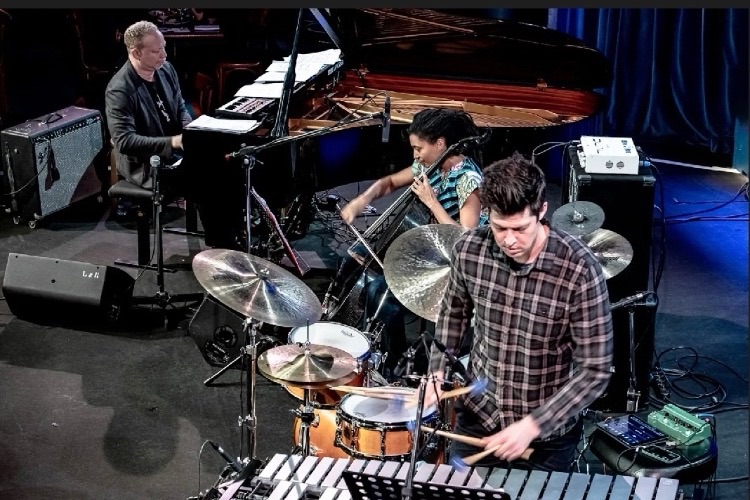

The first release by Craig Taborn since being named a MacArthur Fellow in late 2025, Dream Archives (ECM, 2026) finds the pianist/composer leading an unusual trio with noted cellist Tomeka Reid and in-demand drummer-vibraphonist Ches Smith. All three are acclaimed bandleaders in their own right, with Reid having an extensive history of collaboration through her association with the AACM and as contributor to Myra Melford and Dave Douglas and Smith equally in-demand. While the leader also plays various keyboards, the acoustic piano is prevalent throughout the record. Even so, the trio creates soundscapes that belie a conventional piano trio format. Sounds merge collectively and freely.

Unlike most ECM albums, Dream Archives was recorded in the States, specifically in New Haven, Connecticut. But it was produced by Manfred Eicher, whose characteristic use of space and silence pervades the recording. Taborn composed four pieces, with two others owing to Paul Motian and Geri Allen. On the whole, the album is cerebral, though some tracks are more accessible and logically structured than others. Certain idioms seem pulled from history, altered slightly by electronics and the blending with Reid’s contributions, part melodic and part pizzicato bass.
“Coordinates for the Absent” leads off with Taborn’s tinkling piano enveloped in an ethereal blend of electronics, Reid’s whispers on the high end and drones on the bottom, and with Smith’s chattering percussion. The spacey soundscape never quite latches into a groove. Instead it remains suspended in the ether, marked by dense chords and a few arpeggios from Taborn, punctuated by ever-changing percussive elements and dizzying electronics.
Reid and Taborn soon engage in joyous, dancing interplay to begin the standout track “Feeding Maps to the Fire,” as Smith’s percussion drives the forward momentum. The sequence then morphs into a series of dense chords by Taborn, with Reid gently maneuvering on the high end. They ultimately give way to a feisty, unpredictable conversation between Smith and Taborn, with constantly shifting patterns.

Similarly danceable grooves interplay in Allen’s “When Kabuya Dances.” The piece’s intro highlights minimal single-note piano figures, before the trio gathers momentum in the compound meter main section, remaining faithful to its author’s jubilant arrangement. The trio swings blissfully here, in the realm of a piano trio. Motian’s “Mumbo Jumbo” first appeared on the drummer’s From Time to Time (JMT, 1991). The trio’s version provides a prominence to Reid’s strings, with Taborn moving from elemental single notes to wild, all-encompassing excursions.

The album’s final two pieces are both largely improvised and each run close to twelve minutes. The angular title track is filled with start-stop and off-kilter rhythms and dynamics that range from the bombastic to the barely audible. Taborn’s piano seems to tiptoe through a murky, mysterious space formed by Smith’s array of electronics and buzzing percussion. The leader gathers more confidence and deliberate intention as the piece evolves, despite the gamut of obstacles in his path. The closing “Enchant” forms a bookend of sorts with the album’s opener. One can get lost in the trance-like vibe the trio proffers alongside Reid’s foreboding tones. Smith’s gusts of cymbal flourishes around the five and seven-minute marks seemingly signal a change in direction. Yet, the piece stays on its original course with the piano issuing repeatable refrains. Finally, a semblance of groove behind Smith’s kit work around the ten-minute mark suggests a promising ride that ends all too abruptly.
Dream Archives’s complex and intricate music lives up to its title. Taborn and his cohorts take the listener from dreamy, hypnotic states to exhilaration, mystery, and the unexpected. While at times unsettling, the overall effect is curiously uplifting and exploratory, encouraging repeat listening.
‘Dream Archives’ will be released on ECM Records on January 16, 2026. It can be purchased directly from the label.
Photo credit: Roberto Cifarelli


Leave a Reply