


|
Getting your Trinity Audio player ready…
|
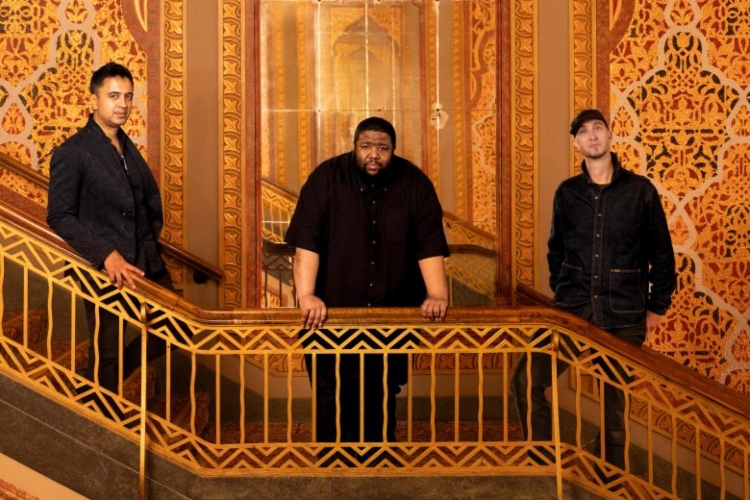
Fresh off their appearance at the Big Ears Festival, which this author unfortunately missed, the trio Fieldwork return with their first album in almost two decades, Thereupon (Pi, 2025). You will likely not find three more decorated individuals in any trio than those in this band: Vijay Iyer, Steve Lehman, and Tyshawn Sorey. Pianist Iyer is a MacArthur Fellow, A United States Artist Fellow, and a three-time Grammy nominee. Drummer Sorey, also a MacArthur Fellow and United States Artist Fellow, received the 2024 Pulitzer Prize in Music for his composition “Adagio (for Wadada Leo Smith).” Saxophonist Lehman is a Guggenheim Fellow and Doris Duke Performing Artist whose longstanding trio, augmented by Mark Turner, won the mid-year Francis Davis Critics’ Poll for The Music of Anthony Braxton (Pi, 2025). Credit for the compositions on Thereupon is shared by Iyer (five) and Lehman (four), while the trio collectively developed the arrangements for all. Iyer plays acoustic piano and Rhodes while altoist Lehman and drummer Sorey remain acoustic throughout. Despite the gap between recordings, these three have often collaborated in different settings, developing their intuitive language in creative music. All are fearless and function without any notion of hierarchy, with an emphasis on listening and interplay. While the album’s pieces are composed, none are fully through-composed, allowing for creation in the moment and the unique interplay that is theirs alone.
Iyer’s “Propaganda” leads off with the pianist’s right-hand riffs and dense left-hand chords, inviting Lehman to enter with bursts and jabs as he rides above churning rhythms from Iyer and Sorey, only to end abruptly as if a derailed train. Lehman’s angular “Embracing Difference” also moves along with boiled intensity. As evident throughout, Lehman seems to use every key on his horn, sometimes even reaching into microtonal fingerings. Sorey is stormy on this one, even as he maintains the groove. Iyer doesn’t overplay but simply gives the piece what it needs, revving up before freeing himself entirely with his own solo.
The Iyer penned Evening Rite” is a somewhat scalar piece with start-stop rhythms. It features the pianist’s pulsating keys, but what stands out in several places are the unison lines between him and Lehman in yet another energetic burner, though decelerating as if losing they are fuel as it goes out. “Fire City,” as one would expect, finds the trio burning with abandon, especially Iyer, who composed the piece. Sorey plays both with ferocity and subtlety, guiding the trio through the various sections to a volcanic climax. Lehman takes the intro on his “Domain,” which later explodes into a kaleidoscope of intensity, notes ricocheting off one another when his trio mates join. It’s another piece that’s of supreme complex rhythmicality, the kind that only a trio of this caliber could deftly navigate. Lehman’s high-pitched riffs pose questions to the ether before they meet responses from Iyer and Sorey.
“Fantome” reveals the saxophonist’s penchant for angular and high-level syncopation. Interestingly, contrary to some ot the others, Lehman delivers plenty of low-register lines here, surfing above Iyer’s Rhodes. Lehman’s “Astral” is the first of a few moments on the record that we dare call ‘meditative.” Iyer is back on the piano, while Sorey takes to the brushes as Lehman spins his more sustained, spacey lines. The piece evolves into vibrancy in a call-and-response way between sax and drums.
Iyer’s title track is a tour de force for the pianist. Iyer says that the piece draws inspiration from “a moment near the beginning of the Buddhist foundational text, the Vimalakirti Sutra, where the world is shown to be much more than it appears: ‘Thereupon the Buddha touched the ground of this billion-world galactic universe with his big toe, and suddenly it was transformed into a huge mass of precious jewels, a magnificent array of many hundreds of thousands of clusters of precious gems…’ Musically, he says he used a telescopic form that reveals more as you zoom in. At over eight minutes, Iyer’s “The Night Before” is by far the album’s lengthiest piece. He creates a spacey, ethereal, and mysterious vibe through both the Rhodes and its effects, as well as the piano. It is contradictorily equally calming and disorienting, remaining unclear where the piece is headed, leaving constant surprises for the listener along the way. Weirdly, it evokes the band Weather Report, giving it an entirely different feel than the opening tracks. Sorey’s cymbal flourishes are particularly central to the piece.
Fieldwork is fully engaging. There are no limits to the imagination of this trio. Most listeners will want to replay Thereupon several times. If doing so, concentrate on a different member of the trio each time; you are bound to find something fascinating.
‘Thereupon’ will be released on September 5, 2025 on Pi Recordings. It can be purchased on Bandcamp.
Photo Credit: Lynne Harty


Leave a Reply