
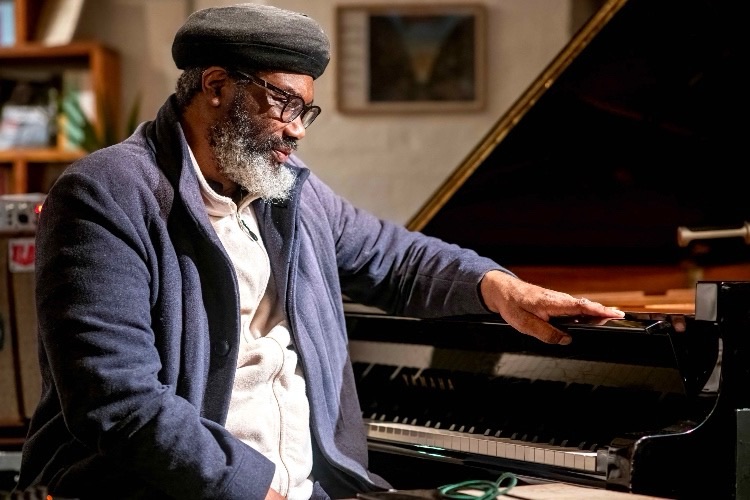

Hikmah (TAO Forms) is the solo album from [Ahmed]’s virtuoso pianist Pat Thomas, whom Matthew Shipp has identified in his recent book as among the Black Mystery School Pianists. While Thomas may be in that school, his playing bears only a few similarities to his contemporary, Shipp. Thomas’s music is seemingly more spiritually focused. As a person deeply devoted to Sufism, he sees the practice and performance of music as an elemental form of spiritual practice. Thomas also uses almost every aspect of the piano. As William Parker notes in the album’s liner notes, Thomas plays with his hands, feet, and body on top of and inside the piano. Sometimes he also adds electronics, bringing messages from the past, present, and future. He is also worldly conscious, incorporating music from Africa and Asia in his work. In an interview with Daniel Spicer of Jazzwise magazine, Thomas referred to the piano as “basically a zither with keys” and proceeded to both reference an Arabic instrument called a kanun and attribute jazz percussion, especially the snare and cymbal, to the Ottoman Empire. Yes, Thomas is a deep thinker.
Hikmah, meaning “wisdom,” opens its title track with the pianist’s right hand dancing at dizzying speeds while his left pounds dense, powerful chords. Parker’s description of the piece is beautiful -“[it] reminds me of being in a cave where crystals of solid light fall in and sound becomes color.” His fascination with percussion is exemplified in “For Joe Gallivan,” dedicated to one of the unsung heroes of modern drumming. Close your eyes, and you can easily equate this to a drum solo on the piano. Listen again, and it might sound like a joyous Latin dance. The piece is simultaneously free and controlled, with Thomas never straying too far from repeating the driving motif that holds the piece together.
“For Toumani Diabate” is part elegy, part celebration of life for the deceased kora player. Thomas unhurriedly plays a series of chords, some discordant, and lets them reverberate between his pauses in the first section. But he then drastically switches to rapid right-hand runs in the latter half. There are even curious references to stride piano in this section. He eventually returns to the chordal approach of his opening, this time with chords sounding even more declarative and definitive.
The other longform piece is “For McCoy Tyner,” rendered without the slightest imitation. The track is inventive in its emphasis on the piano’s place as a percussive instrument, with Thomas playing both inside and on top of the piano as he delivers a marching cadence. He also employs electronics that evoke a grinding sound, something off kilter in itself, given that Tyner’s work was exclusively acoustic. It may well be his idea of a futuristic McCoy Tyner. It doesn’t matter. It’s fascinating and not the least bit reminiscent of Tyner’s music, except in its accented percussioniveness.
“For Carolyn L. Karcher” is for the renowned professor of English, American, and Women’s Studies at Temple University. Here, Thomas blends ideas of composition and improvisation, staying with the conventional piano, emitting colorful palettes with each hand that are far afield but inexplicably coherent at the same time.
“Lugman The Wise” is a shorter piece, one that blends soft electronics with a caressing of the strings inside the piano. Its overall effect is far gentler than is heard on the rest of the album, making it somewhat of an outlier. “The Shehu,” an unadorned piano piece, is starkly angular, taking Monk to a higher level with far more exploratory excursions. “Sheikh Amadou Bamba” is a cousin to “The Shehu,” a bit less angular, but filled with odd rhythms and similarly spirited playing.

The above does not follow a direct sequencing of the album, and that may have done Thomas an injustice because of the way in which each piece seamlessly segues into the next. Listen to Hikmah straight through, uninterrupted. Thomas’ talent is staggering, and his music is unequivocally transportive.
‘Hikmah’ will be released on November 7, 2025 on TAO Forms. It can be purchased on Bandcamp.
Photo credit: David Laskowki


