
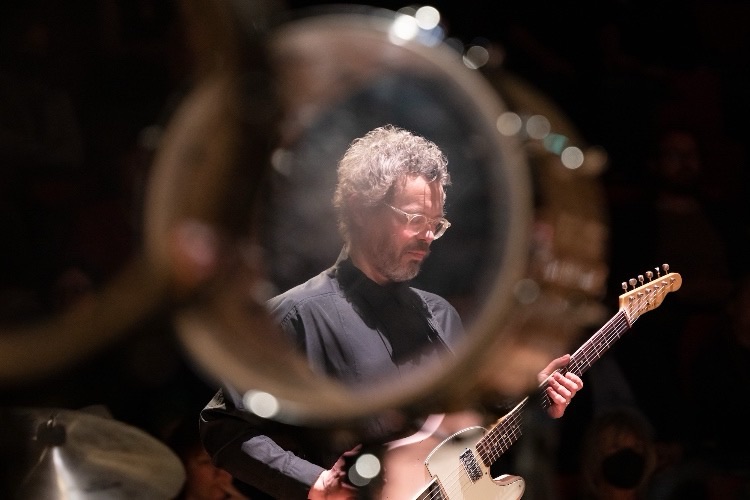

Danish guitarist Jakob Bro is the owner of the Copenhagen-based Loveland Records,, a label issuing two albums within a month of each other: the more recently recorded trio of Bro, trumpeter Wadada Leo Smith, and drummer Marcus Gilmore for Murasaki (Loveland, 2025), and The Montclair Sessions (Loveland, 2025), from a 2022 recording session that paired Bro and Smith with pianist Marilyn Crispell and drummer Andrew Cyrille. These two releases come on the heels of Smith’s final tour in Europe, where bassist Thomas Morgan will join the trio. Notably, neither of these recordings features a bassist, however.
Seldom will you see such an aggregation of talent. Crispell is an NEA Jazz Master and Cyrille and Smith deserving of that title as well. Gilmore is acknowledged as one of today’s leading drummers, increasingly playing “out” as well as “in.” Bro has been increasingly prolific in recent years, becoming a major force in improvised music.
Murasaki
The hastily assembled trio laid down a spontaneous session in New York that involved no retakes, no discussions, just an intuitive rendering of a shared musical language. As Bro commented, “It felt as though this music already existed before we started playing… it sounded as if they were old memories coming back, or plants growing for a lifetime and now breaking through a surface.” As one could expect, these are unstructured pieces with little, if any, adherence to time signatures or conventional forms. Smith, the primary conveyor of melody – if you can call it that – exudes a metallic, ethereal tone that carries the listener to untold, mysterious places, only occasionally via the use of effects. This was the first meeting of the trio, though Smith and Bro had played together previously on The Montclair Sessions. In that respect, Bro had some solid grounding for his chordal choices in support of Smith.
However, Gilmore is the primary mover of the three, having composed two of the seven pieces himself and co-writing most of the remaining four with his trio mates. Don’t be misled, there is more live creation than through-composed music in these forty-one minutes. Gilmore’s unaccompanied “Winnowing One” and “Winnowing Two” are bookends, revealing inventive use of the drum kit as he plays the complete arsenal with an emphasis on cymbals and glass percussion. The remaining material is spacious and otherworldly at times. At others, it is not far removed from the dreamlike ECM sound, which makes sense, given both Bro’s Nordic heritage and he and Smith having played on the label several times. “Sonic Mountains,” a trio composed piece, features Smith blasting more aggressively than his usual, spiraling, elongated tonal statements. He drops out midway, yielding to a mix of Bro’s chimed chords and Gilmore’s bubbling percussion and cymbal flourishes. “Yoyogi Park Dream,” another trio piece, features Bro’s effect-laden chords behind Smith’s muted, high-pitched trumpet, seemingly augmented by electronics. It is a prime example of the elongated tonal statements referenced previously.
Meanwhile, Gilmore plays rather unobtrusively, with chattering brushwork and judicious cymbal swipes. Smith wrote “Chronicles of Bending–Air Columns and Fire Discourses,” a solo piece where his reaching trumpet dips across registers for a brief one minute and twenty seven seconds. It’s a short journey, but he resolves it in the final notes.
The two pieces stand out as the most trio-engaged. The first is “Heart Language,” which features Bro’s searching lines meeting Smith’s as the two probe a dark region, underpinned by subtle kit work from Gilmore. The second is “Imagine the Fire and Flames That Light Up the Light World,” which has a brisker pace, even a groove in the opening section. Smith has often commented that he’s a longtime admirer of Miles. That shows through prominently on “Imagine” more than any of the other pieces on the album. Note Gilmore’s statements during Smith’s pauses, a call-and-response of its own kind. Midway through, Smith delivers a series of scratchy bursts which, in turn, enlivens Gilmore’s inventive percussive attack. In the final section, Smith mixes sharp bursts with his sustained lines, as if taking the trumpet-drum conversation to yet another different level.
The Montclair Sessions
Immediately, one notices a far greater emphasis on the chiming chords through the pairing of Crispell and Bro on the opening “Sunrise.” It moves at a minimalist pace, letting the notes and chords resonate. Smith enters after a couple of minutes, presumably as if to symbolize the sunrise itself. Meanwhile, Cyrille skitters and swipes as Smith blows powerfully, pausing to let Crispell and Bro resume their colorful harmonics, which Smith rounds out brightly upon his return, improvising freely. “Very, Very, Interesting” is a feature for Cyrille that avid listeners could compare to the two Gilmore solo pieces on Muraski. Cyrille is more drum than cymbals focused and doesn’t use the glass percussion like Gilmore, but is every bit as inventive. Bro begins “Exuding Light’ with effects and loop-driven guitar, soon joined by Smith on muted trumpet that also seems to use the effect of siphoning the muted sounds through a blender. “Dancing on Water” presents a stunning solo by Crispell with her hands both in and outside the piano.
The full quartet gathers for the meditative “King of Kings (for Charles Lloyd),” led by a sharp, unaccompanied intro by Smith. Cyrille enters first, while Crispell and Bro supply an ethereal backdrop for the trumpeter’s articulated, mostly drawn-out lines. The rhythm section then illuminates the piece mostly by Crispell’s bright strokes while Bro and Cyrille have a quiet conversation below. Ironically, Crispell begins “Dreamer” with dense foreboding chords. The leader adds lightness in his counterpoint, and Cyrille stays calm, deftly using his cymbals. Smith enters around the two-minute mark with his robust full tone, often centered in the lower register. He changes the whole feel of the piece as Crispell moves to lighter and brighter harmonics and Cyrille grows more energetic. Then, the bottom falls out. The dreamer has gone to sleep with the gentle final notes that close the album.
Murasaki and The Montclair Sessions represent the best in improvised music. Wadada Leo Smith is exceptional on both, and the other talented musicians frame his lines brilliantly. Bro is ostensibly the leader, but he is fully aware of the musical talents in the room. He rarely solos, more content to share the spotlight. Listeners do themselves a disservice by not gravitating towards both recordings.
‘Murasaki’ and ‘The Montclair Sessions’ are both out now on Loveland Music. They can be purchased on Bandcamp.


