

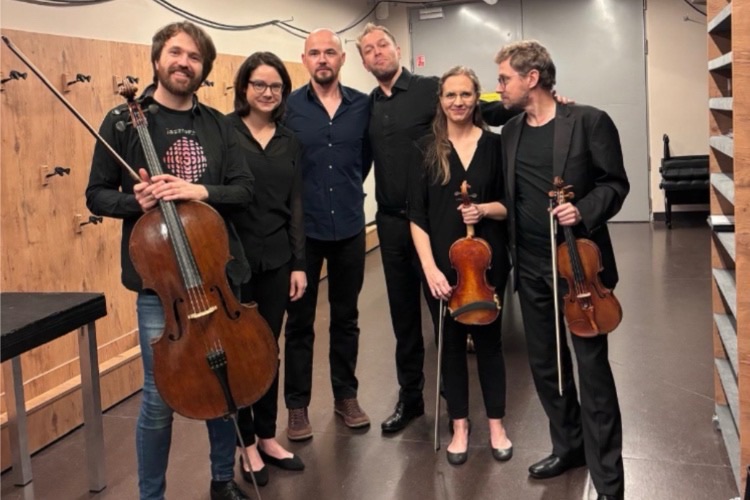

Coined by the philosopher Glenn Albrecht, the term ‘solastalgia” centers on the theme of homesickness while still at home with a focus towards surveying environmental damage. “Our environment is transforming around us, and we grieve for the landscapes and ecologies we knew,” says Albrecht. These feelings inspire The Solastalgia Suite (Pyroclastic, 2025), Grammy-winning pianist and composer Kris Davis’ first record with a string quartet, Poland’s renowned Lutosławski Quartet. Davis, a Vancouver native, has witnessed ecological devastation in her homeland, feeling that her connections with nature are different – or, in some cases, broken – due to climate change and encroaching technology and those sentiments guide the recording. The eight-movement suite evokes a wide range of tones and emotions. From the graceful to the bracing. From the defiant to glimmers of hope. It may well be the most ambitious of Davis compositional work, given that the string quartet doesn’t merely accompany her piano and renowned prepared piano. Instead, the strings often serve as percussionists and owners of the melody, at times the driving force of a full orchestra, wherein the piano is just one element. The versatility of the Lutosławski Quartet is staggering.

Commissioned by the Jazztopad Festival in Wrocław, Poland, The Solastalgia Suite premiered at such festival and at Dizzy’s Club at Jazz at Lincoln Center in New York. The Lutosławski Quartet, founded in 2007 and named after the Twentieth Century Polish composer Witold Lutosławski, has collaborated with classical and jazz artists, notably Vijay Iyer, Craig Taborn, Kenny Wheeler, Uri Caine, and Benoit Delbecq. Compositionally, Davis drew on the work of Olivier Messiaen, notably his “Quartet for the End of Time.”

The titles of the suite’s movements are intriguing and enticing. Among them, “An Invitation to Disappear,” “Towards No Earthly Pole,” “The Known End,” “Ghost Reefs,” “Pressure and Yield,” “Life on Venus,” and “Degrees of Separation.” There’s a sleight of hand at play as well with the opening piece entitled “Interlude,” suggesting we are joining in the middle rather than at the beginning of the narrative. Davis’s chords are dense, foreboding, and emphatic as the strings swirl around them, alternatively gentle and stormy. Toward the end, the quartet takes charge, galloping to an abrupt climax. One lonely, weeping violin begins the moving, elegant “An Invitation to Disappear,” soon joined by the other quartet members. Davis enters about two-and-a-half minutes in with a simple, scalar single note excursion before quickly surrendering to the quartet. Davis re-enters slightly after the four-minute mark, collaborating with the strings to glide to a graceful, calm exit. “Towards No Earthly Pole” features strident, scraping strings set against Davis’s bold prepared piano, creating an eerie, sense of life-on-the-edge.
“The Known End” will shake you out of a reverie as the quartet resorts to a concerto-like form as a backdrop for Davis’s adventurous piano, before assuming control in the mid-section, and then working with Davis in a call-and-response manner, building intensity via controlled chaos. Yet, midway through, sonics descend into a low whisper, suggesting a proverbial calm before the storm, the latter of which fails to materialize. It’s the T.S Eliot effect wherein the “world doesn’t end with a bang but a whimper.” The brief, haunting “Ghost Reefs” references the loss of bleached coral reefs, with the music shaped by Davis’s study with Henry Threadgill.
The music in “Pressure and Yield” embodies its title. Atonal strings, serving almost like a complex percussion setup, simulate cracks and fissures of an Earth in upheaval. Piano is virtually absent here, but its definitive chords lie like tolling bells as they provide a critical aspect of the ethereal “Life on Venus,” that otherwise aptly floats into the ether. The eleven-minute final movement, “Degrees of Separation,” begins with a jolt of strings and moves obtusely and chaotically through a series of changes and dynamic shifts, emblematic of constant, and at times, terrifying change. Bracing sections give way to brief calm pauses, only to gather more intensity as the piece evolves into an unsettled, by turns startling listen.

The idea of homesickness, while still at home, resides more subconsciously than consciously for many. Davis and the Lutosławski Quartet bring it to the forefront vividly, emphatically, and rightly disturbingly. With The Solastalgia Suite, Kris Davis continues to stake her claim as one of our most visionary composers.
‘The Solastalgia Suite’ will be released on January 9, 2025 on Pyroclastic Records. It can be purchased on Bandcamp.


