


Sometimes, the voice of an outsider provides a fresh perspective that adds richness to the status quo and pushes things in new directions. This was certainly the case with Ethiopian jazz. Over the last two decades, the music – sometimes referred to as Ethio-jazz – has proliferated via the internet, dissolving geographic boundaries around sounds in ways never before dreamed. Western appreciation of the work of someone like Mulatu Astatke, who recently announced his retirement, has grown from niche listening rooms to the soundtrack of a Bill Murray film (Broken Flowers (Focus, 2005)). The music of pianist-turned-nun Emahoy Tsegué-Maryam Guèbrou has run from rare imported albums to Amazon and Walmart commercials. It seems the West has increasingly caught up with the mystery and wonder of the sounds that have emerged from the land once known as Abyssinia. But a perhaps surprising fact is that while the music is fully reflective of its national origins, it also would not exist in its current form without the impetus of an immigrant from Armenia. The Either/Orchestra’s Éthiopiques, Volume 32: Nalbandian the Ethiopian (Buda, 2025) is a rare reminder of the fuller story of the music’s origins.
Before the 1920s, Ethiopian music was primarily traditional religious and folk songs. Western orchestration would come from two men of Armenian origins: Nerses Nalbandian and his uncle, Kevork Nalbandian. Both came to Ethiopia to escape the genocide in their native land that killed somewhere between six hundred thousand and a million and a half. Both foreigners in a, to them, strange land, they found something in the sounds of their new home that would wed well with the brassiness and rhythmic swagger of swing bands. The elder Nalbandian explored these connections as the leader of Ethiopia’s first official orchestra. He also composed the country’s first national anthem. And he laid the groundwork for his nephew to become musical director of the Addis Ababa Municipality Band, the country’s first truly modern ensemble. The role would ultimately become Nerses helping create nearly every institutional band in Ethiopia and leading the orchestra of the Haile Selassie Theatre – today, the National Theatre. Largely a self-taught and prolific composer, Nerses continually kept a free ear and an open mind to expand the sound of Ethiopian music to what we hear today.
Despite his importance, Nerses Nalbandian remained a largely underappreciated figure. In large part, this is due to his limited recorded output, having released only three songs. Nearly a half-century after his death, Nalbandian the Ethiopian aims to share the composer’s contributions to a much wider audience. To make it a reality, the Either/Orchestra’s saxophonist-leader Russ Gershon and his colleagues took radio transcriptions, broken pieces of scores, and full arrangements and tried to piece them all together in a way that would be both compelling and faithful to its source.
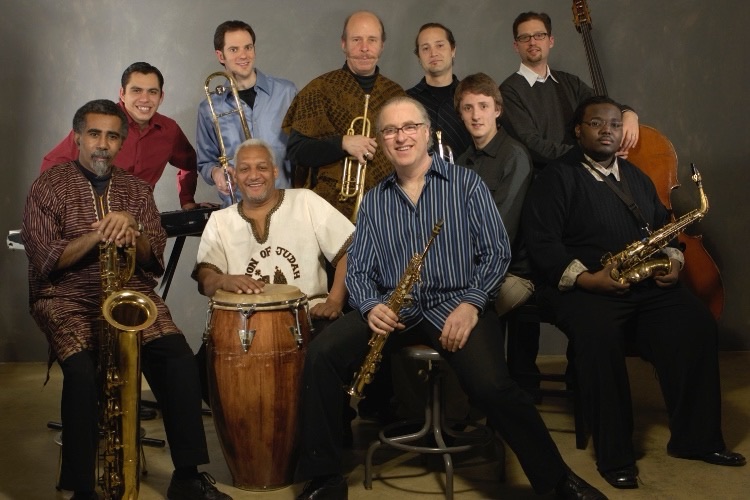
The Boston-based Either/Orchestra is a particularly apt interpreter of the material at hand. Since 1985, the group has conveyed a heavier big band sound with a smaller ensemble. Like Nalbandian, Gershon and his colleagues have maintained a continually open perspective toward all music. This has led the band to explore everything from jazz standards to 60s folk and pop tunes to avant-garde experimentations. It has additionally resulted in membership over the years that reads like a who’s who of modern improvised music, including Josh Roseman, John Medeski, Matt Wilson, Miguel Zenon, Jaleel Shaw, and Curtis Hasselbring. One of the band’s areas of exploration over the last two decades has been Ethiopian music, even collaborating with some of the music’s biggest figures. Again, like Nalbandian, the group does it from the perspective of an outsider looking in.
The Either/Orchestra largely approaches Nalbandian’s work with deference to the original material. Thus, much of Nerses sounds older, in the best sense, as if a classic record only recently recovered. Just as the Either/Orchestra has powerfully packed the big band sound into a smaller setting, one can’t help but wonder if they also parked a time machine in there as well. But with an ensemble of master improvisors, the album also leaves ample room for improvisation and interpretation. Nerses is equally a historical document and something thoroughly contemporary. “Mot Lehulum Ekul New” is a reflection on mortality that dates back to the 1950s but features a bassline so funky that it sounds like it could have come out last week. The hypnotically swirling lines on “Yene Hassab” disorient you even as they nod to Ethiopian jazz’s classic sound. And “Eyeye,” a piece Nalbandian wrote to mimic the vocals of the azmari – troubadours of his chosen home – is vibrant and sonically explosive.
We sat down with Russ Gershon to discuss the history of Ethiopian music, the importance of Nerses Nalbandian, and the Either/Orchestra at forty.
[bandcamp width=100% height=120 album=2562026746 size=large bgcol=ffffff linkcol=0687f5 tracklist=false artwork=small track=3686796723]
[bandcamp width=100% height=120 album=2817009904 size=large bgcol=ffffff linkcol=0687f5 tracklist=false artwork=small track=513016165]
PostGenre: The Either/Orchestra has some significant performances coming up, at Winter Jazz Fest in January and Big Ears in March. For both, the band will be joined by two vocalists. One is Teshome Mitiku, a pretty legendary figure in Ethiopian music. How did you get connected with him?
Russ Gershon: Right. Teshome Mitiku was born in 1949, making him a second-generation modern Ethiopian musician. The modern Ethiopian sound was born in the early 1960s when Teshome was a pre-teen. He and his cohorts were the first sub-generation of Ethiopians to listen to rock and roll and soul records growing up and they brought that sound into smaller combos. Ethiopian pop and dance bands before then were larger and had many horns. With his saxophonist brother, Teddy, who is no longer with us, Teshome formed a band called the Soul Ekos Band. Even when they were teenagers, the band was so popular that became among the first groups to record for Amha Records. They recorded several songs for Amha that became hits and are still known by Ethiopians everywhere.
Today, even younger Ethiopians seem to know the band’s core batch of songs. In the early 2000s, the Either/Orchestra recorded one of Teshome’s songs as an instrumental for one of our records. He lives in Alexandria, Virginia, and while he was driving along one day, heard our version of his song on the radio. He had to pull off to the side of the road when he did because he was so surprised to have heard it. He contacted me through a relative to find out what we were up to, and to ask for royalties, which I was happy to pay.
So, that is how I first got in touch with Teshome. Then he started coming to do gigs with us in Boston and we learned all of his old songs. And then he and I started working on some newer material together. We’ve been playing with him on and off since then. We even headlined a night at the Chicago Jazz Festival with Teshome. We played at their biggest stage before thirty-five thousand people. Teshome loves playing with us and us with him. He’s been very hip to American music and jazz ever since he was a teenager, and appreciates the strange, sometimes non-Ethiopian, things that we do to the music.

PG: The other vocalist performing with the Either/Orchestra is Munit Mesfin, who is much younger.
RG: Yeah, she is of a younger generation. Munit has Ethiopian parents and grew up in both Ethiopia and the United States, though I think she was schooled mostly in the United States. I first heard her perform in Ethiopia in 2011. I was there without the band and heard her sing at a major event for the opening of a new [United Nations], office there. At the time, she struck me as an incredible singer. She was also so charming and had a great stage presence.
Before the pandemic, about six or seven years ago, someone had adopted an Ethiopian baby and wanted Ethiopian music to celebrate. I decided to do the gig with a smaller group instead of the full Either/Orchestra and reached out to Munit to see if she would be willing to come up to Boston – like Teshome, she lives near Washington, DC – and sing with us. We did the gig together, it was great, and we became friends. So far, that was the only time we’ve performed together but we’ve been trying to do something together ever since.
Although we haven’t performed together much, I completely trust her abilities. I’ve heard her recordings and have met her other times when I’ve been down in DC. She can sing Ethiopian music perfectly. She can sing American music – jazz, soul, and more. She’s a really great singer. I’m psyched to have both Teshome and Munit on board for our upcoming performances.

PG: With them, the Either/Orchestra will perform music from the band’s latest addition to the Éthiopiques series. Going back, you first encountered Ethiopian jazz as a listener. Do you remember how you first found it?
RG: In 1989, a friend of mine was working at the distribution wing of Rounder Records. They were distributing my label at that time and also an album by the great Ethiopian singer Mahmoud Ahmed. My friend knew that I liked African music; I had been tuned onto Fela [Kuti] and many other things before that. So, she gave me a copy of Mahmoud’s album. I thought it was pretty cool but it didn’t quite blow my mind.
Five years later, in 1994, my good friend, colleague, and bandmate, Mark Sandman, the late singer from Morphine, came back from a trip to France with a CD called Ethiopian Groove: The Golden Seventies (Blue Silver, 1994). Even just the title alone was so great. Mark gave me the CD, and once I put it in my player, I swear it didn’t come out for two years.
But it took a few years before it occurred to me that I could arrange some of the music for the Either/Orchestra.

PG: Why the delay?
RG: Part of it was that the music had a lot of vocals that needed to be turned into horn parts for the band to use them because we usually had no vocalists, let alone one who can sing in Amharic. But in 1997, we started playing Ethiopian jazz music, and it really clicked for the band and audiences. People loved what we were doing even though they didn’t know the music; to them it sounded exotic. But it was groovy and worked well. A year or two later, I received an e-mail from a mysterious person named Francis Falceto. He told me he had heard about our band and how we were playing arrangements of Ethiopian music. He also said he was interested in hearing what we were doing.
I later did a little research and realized that Francis was the guy who put together Ethiopian Groove: The Golden Seventies. He was also responsible for Mahmoud Ahmed’s album coming out in 1989. And he’s the one behind the Éthiopiques series. I sent him some recordings of our band, and he really liked what he heard. He asked if I would ever come to France to hang out with him and play some unreleased music he had found in theater basements in Addis Ababa.


PG: So, you went to France to meet him?
RG: Yes, and when I did, Francis briefed me on the history of modern Ethiopian music and how he had been involved with it since 1983. He told me that in the 50s and 60s, big horn bands were very important in Ethiopia for the development of modern music, influenced by jazz, Latin music, and R&B. Francis had been wanting to help Ethiopian musicians in the current era. The country had a terrible dictatorship in the 70s and 80s that killed the whole artistic world there. He wanted to reconstitute the idea of the Ethiopian big band and bring it back to life somehow.
Francis is not a musician, so he couldn’t lead a band to play the music. But he discovered that I was already doing it with my people to some extent. We’re not Ethiopian, so we came at the music differently than an Ethiopian band would; we came with an American accent. But our sound was close enough to his vision. He saw the band as a good opportunity to bring Ethiopian music out to the rest of the world.

PG: You also brought the Either/Orchestra to Ethiopia.
RG: Yeah, another part of Francis’ vision to bring foreign musicians into Ethiopia. So he got us invited to play at the huge Ethiopian Music Festival in 2004. We were the only American band to ever play at that festival. It was a major event for us because it really gave us the flavor of Ethiopia. We were able to meet some of the old-timers and play with them. I think our visit was also a big deal for many music students in Ethiopia because we also taught at the music college there. The students wanted to know about jazz, and we were happy to play Ethiopian songs for people who actually knew them.
That experience led to collaborating with Ethiopian greats from the past – musicians who were on Ethiopian Groove: The Golden Seventies – in person. We wound up playing all across Europe and North America with Mahmoud Ahmed, the first Ethiopian musician I had ever heard. Also, Mulatu Astatke, the father of Ethio-jazz. And various other old-timers. It was a great thing for all of us in the band, and I think the older musicians appreciated how we brought our modern jazz and Latin aesthetics to the music. We loved playing with them, – with the source of the music that we loved – and being able to soak the music in with them.

PG: Is that when you were introduced to the music of Nerses Nalbandian?
RG: Yes. When we were in Ethiopia in 2004, we were there for a couple of weeks and did several different gigs. While there, Francis introduced me to the Nalbandian family and told me how Nerses was the man behind all of Ethiopian jazz. I didn’t know much about Nerses Nalbandian at that point. But his children, who are a little older than I, heard us play and felt we should play their father’s music, which hadn’t been played since the Ethiopian Revolution in the ‘70s. So, his kids and Francis invited the whole band and our entourage to dinner at one of the kids’ houses. At the dinner, his kids brought out a large dusty box of sheet music from the basement and told us that they thought we should play it. It sounded like a great idea.
Seven years later, we went back and did another concert at the National Theater of Ethiopia, where Nerses Nalbandian was musical director in the 1950s and 1960s. He was appointed by Haile Selassie, who really liked him, to that position. This time, we played his music. So we got to play his old music at his old venue, and it was a great event. It was like Buena Vista Social Club, East African style. The hall was full of old-timers performing with younger Ethiopian musicians. The audience was full of older people who remembered Nalbandian or his music from two revolutions ago, forty or fifty years earlier, and also young people who had never heard the music before. It was an incredibly interesting cultural moment. It was fun and a little weird to be in the middle of it all as the band leader and music director for the whole thing. It was funny to be in the vortex of all of this emotion and history while in someone else’s country.

PG: Though even Nalbandian himself was not Ethiopian.
RG: That’s right. He was a refugee from the Armenian genocide. I guess there was a little bit of an echo there of somebody from outside the country being in the middle of a musical event. Nalbandian loved American music. His son told me that his favorites were Xavier Cugat and Ray Charles. He also had Armenian musical influences, and he played classical music. He was a very versatile musician. He was like a one-man world music pioneer in the 40s and 50s in Ethiopia. An interesting character.
PG: Were you aware of Nalbandian before his family approached you?
RG: Francis probably mentioned him to me. But he was one in the sea of names of Ethiopians I was trying to learn about from Francis over those years. I didn’t quite understand his importance until I met his family and started going over the history. Once I did, I realized how he was a key figure because the National Theater wound up being a training ground for many musicians who went on to do other things. It was a big platform. They would present major concerts and were on the radio every Saturday night. Nerses Nalbandian was a key man even though he was a foreigner.
[bandcamp width=100% height=120 album=1140712433 size=large bgcol=ffffff linkcol=0687f5 tracklist=false artwork=small track=3480605159]
PG: Presumably, the other Ethiopian pieces for the Either/Orchestra had no written scores, and you did the arrangements by ear.
RG: All by ear, no paper at all.
PG: Was it easier working with Nalbandian’s pieces because they were written out?
RG: There were complete scores for a couple of tunes, partial scores for others, and still some where all we had were recordings from an old radio broadcast. Putting it all together was a little like completing a crossword puzzle. We had clues and pieces, but often not the full thing. Even for the pieces where we had complete arrangements, Mr. Nalbandian was writing for groups bigger than the Either/Orchestra. He was writing for fifteen or seventeen-piece bands. So, even where we had the full score, I had to figure out how to fit the arrangements so we could play them with a smaller group.
[bandcamp width=100% height=120 album=1140712433 size=large bgcol=ffffff linkcol=0687f5 tracklist=false artwork=small track=4118543899]
PG: You also had to take some liberties with how certain parts were composed.
RG: We did. The album wasn’t designed to be an exact historical reconstruction. In the notes to the album, I wrote a description of the different amounts of liberty we took with each tunes. I feel this album is probably the only document that will ever be made out of Mr. Nalbandian’s music. It deserves to have good information on it. We definitely took our own interpretations on some parts and had fun with it.
PG: What do you feel you learned the most from working with what he had written?
RG: Mr. Nalbandian’s style was very quirky. After having spent years turning Ethiopian vocal melodies into instrumental melodies for our band, it was interesting to see somebody else, about a half-century before me, doing the same thing. Especially given how he, too, was a foreigner. He identified what he felt were characteristic Ethiopian melodies and ways of singing and then tried to turn them into notated music with woodwinds or other instruments. And when writing down music that first exists as sound, you always need to make decisions about how to notate rhythms and other stuff, especially this kind of music that has very subtle rhythmic inflections. I felt like I was looking over his shoulder and trying to figure out how he approached these things and who he was.
[bandcamp width=100% height=120 album=1140712433 size=large bgcol=ffffff linkcol=0687f5 tracklist=false artwork=small track=3583443421]
PG: Do you see meaningful parallels between your role and his?
RG: Yeah, I think so. I think we’re both musical omnivores who are happy to enjoy many different types of sounds and open to many different ideas. The more I heard about Mr. Nalbandian, the more he seemed like a walking one-man crossroads of music.

PG: While an important figure, Nalbandian’s name does not come up much in discussions on Ethiopian jazz music, a music already a little marginalized in the West. Do you have any idea why he is not more discussed?
RG: It’s complicated. I’ll start with why Ethiopian music hasn’t even gotten as much of a foothold in the West as, say, Nigerian music or Malian music. I think part of that comes from the history of colonization. Nigeria was a colony of England, and people went back and forth between Nigeria and England, with English being the official language in Nigeria. So, musicians like Fela, King Sunny Ade, and others had a natural outlet in the West through England. Senegal had a similar connection with France. South Africa, of course, was connected with both England and Holland. Mali and Algeria were both connected with France, too. Many more people and music were going back and forth between those countries and Western countries. I guess that’s the happy side of colonialism. [laughing]. One good thing among the many bad ones.
Ethiopia was a different story. Officially, it was colonized by Italy. In the Berlin Conference of 1885, the Europeans carved up Africa, with Ethiopia, Somalia, and Libya given to Italy. But the Italians were never very effective colonizers, which is probably good for the Ethiopians. Italy tried to invade Ethiopia in 1896 and lost to an Ethiopian army at the Battle of Adwa, the only big battle of the colonial period that an African nation won. The Battle of Adwa prevented the Italians from marching through a mountain pass to take control of Ethiopia.
Ethiopia is very mountainous, especially in the center, and it was hard to get around before there were airplanes. So, Ethiopia ended up being isolated. Of course, the fascists got in there in the 30s for about five years and killed a bunch of people before they were chased out again by the Allied forces. So, there wasn’t a natural place for Ethiopian culture to be funneled into the Western cultural matrix.

PG: The revolution in Ethiopia probably did not help matters either.
RG: Right. From 1930 to 1974, Ethiopia was under the rule of Haile Selassie, who was a westward-facing emperor. He was a dictator who suppressed his people and was also very restrictive about culture. His government made a deal for Phillips Records, from the Netherlands, to serve as the exclusive record company for Ethiopia. And it wasn’t until a little independent label popped up in the late 60s, called Amha [Records], which is where many of the Éthiopiques records originally came from, that any other label was in the country.
When Selassie was thrown out of power in 1974, he was replaced by the Derg, which means committee, a Maoist revolution. The Derg officially renamed itself a Stalinist regime in 1981. It was by far the last Stalinist regime in the world, and was very restrictive. The Derg prevented people from getting in and out of the country. There was a series of dictators, but the Derg was the worst in the sense that it really didn’t want people to communicate with the West. They also shut down nightclubs and were restrictive in and highly selective towards culture.

PG: Is that part of why there have been so many Ethiopian immigrants to the United States in particular?
RG: After the Revolution in 1974, many Ethiopians emigrated to the United States to the point that the largest population of Ethiopians outside of Ethiopia is around Washington, DC. There are something like two hundred thousand people of Ethiopian descent in the DC, Virginia, and Maryland area.
But even after the Derg was thrown out of power in 1991, Ethiopia remained a bit isolated from the West due to a border war with Eritrea. And on top of all of this, or underneath all of it, Ethiopia is a very poor country. Even today, eighty-some percent of the country is made up of small farmers. Out in the countryside, you see incredible poverty. All of those things worked together to prevent Ethiopian culture from having much of a connection with our Western culture mill, which makes Ethiopian music less discussed in the West.

PG: So, the isolation of Ethiopian music from the West is primarily a function of history and not reflective of anything inherent in the music itself?
RG: Well, another reason Ethiopia has been a bit more isolated musically is the Amharic language. Most people like hearing songs where they can understand the lyrics. Unlike in countries colonized by the English or French, vocals in Ethiopian music are generally not in European languages. And that makes it more difficult for the music to reach Western audiences.
Ethiopian music is also very different harmonically from much of Western music. As with many other non-Western cultures, Ethiopian music usually uses pentatonic scales- five-note scales. And many of their songs are based on what in the West we would view as some very knotty scales harmonically, with strange intervals. They are a little trying for people outside of jazz. We jazz musicians love unusual harmonies, but they’re not the poppiest-sounding thing for Western ears. That is part of the separation from the West as well.
PG: Do you think the unique features of the music explains why so many Ethiopians first thought their music could not be properly exported elsewhere? Or was it primarily a function of the country’s general isolation from the rest of the world for much of its history?
RG: That’s a good question. When I asked Francis about that, he suggested it was both. On the one hand, Ethiopia has, for hundreds of years, been a little isolated because of its topography and location. Many Ethiopians felt they had their own unique thing, and there was no point in messing with it. But the inverse was also true for some people. Many often felt their culture was so unique to them that no one else would be interested in it.
Both forces were things Francis has tried to counter in sharing Ethiopian music with the rest of the world. He saw both as barriers that needed to be broken down. Francis first heard Ethiopian music in 1983 when he heard a DJ in Paris who had a cassette somebody had brought back from Ethiopia. He heard the cassette, and it immediately clicked for him. But at that point, Ethiopia was still ruled by the Derg. Francis was already a music promoter who had done work in jazz and rock, and started trying to get into Ethiopia. Being French, he was able to get there; Americans probably would have had a harder time at that point. And once he did, he started figuring out who the important old timers of the music were. He met Mahmoud Ahmed and several other people who were out to tour Europe, even during the Derg period. Then he started the Éthiopiques series.
PG: The series has done a particularly fantastic job at expanding the recognition of Ethiopian music in the West. Especially the Mulatu Astatke volume [Éthiopiques, Vol. 4: Ethio Jazz & Musique Instrumentale, 1969–1974 (Buda Musique, 1998)].
RG: Yeah, that’s the one that became a big hit.
I think many people were first exposed to Ethiopian music through that record. Even before that album, Mulatu’s music had already become a favorite of super hip London underground DJs. But they, of course, know everything before anybody does. When that volume became such a big hit, it kind of became identified as the signature Ethiopian jazz record around the world. And Mulatu has had an incredible latter-day career over the last twenty years since it came out. When most people think of Ethiopian music, they tend to think of Mulatu’s work.

PG: Why is that?
RG: For one, his album doesn’t have singing in a language most in the West would find difficult to understand and is sometimes grating to their ears. Mulatu’s music is more palatable to Western ears. His music is also more accepted in the West because of the way it’s constituted. It’s still based on pentatonic modes, but has a few extra chords too. Mulatu had spent time in America, learning about jazz harmonies and theory. His music is difficult to play well, but easy to listen to. And I have to say, I’ve learned many tunes off that Éthiopiques album and many other Mulatu tunes when I played in his band. He’s played with the Either/Orchestra, and we recorded some of his newer tunes when he spent a year in Cambridge [, Massachusetts], in 2008.
[bandcamp width=100% height=120 album=1140712433 size=large bgcol=ffffff linkcol=0687f5 tracklist=false artwork=small]
PG: Going back to your work with Nerses Nalbandian’s music, you did a great interview with Brian Carpenter back in 2017 and suggested, at that time, that a recording of the Either/Orchestra playing those pieces was imminent. What took eight years for the album to ultimately come out?
RG: Well, Éthiopiques is Francis’ one-man operation. He works with a label called Buda Musique, which is run by Gilles Fruchaux. Even though it has hundreds of titles, Buda is also a very small operation. Both Gilles and Francis are getting up there in years. Francis has to be eighty years old now, and Gilles is probably about the same. And they are both slowing down a little. In that period too, Francis’s wife unfortunately got sick with cancer, and he took care of her for a few years. The [Coronavirus] pandemic also took place during those eight years. It was one thing after another that kept the album from coming out.
I was so delighted when, about a year ago, Francis told me the album was finally going to be released. I think he sees this one and maybe two or three other albums as the last ones for Éthiopiques. He had a master list somewhere in his head, or on a piece of paper, of things he wanted to make sure to release before ending the series, and he is about done. Sadly, it is ending, but I am also happy with how much he has been able to get out. The Éthiopiques has been such a great series. It has changed my musical life and, through me, many of the Either/Orchestra’s members’ musical lives as well.

PG: Even with Éthiopiques ending, do you feel the Either/Orchestra will continue to explore Ethiopian music going forward?
RG: Definitely. It’s part of our DNA now. As human beings, Ethiopia is part of all of our DNA, going back two hundred thousand years. But it’s also part of the band’s musical DNA. We love it and have so many arrangements of Ethiopian music, both with and without singers. I feel like when I go to write or arrange music now, I do things that I wouldn’t have done had it not been for all the time I spent with Ethiopian music. So it’s not going anywhere from our repertoire, that’s for sure.


PG: The Either/Orchestra turned forty years old in 2025. How do you feel the group has changed the most over the last four decades?
RG: Oh, gosh. It’s been a very interesting and weird trip down the time tunnel for me to get ready to play with the band now because the group hasn’t played since before the pandemic. Our last concert actually was in 2019 with Teshome here in Boston. When the pandemic ended, I didn’t have the energy needed to organize a ten-person band. Because we have played such high-profile and glamorous gigs before, sometimes it’s difficult to go back to playing local gigs.
But Francis telling me that the new record was coming out put me into gear. I started listening to all of the band’s old recordings, and that brought back so many memories of when I wrote or performed those pieces so many years ago. They captured a moment, an era of our band’s personal music. But they also reflect things like my stance on jazz in the 1980s. In the Young Lions era, when people were very neo-traditional, the Either/Orchestra was a kind of counter-programming. I’m a big believer in the idea of jazz tradition, going all the way back to its beginning. But my take on jazz tradition and history comes more from things like Sun Ra and the Art Ensemble [of Chicago]. People who can play both old-sounding music and very new-sounding music, futuristic music, without it sounding like each came from separate cabinets in a museum. Instead, they are played more as a continuum of sounds.
It’s been interesting to go through those different Either/Orchestra albums and try to remember what was tickling my fancy at a particular point. Of course, I don’t do the band alone, and other people write for it too. There are different generations of players in the band. When it started, I was twenty-six, and we were all mostly in our twenties. Fifteen years later, the band was a whole new bunch of people. Some of them were twenty years younger than me. Then we started having people from overseas join the band. Adding a conguero especially changed our sound. Actually, every drummer has come in with an entire culture of their own. The band has evolved very much.
Sometimes it feels like we’re a cover band of ourselves. Should we play a song today just as we did on our record back when, or should we change things? We’re not touring like we used to back in the old days. I miss those long tours where you could play a song every night and let things go where they do naturally. But seeing how much we have grown and changed over the last forty years, I can’t wait to see what the future has in store for us.
‘Éthiopiques Volume 32, Nalbandian the Ethiopian’ is out now. It can be purchased on Bandcamp. The Either/Orchestra, with special guests Teshome Mitiku and Munit Mesfin will be performing at the Brooklyn Bowl on January 10, 2026 as part of the Winter Jazzfest. They will also be performing on March 29, 2026 in Knoxville, Tennessee as part of the Big Ears Festival. The day before, March 28, 2026, at the same festival, the band will be revisiting some of the compositions across its forty year span. More information on Russ Gershon and the Either/Orchestra is available on the band’s website.


Leave a Reply