
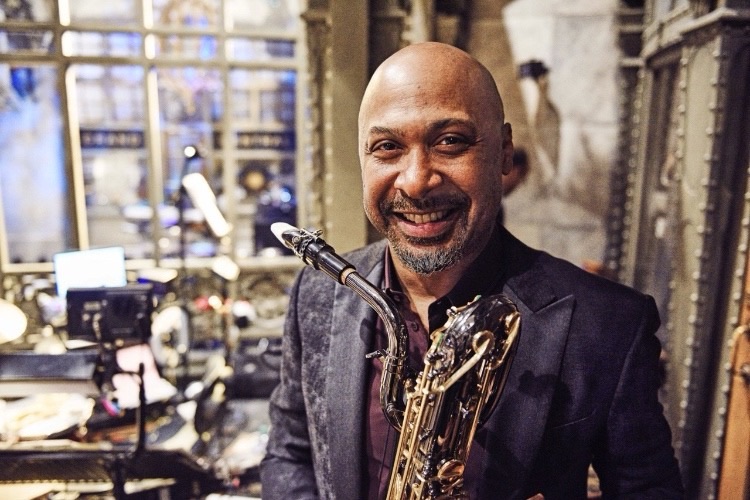

For a musician who excels in both big bands and combo settings, large and small, sometimes it’s refreshing to take a ‘less is more’ approach. Such is the case with Ron Blake. With SCRATCH Band (7tēn33, 2025), the veteran saxophonist, composer, and educator forms a trio with fellow Virgin Island native Reuben Rogers on bass and the veteran John Hadfield on drums. Blake is a well-rounded saxophonist who plays mostly baritone here, but also soprano and his renowned tenor on select tracks.

As detailed in the album’s liner notes, SCRATCH band references a tradition of folk music performed by storytellers and groove makers where Blake grew up in St. Thomas, the same island immortalized by Sonny Rollins. The music on the album is not drawn from or reflective of the music of scratch bands, called quelbe, but rather inspired by such group’s ’simple and engaging approach.’ Put another way, the trio is driven by ‘simplicity and soul.” In fact, Blake composed less than half of the album’s nine pieces. Five are covers, including the Black National Anthem, a jazz standard, and one from Blake’s former bandleader, Roy Hargrove.
Opener, “Bassman,” aptly features Rogers on a long bass intro. We hear Rogers and Hadfield’s delicate taps of the snares for a full fifty seconds before Blake blows danceable rhythms on his baritone. The tune, initially a 1970s mega hit for legendary calypso artist Shadow, sets a lively, engaging tone for the album.

While countless tenorists have played the classic “Body and Soul,” Blake gives the tune a new sheen with his relaxed duet rendering on baritone and Rogers on counterpoint. Blake conveys the same deep emotion as any of the great tenors who have played it, Coleman Hawkins included. The duo displays the opposite, an all-out energetic take, on Roy Hargrove’s “Another Level.” The piece launches from ballad mode into fierce improvisation, as each takes lengthy turns. The duo also renders “Grace Ann” from Blake’s former album, Mistaken Identity (7tēn33, 2023), again with Blake on baritone in a tender, heartfelt tribute to his wife.
Another oft-covered song, “Lift Every Voice and Sing,” serves as a feature mostly for the inventive Rogers and the skittering Hadfield. The former has had many opportunities to play this piece, as it is often a staple in Charles Lloyd’s sets. After a full three minutes of bass and drum trading lines, Blake enters on tenor. His approach is a deeply poignant take, with the tune recorded not long after the George Floyd tragedy. Blake’s tenor also graces “Song for Maya,” written for his eldest daughter and, like “Grace Ann,” delivered in ¾ time. As you listen, the approach to both the baritone and tenor is very similar, amplifying the great emotion he coaxes from the baritone, which is used mostly as a rhythm or low harmony instrument. Also note Rogers’ lyrical bass solo on this one.

The two head bobbers here are the opener and the Caribbean flavored, funky “Appointment,” with the latter delivered both on baritone and soprano. Yet, Blake reverts to baritone for what begins as a Cuban sensuous ballad, “La Conga de Juana,” that later morphs into infectious, danceable grooves. It may have been a great closer in terms of bookending the album. But Blake instead favors the ballad route with the slow-burning and deceptively tricky rhythms of “April’s Fool,” yet another remarkable example of his robust tone on the baritone and the telepathic support of his trio mates.
The concept of SCRATCH Band may be ostensibly simple, but there are plenty of rich melodies and toe-tapping rhythms to delve into. We all know that the iconic Gerry Mulligan and Pepper Adams made the baritone the principal melody instrument in their bands. Yet, we haven’t heard many standout examples since. Ron Blake just changed that.
‘SCRATCH Band’ will be released on August 8, 2025.


