

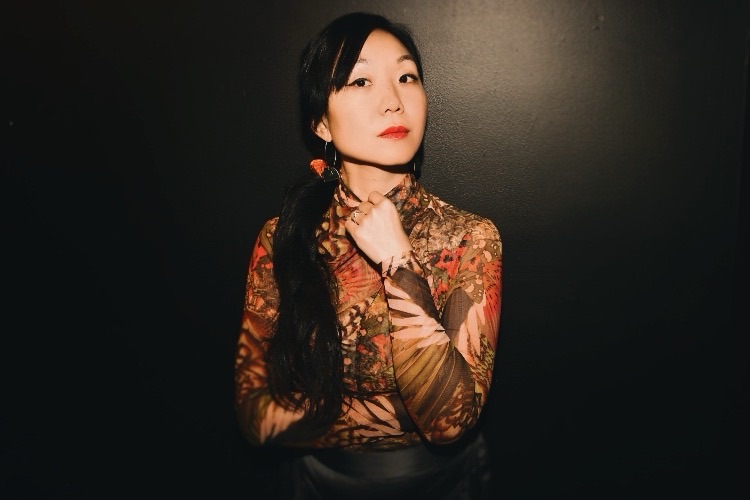

The comparison of a familiar hell to a strange heaven drives Australian-born bassist and composer Linda May Han Oh’s thinking for her trio album Strange Heavens (Biophilia, 2025). It is far too easy to be lulled by society into complacency and benign acceptance of social and political conditions. Strange Heavens stands opposed to this status quo. However, the record is by no means a protest album, instead aimed toward inspiration, resilience, and healing. A quote by the leader best captures her thoughts on the album: “There’s been a lot of worry and anxiety over the new presidential administration and issues like gun violence or healthcare, and I believe that’s a symptom of embracing familiar hells, especially here in America. This is the way things have been for so long; the idea of change can be frightening. But we have to figure out how we’re going to build a better world for our kids.”
The unusual chordless trio configuration of bass, drums, and trumpet returns Oh to the format of her debut, Entry (self-release, 2009), with returning member Ambrose Akinmusire on trumpet. Where Obed Calvaire provided drums on the older album, Strange Heavens finds Tyshawn Sorey in that role. All three of the artists in the trio are at the top tier of Creative Music in terms of technique, listening, and working within the trio format.

Oh’s earthy bass leads into opener “Portal,” where she is soon joined by her bandmates. Sorey establishes a tight groove while Akinmusire’s expressive, agitated trumpet, fades to a gurgling whimper by the end, conveying the stress we often feel from social media. “Strange Heavens” unfolds at a much slower pace. It is a rumination on the current state, with Akinmusire initially in the lower registers while Oh plucks a declarative solo and Sorey beats in a steady hand-clap-like rhythm. The trumpeter embraces brighter tones in the latter half, perhaps signifying hope.
“Living Proof,” taking inspiration from stories of self-improvement, by contrast, plays at a brisk pace. In their unique way, the trio swings hard here. The group returns to calmer tones on “Acapella,” with Akinmusire’s beautiful, sustained tones in reflection on Joni Mitchell’s “The Fiddle and the Drum,” as a “healing anthem” for families. The tempo revs up for “The Sweetest Water” as Oh delivers a remarkable solo. The piece has two sections: the first reflects the value of community and the second on the need for grit and struggle, as conveyed by the angst and agitation of the trumpet. Sorey lays down an infectious, upbeat groove on “Noise Machinery,” meant to rise above the clamor of everyday life. Akinmusire soars while Oh is funky and robustly rugged.

The acute listening and interplay of the trio arguably reach their peak in a four-song suite consisting of “Home,” “Paperbirds,” “Folk Song,” and “Work Song.” Each draws on images from Australian author Shaun Tan’s wordless graphic novel The Arrival (Hodder Children’s, 2006). Listen closely for the masterful techniques from each member – Akinmusire in “Home,” Sorey and Oh in “Paperbirds,” Oh’s bowed bass lies in harmony with the trumpet in “Folk Song,” and the riveting exchanges between Akinmusire and Sorey in “Work Song.”
The final two pieces honor female composers: Geri Allen’s “Skin” and Melba Liston’s “Just Waiting.” Akinmusire dazzles in the former. The latter, as its title suggests, is more ruminative and features a wooden-sounding bass solo, a reflective trumpet, and delicate brushwork from Sorey.

It’s not only the masterful playing and interplay, but it is their fiery, graceful, and delicate passages that have us yearning, feeling anger, and calmly reflecting. Trio rendering does not get any better than Strange Heavens.
‘Strange Heavens’ is out now on Biophilia Records. It can be purchased on Bandcamp.
Photo credit: Shervin Lainez


