

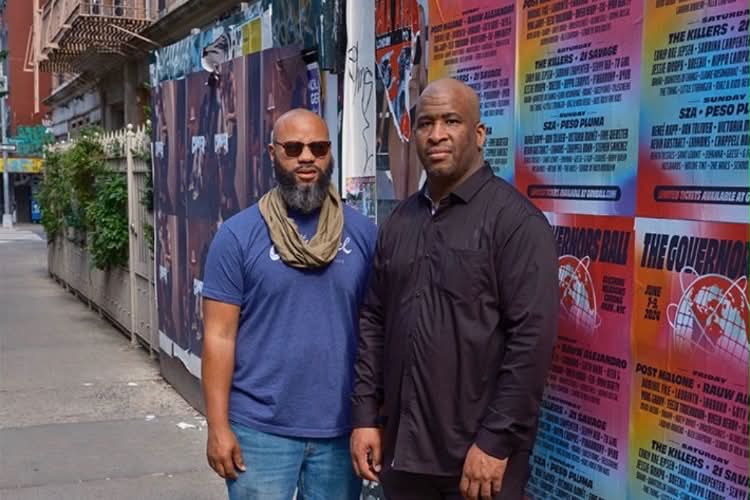

With a lineup full of long-established masters and viral sensations, it is easy to overlook some of the 2026 Newport Jazz Festival’s less-publicized performers. Invariably, at the bottom of the Festival’s list of artists are those unfamiliar to many. Names that require most attendees to research to discover who they are and what they do. But that additional investment of time often proves fruitful. Sometimes it is these hidden corners of the lineup that offer the most fascinating ground to explore. Outside of Nashville – at least for now – Concurrence is not a household name in jazz circles. Even the duo who comprise the band’s core – keyboardist Paul Horton and bassist Greg Bryant – are best known for work outside the band; the former under the stage name “No Stress” and the latter as an acclaimed broadcaster. Nevertheless, Concurrence’s performance at Newport may prove to be one of the most distinctive sets of the entire weekend. The band and its music from Indivisible (La Reserve, 2024), will certainly give listeners something no one else in Newport’s seven decades ever has. But let’s go back for a minute.
Following the end of the second World War, America entered an age of rapid growth. The population was booming. So too was the economy. People were increasingly moving westward, to places like California and Texas where they saw opportunity in underutilized land. But even in an age of automobiles and electricity, the Wild West still remained somewhat untamed. Travel across the vast nation took inordinate amounts of time, driving across a patchwork of dangerous and unpredictable two-lane roads. To truly facilitate both travel – of people and products – and national security, we needed large scale investment in infrastructure. This would ultimately come in 1956 when Congress passed the Federal Aid Highway Act. The new law created a massive forty-one thousand mile network of high-speed, limited-access and controlled-access freeways with uniform standards. It would come to be known for the President who signed the act into law: the Dwight D. Eisenhower National System of Interstate and Defense Highways.
Few would say such construction was unnecessary or unwarranted. Unfortunately, however, a gap often forms between ideals and application. While the Interstate System met its stated goals, often it came at the cost of marginalized minority communities, particularly Black ones. In city after city across the country, the new passageways disproportionately impacted people of color. Thousands had their homes and businesses evaporate in the name of eminent domain. One may be quick to blame implementation solely on racial animus – and it certainly played a part in the destruction – but the record is more complicated, as shown in the figure of Eisenhower. It is difficult to find a figure who did more to destroy Nazi claims of Aryan superiority than Ike. Once President, he also integrated the US military and Federal facilities, appointed the Supreme Court justice who would kill the deeply flawed concept of “separate but equal” in Brown v. Board of Education, enforced integration on non-compliant states, and signed into law the first major Civil Rights act since Reconstruction. And yet – due to fear, ignorance, and entrenched bureaucracy – the law bearing his name still did untold damage.
Jumping forward almost a half century, as musicians in Nashville in the mid 2000s, Horton and Bryant saw the lasting impacts of this destruction first-hand. They witnessed the ramifications of I-40 slicing apart a community. Prior to the erection of the “tourniquet of concrete,” Jefferson Street was once a vibrant Black neighborhood between three Historically Black Colleges and Universities. It housed several churches while venues like the Del Morocco, the New Era Club, Club Baron, Maceo’s, and Club Stealaway shared Black musical excellence. It also served as a place of protest for those seeking justice. When it came time to build a highway in Nashville in late 1967, at first Jefferson Street seemed safe. But when officials realized the original plans would route the interstate near Vanderbilt University, too much wealth and powerful white political leaders realized it would be far easier to redraw the route through the Black community instead. And, as a result, the physical representations of the blood, sweat, and tears of those near Jefferson Street were gone in an instant for a road.
With Indivisible, Concurrence starts by musically recreating what life may have been like on Jefferson Street prior to I-40. The album’s gospel-infused opener, “Sunrise on the Northside” speaks to both the area as a place of hope and the dawning of a new day for the community. The uptempo “Rebuild” then portrays a bustling city with people – represented by Horton’s keys- walking to and fro and cars leisurely passing by. The next three tracks “Introduction,” “Groovin at the Del Morocco,” and “Last Call at the New Era” energetically depict the band’s imaginary performances at their namesake venues. Very few reading this have ever attended these long shuttered clubs but Concurrence masterfully transports us all to the energy and vibe of those spaces regardless. The tracks capture the dynamism of live shows, an incredible feat given they were all made in-studio. Things like a bustling audience, applause, and the shop bells at the end of “Groovin” certainly help as well.
But the turmoil of the impending freeway begins to rear its ugly head on the urgently pounding “I-40 Was a Razor.” A peek of what was to come, the once leisurely cars on “Rebuild” are frenetic and urgent, zooming through the slower-paced lives of everyone from before the highway began. The echoing and dystopic mournfulness of “The Steering Committee Blues” speaks of those near Jefferson Street who did all they could to save their homes and businesses, but for naught. Even with the highway in place, however, their resilience and yearning for a return to the time before never wanes. The slowly rolling drums, gradually emergent basslines, and soaring trumpet on “What Could Have Been Still Can Be” shows that hope for a united community has never died even if the place itself is no longer hospitable. And by the closer, the wild title track, a heavy groove is formed with keyboard, bass and drum parts swirling weightlessly around one another. It becomes clear: the relationships that formed the true crux of the community of Jefferson Street remain as powerful as ever, they just no longer have a physical space to call their own. A mere road, even the entire destruction of a neighborhood, is far from the end.
Indivisible also cleverly tracks a lineage of Black music from the shuttered clubs of the 1960s to the present. While labels are reductive, they also help convey a larger message about the album. Solos invariably hint to the jazz, blues, and soul music of those departed spaces. The fusion of jazz and rock, which only grew since those years, provides a blueprint to the outing even as the artists also look back. But even more significant, perhaps, are the ties to hip hop. The inventive use of samples and shifts in rhythmic time owe an indebtedness to the great J Dilla – himself a child of an interstate ravaged place – and create a richly textured environment for the entire album. Perhaps the title of the track built on a heavy bass line, short repetitive drum motif, and Dara Tucker’s dreamy vocals says it best: “Black Music is Forever.”
While Indivisible tells the story of North Nashville, it would be folly to relegate its message to solely the “Athens of the South.” I-35 in Austin, Dallas, and Minneapolis. I-45 in Houston. I-94 in St. Paul. I-95 in Miami. I-375 in Detroit. I-75 and I-85 in Atlanta. I-395 and I-695 in Washington. I-90 in Chicago, Cleveland, and Seattle. They, and many others, all share a similar story as I-40 even as specifics differ. While Concurrence’s Indivisible does focus on a city Horton and Bryant know best, it speaks to things much larger than there and then.
But what truly makes the project a special fit for Newport is the setting in which it is presented. In sharing this music with audiences at Fort Adams in 2026, Concurrence reflects on the seventieth anniversary of the passage of the law that created the interstates. But more, the performance takes place at the foot of the summer cottage of the man who signed it into law, Eisenhower. These elements add an additional poignancy to the work that can neither be replicated in the studio nor caught in a live show elsewhere. Seeing the band under these circumstances provides an utterly unique opportunity few concerts could ever approach.
PostGenre: Do you remember the first time you ever heard about the Newport Jazz Festival?
Paul Horton: Growing up, I didn’t have an extensive record collection. But we had a family friend and neighbor who had a really big collection. They let me come over and listen to stuff all the time. And he had Miles & Monk at Newport (Columbia, 1964). That was the first time the festival was on my radar at all. One summer, a few years later, I got a copy of [John] Coltrane’s Newport ‘63 (Impulse!, 1993) and that changed my life.

Greg Bryant: My great aunt was basically like a third grandmother to me. And she had a copy of Ellington at Newport 1956 (Columbia, 1957). I first heard it when I was eight or nine years old. I was already into the music by then because of my parents’ record collection and, really, all of my grandparents’ record collections. The so-called “jazz” stuff is what I gravitated towards. I remember reading the liner notes to the Ellington album and how they discussed Paul Gonsalves taking a twenty-seven chorus solo that nearly caused a riot. From that, I knew I needed to know about this place. Man, where was this place? I didn’t even know it was in Rhode Island. I just knew it was somewhere on the East Coast far away from where I was in Tennessee. Then, like Paul, I heard the Miles Davis and John Coltrane recordings from Newport too. It’s pretty significant that we’re playing there on the centennial anniversaries of both.
PG: Have either of you been to Newport before?
PH: I played there for the first time a few years ago with the vocalist Brittany Howard. We did both the Folk and Jazz Festivals that year. And it kind of blew my mind. It was a surreal moment to be occupying the same space where all these legendary performances I listened to and watched on YouTube for years had taken place. I was in that space performing for a new generation of listeners. I also saw some amazing performances there, and left incredibly inspired.

GB: This will be my maiden voyage. I was a broadcaster on the East Coast for about four and a half years from 2020 until the end of 2024. I was in Newark, New Jersey, and then later Philadelphia, Pennsylvania. Several of my friends always attend and I’ve always wanted to, but never have. I was always either working with Paul or another ensemble on the same weekend in another place. It never worked out for me to be there.

PG: It is surprising you have not gone with [your former Jazz United podcast co-host] Nate [Chinen] given his ties to the festival.
GB: Yeah, that’s my buddy. We’ll get to link up this time. I’m really excited.
PG: Anyway, going back, how did the two of you first meet? You were both in Nashville, right?
GB: Murfreesboro, Tennessee, technically. It is about twenty-five to thirty miles from Nashville, right in the very center of the state. We were both at Middle Tennessee State University in the year 2000 and met there. I am originally from Nashville and Paul is from Athens, Alabama.

PG: Obviously, you two are the core of Concurrence but you also work with a revolving set of drummers. For Indivisible, you had several, including Nasheet Waits. Who will you have on drums at Newport?
PH: We’re blessed to present our current configuration, which includes a drummer named Aaron Smith. He’s a Cleveland native, and an incredible drummer. Although I’ve known Greg since 2000, Concurrence has been a collaboration since 2004. Our current version of the group has been going non-stop for the last ten years or so. Before that, it was just the two of us, with no drummer. But the current form with a drummer works incredibly well.
PG: Will you be presenting the music from Indivisible or something new you are working on?
PH: Indivisible has definitely been our main focus the last two and a half years. We will continue to bring it to the attention of people so they can learn about what the project is about. But we are also working on new music right now that we will further refine this fall and release in December. We definitely intend to put Indivisible front and center in our Newport performance but we will probably have some new music too. We’re over the moon to be presenting our music at Newport. We’re really excited to reach some new ears.
GB: It’s been a real – as much as I hate to use the cliché phrase – labor of love to bring the story of the interstate highway system to a lot of people who don’t know about it. The system divided up communities all over the United States. Paul has done extensive research on it and our families both lived through it. Indivisible is crucial to the mission of what Concurrence means both musically and as a force in the world. So, we will definitely play some songs from Indivisible. But we’re also going to play some songs that we typically perform live but haven’t recorded in a studio setting. We may also play something from the new stuff coming out later this year.

PG: One thing that is really cool about Indivisible, from a purely sonic perspective, is how it is a studio recording but often sounds like a live performance. When you move it into actual live performances, how does that element change, if at all?
PH: Well, the record is from three different studio sessions in Nashville. I also used some things from an extensive recorded archive we had of our live shows. I’ve since lost a lot of those archives through a computer situation, but we mixed some in with the studio recordings. There was also production work that Greg did at his home in Philly at the time and I did here in Florida. We worked from the ground up, creating sound design and producing stuff that way. So, yes, it is a studio recording but definitely brings in a live element.
As far as performing the music live, for most – but not every – show, I have a sampler on stage. I implement some electronic sampling and other stuff to capture our current sound as it is represented on the record.

GB: That’s very accurate. We’re big fans of several different bands from the 50s, 60s, 70s, and even before. But one that struck us in different ways was Weather Report. Something I’ve learned from them is that not everything on your record necessarily has to be a part of your live show. Back in the 70s and early 80s, Weather Report also provided new textures and sounds through cassette manipulation. With Paul’s sampler, we’re similarly able to provide those extra textures to serve as sonic templates we can sometimes implement. Incorporating the sampler also helps us give a nod to folks we admire. That includes J Dilla – who is an especially significant influence, Pete Rock, and Madlib in addition to people like Andrew Hill, Sonny Clark, and Herbie Hancock.

PG: Do you see a difference between some of the older groups and artists and someone like J Dilla? It seems, outside of some hip hop circles, Dilla is generally very underrated as a composer. He’s acknowledged as a great producer, but he was also one of the best composers of the early Twenty-First Century and seems to get little recognition for it.
GB: You’re right, man. You’re right. Paul and I got a chance to hang, learn, and play with Roy McCurdy, who will be ninety years old this year. He sounds just like he’s still thirty-five, as he was back when he was with Cannonball Adderley and Sonny Rollins. But he played on Cannonball’s record, Mercy, Mercy, Mercy (Live at “The Club.”) (Capitol, 1966). On the track, “Fun” on that album, you hear him manipulating his drumset in real time. He’s pushing the beat forward and pulling the beat back. That concept has been with us for eons. But to have somebody like Dilla make his career around that principle – though he did other things too – really changed music. As you’re suggesting, Rob, I think he’s a “time innovator.” He changed the quarter note, man. He changed the beat.

PH: You said it. I’m right there with you. The stuff that Roy’s doing with Cannonball takes a similar approach. So too does the work Erroll Garner did. You can draw a throughline between both of them straight to Dilla.
And I think you’re right that he’s not really celebrated as a composer. He’s better known as a producer. But I do look at him in compositional terms. For some reason, the average person doesn’t consider a drummer a composer, even drummers who lead their own groups and write their music. There is a disconnect that someone is “just a drummer.” Dilla encounters something similar; to many, he’s “just a producer.” But thanks to people like Robert Glasper and Chris Dave, that perspective is changing. More people are starting to fully appreciate what an innovator Dilla truly was.

PG: Dilla also ties directly into the larger themes of Indivisible because the Black community in Detroit that he grew up into was, like Nashville, negatively impacted by the interstate highway system.
PH: Absolutely.
PG: I-375 and I-94 in Detroit and I-40 both in Nashville came about because of President Eisenhower signing the Federal Aid Highway Act of 1956 into law. To be fair, he also integrated the military and signed the Civil Rights Acts of 1957 and 1960, the first significant civil rights legislation since Reconstruction, into law. So, perhaps he has a bit of a mixed record on civil rights matters. Interestingly, the Eisenhower House, his summer residence, is on the Fort Adams grounds. Will it be especially interesting to present this project in a space right next to his home, seventy years after he signed it?
GB: Wow. I didn’t even know about the house.
PH: I wasn’t aware that it was right around there either. But I will say that the deeper I dove into the US Interstate Highway Act, the more my eyes opened to a new reality. I, of course, use the interstates to travel to different cities like everyone else. But there is also the side of what they did to communities. It is all something that I’m still processing. Knowing that Eisenhower’s house is on the Fort grounds is something I’ll be processing too.

GB: I appreciate you, Rob, for bringing that to the forefront. It will bring some additional significance for me, Paul, and Aaron. I think in general, when we investigate that complicated period, we have to be honest with ourselves. We’re basically talking about the environmental racism of that time. It wasn’t always done out of hatred. Sometimes choices came out of ignorance. Sometimes they came out of fear. Recognizing those elements help us understand the complexities of what those things mean and the adverse effects that they have on people, past, present, and future.
To be very candid about it, being in Nashville, in 2004-2006, Paul and I were some of the last people in the so-called “Black community,” to play our music before full-on gentrification took place. The whole area was a shell of what our mothers and fathers enjoyed. We feel very purpose-driven to be able to tell the story that while things were desegregating, the creation of the interstate system at the time basically robbed people in that community of their economic base. Integration came at half-mast. There were no things like vouchers given to help the displaced. When my mom and her family were forced to move away from Jefferson Street in Nashville, they were forced to figure out for themselves what to do next.

And when Paul and I were very young adults, coming to Nashville to play, we were basically in the vestiges of – pardon me but – “crack town.” It was not always like that. It wasn’t always dangerous there. It was once a thriving community.
Again, it’s a balance. Highway travel has been easier over the last seventy years. But the economic security of Black and brown people has been nebulous throughout that entire time. That’s the sacrifice that was paid through the plan of Eisenhower and his cabinet members. And it’s something that we’re still reckoning with.
PH: When we present our music, someone almost always comes up to us after and tells us that they did not know about the damage that the US interstates often inflicted on communities. It is fulfilling and inspiring to have those opportunities to share knowledge. I use the example of Nashville and point out that around eighty percent of Black-owned businesses in the county were focused in North Nashville. That eighty percent of Black businesses were in the area that the interstate cut through. You can imagine what that does to the economy of the community. People are shocked when they hear that. We encourage people to look into their own communities and see what happened there. If they don’t know the history, they don’t necessarily have their antenna up to realize when it happens again. And it’s still happening today in various forms, through eminent domain.

PG: So, what is your research process for the project; is there a lot of digging through books and records? And, also, how do you translate what you find into musical form?
GB: Well, the full name of our band is Concurrence Music Research Collective. It’s cool for people to call us Concurrence because that encapsulates the full name. But we definitely exist beyond the notes.
There’s a general research that Paul does for the project where he goes through library archives. Thank goodness for microfiche, even though it’s somewhat dated now. Reading these classic articles from Tennessee newspapers about the steering committee in North Nashville that resisted and tried to get the city to reconsider routing I-40, through Black Nashville, made things seem even more real and even more tactile. But it only tells us so much.
Firsthand accounts with family and friends who endured the results of the imposition of the highway system have been an essential part of our research process too. Person-to-person research is incredibly important to us. Being in the Nashville area when I was eight, nine, or ten years old, I had heard that Jimi Hendrix learned to play guitar in Nashville. Ray Charles got four or five band members from Tennessee State University in Black Nashville with Hank Crawford being one of those premier members of that band. And all of that raised questions for me. So, I asked my parents why our community needs so much help. Why is it run down? Why couldn’t we go to South Nashville or West Nashville and get the services that we needed?
Again, I go back to being on Jefferson Street in 2004-2006 and seeing the last vestiges of the community there. I don’t put us on a pedestal, in the lineage of folks like Jimi Hendrix, Little Richard, Ray Charles, and Duke Ellington who schlepped around there either passing through or even living there for a short period before everything completely gentrified. But it gives us a sense of pride and directs our research. And then as Paul moved to Miami, he found that the same thing happened in Liberty City. When I moved to Los Angeles, I found the same thing happened in Crenshaw and South Central. The interstates busted up Central Avenue and the West Adams neighborhood. Some people try to relegate the story to solely Nashville and are missing the bigger picture when they do. There was a national phenomenon with the highway system that we’re helping uncover and put before the people. And the statistics are staggering. Paul, you had the one on how many people in Nashville were displaced by the interstate highway system.
PH: Well, I used to say it was fourteen hundred but I found out that may be wrong. It may be undercounting how many there actually were because data collection was not very reliable. So, we don’t fully know.

PG: And, of course, that’s only Nashville too. It does not consider the many other places, like here in Austin, with similar stories.
PH: That’s right. Down here in Liberty City, around forty thousand people were displaced. And those are only those that we have records of. It is an astronomical number if you look at the bigger picture of all the cities that the interstate system impacted.
PG: But for Nashville specifically, you mentioned the Black musical scene that once existed in the city. There are other cities that are renowned for their rich Black musical communities. New Orleans, Memphis, and Detroit to name three. These cities have faced similar forces, including gentrification. Why is the Black musical community of Nashville not discussed as much as some other places?
GB: I lived in Nashville for about seventeen years. I feel like Concurrence is a bridge between that city and progressive Alabama where Paul is from. I see a convergence between the two places.
PH: That’s accurately stated.
GB: When you think about progressive Alabama, the one name that comes to mind is Sun Ra.
Most people don’t even know about WLAC, an AM radio station out of Nashville. It was a country western station during the day but, at night, would play the real Black music of the moment at that time.


Rob, you may know about this though your readers may not – the station’s signal would actually skip states. Based on the sun’s position and the season, you could hear WLAC up in Detroit, Michigan. On good days, you could hear it all the way down to Monroe and New Orleans, Louisiana. People could miraculously tune into the station from Nashville because of the season and the sun’s position. And when they did, they found some incredible music.
Man, WLAC launched so many Black music careers in the 1950s and 1960s. I can’t even recall them all. James Brown’s record broke on WLAC. The Meters, from New Orleans, had their record break nationally on WLAC. So many more from the jump era to the early funk and soul records were first shared broadly on WLAC. The music was only later found to be commercially viable. The station found that it could sell advertising directly to the Black, brown, and white communities and that all people loved listening to the station at night.
But it didn’t last forever. I believe the Black musical history of Nashville was strategically undermined by the country music industry and by the Contemporary Christian Music industry. Just look at what’s happening in Tennessee now and who are some of the first people running into the forefront of dismantling voting rights laws, gerrymandering, redlining and hurting folks. Those things have been going on for literally hundreds of years. None of it is anything new, which emboldens us to, again, represent.
But yes, we are the living embodiments of progressive Alabama and progressive Nashville. Even though we don’t live in either anymore. Even though we couldn’t really make a living in either for very much longer because of the suppression of our music. But we got enough of it to make a reputation and are carrying that momentum nationally and hopefully globally.
We have a complicated relationship with Nashville, but it’ll always be our band’s home. And to use another cliche, as Andre 3000 said, “the South’s got something to say.”

PG: And how does that “something to say” continue to shape Concurrence going forward? Where do you see the group going from here?
PH: I think, from a sound standpoint, we’ll continue to build on what we have done with Indivisible. We’re going to expand on the groundwork of our album to try to continue to tell the story of history and how it continues to shape society. From a sonic standpoint, nothing is off limits for us. We will continue to mine territory that we haven’t explored much. Bit by bit, we’ll add things to our live set and that will end up on our next record. Sound design is a big fascination and obsession of mine right now, and it will definitely shape what we do going forward.
GB: That’s exactly right. We’re putting the finishing touches on our next record as we speak and we’ll continue into the early fall. But, at this moment, we are mostly reflecting on how undone the United States is and how unbalanced everything is. We are trying to reflect the musical portrait of that. We want to share history with the people. But we also want to capture where we are as a people nationally. It’s very important for us to tell our story. But we also need to encapsulate the story of all of us here together and what we’re enduring right now, politically and socially. We don’t always have the answers to our problems. But we can also always extend the hand. And that’s probably going to be on what you hear in some form come December.
Concurrence will be performing at the 2026 Newport Jazz Festival on Friday, July 31, 2026. You can read more about the Festival here. Stay tuned as we continue our extensive pre-coverage of the event. We will also be providing live coverage from Fort Adams. ‘Indivisible’ is out now and can be purchased directly from the band.
Photo credit: John Rogers



Leave a Reply