
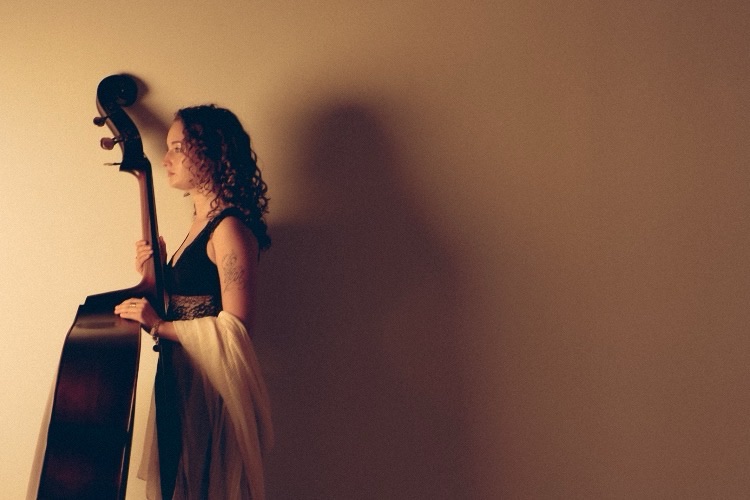

New York City. The metropolis is more than a living space for over eight and a half million. It is a cultural melting pot representative of the American ideal of E Pluribus Unum. The stories of immigrants arriving at Lady Liberty’s feet at Ellis Island are an iconically indispensable part of the American narrative. Lives, both of turmoil and of comfort, given up for the uncertainty of opportunity. But it is all too easy to focus on those who travel from overseas. Equally important to the story, however, are those who voyage from locations closer. Although New York has become the jazz mecca, many of the roads to Manhattan run through the great American Midwest. Chordal structures were stretched far beyond the status quo by a young saxophonist by way of Kansas City. Music itself changed several times over by a chameleonic trumpeter from East St. Louis. It is easy to cast bassist Hannah Marks as a continuation of this lineage. In some ways, she is. But as Feed the Fire (Endectomorph, 2026) shows, that is only part of the story.
The depiction of a rising artist coming out of the country and traveling to the big city, once true generations ago, is a laughable stereotype today. The Iowa city that Marks grew up in is not a small spot along the Des Moines River. It’s a minor powerhouse in the insurance, financial services, and publishing industries. In the internet age in which information travels at breakneck speed, the folk songs of the area become just one of several colors an artist can use to paint. Marks especially uses these hues in Salt of the Earth, her trio with pianist Jacob Sacks and drummer Tom Rainey. But, as shown on her first album, Outsider, Outlier (Out of Your Head, 2023), punk, alternative, and indie rock are writ large as well.
Yet there remains something quintessentially New York about Marks’ second outing, Feed the Fire. The liveliness of walking into a late-night club is captured well on the record. The quartet – with saxophonist Nathan Reising, pianist Lex Korten, and drummer Steven Crammer- scorches through a collection of original pieces and standards. Odd meters and hard swing capture a sonic vibrancy seldom heard outside the Big Apple. With much of her professional career built out of the Jazz Gallery – partly crafted by a Texan turned New Yorker – perhaps this reflection of New York is unavoidable. The equally pointedly staccato and smoothly swaying opener “Aggro,” dedicated to “the House that Roy built,” certainly suggests as much.
But one should recognize that Marks seems fully aware of her once outsider role as she takes a quasi-Tocquevillian perspective on her new home. She is able to extract its best elements while feeling no indebtedness to the less optimal. Rather than taking a side on the longstanding debate between factions of improvising musicians between the straight-ahead and the avant-garde, she takes delight in them both. Her pieces, especially the wild ride on her long-ago composed “Room 157,” shift between the two as if they – properly – exist within the same sphere, not as polar opposites. Even Marks’ selection of standards defies convention to some extent. Instead of picking overwrought pieces, she picks pieces from underrated Middle American compositional greats – Detroiters Geri Allen (the bouncy title track and the candlelit romanticism of “Unconditional Love”) and Bob Hurst (the mysterious “The Dark Knight”) and Fort Worth’s Dewey Redman (the angular swing of “Mushi Mushi”). The album is also produced by Houston native Jason Moran.
In all, Feed the Fire is a work that shows more than its respect for tradition. It burns new paths for the flames to continue to grow in luminescence. We sat down with Marks to discuss the album and to trace the sparks that ultimately gave way to the album’s bright roars.
PostGenre: Feed the Fire has a vibrancy that seems to reflect New York City, where it was recorded.
Hannah Marks: There is definitely a vibrancy, as you say, to the music. I feel all of us in the band are pushing incredibly hard because it’s so hard to live here. You need to be on top of your game to survive, and I think the music captures that feeling too.

PG: The album is also tied specifically to the Jazz Gallery. [Director] Rio [Sakairi] and others do so much for younger artists.
HM: Actually, that’s where I was coming from this morning. I did some teaching for them and am about a block away from there right now. Rio and everyone at the Jazz Gallery have been so instrumental to my development here in New York. She gave me my first gig as a leader. It ended up getting canceled because of the pandemic, but it showed how she was willing to take a chance on me. Some of my first gigs in New York were at the Gallery. Even today, if someone calls me to perform at the Gallery, I am so excited about it. I have yet to play with someone there in a situation where I don’t really like the music. No, if I’m getting a call to play the Gallery, it’s with someone cool.
Rio has given me amazing opportunities. I did a mentorship program through the Gallery with Nasheet Waits as my mentor. We did several gigs around the city. And this year she awarded me a Jazz Gallery Commission. For it, this December, I’ll be debuting a brand new hour-long set of music. I can’t thank Rio and the Gallery enough for their support. Rio always says to artists, “You’re doing the hard work; [the Gallery is] just giving you a boost.” That boost is unbelievably helpful.
PG: But it was actually Jason Moran who led you to move to New York. How did you get connected with him?
HM: I met Jason in 2019 at Betty Carter Jazz Ahead. That experience greatly changed the direction of my life because I was about to move to Chicago. I’m from the Midwest, and many people from my alma mater, Indiana University, were moving to Chicago after school. It felt like a good next step to me. But then I did Jazz Ahead, and Jason and a few other people told me they believed in me and thought I could make it if I moved to New York. Jason said he would support me if I did. That meant a lot to me. So, I basically changed my plans on a month’s notice and went for it.
After I moved here in 2019, I didn’t see Jason much for a few years. I think we casually played once or twice together during the pandemic. I had been looking for the right moment for a long time for us to work together.

PG: It must have been strange to be in a new city right before the pandemic hit.
HM: I had a good six months before the pandemic. I also moved with a lot of friends or acquaintances from Jazz Ahead and from the Banff workshop, which I had done the year before. So, I knew people who helped. I think I had been in New York for just enough time to get settled before everything shut down. I met someone who moved there in February 2020, and it was incredibly hard for him. It wasn’t as horrible for me. And one thing that worked out for me was how the pandemic forced a lot of musicians off the road. I was able to spend time with some people who I think normally would have been too busy in their regular lives.

PG: Your last album, Outsider Outlier, sounds very different than Feed the Fire. Did you intentionally set out to make your second album a little more tied to the jazz tradition than the first?
HM: Outsider Outlier was very impacted by the pandemic because it came from all this time I had alone, in which I could songwrite. I was very passionate about songwriting at that time and got to study with Becca Stevens, which was amazing.
PG: You had even worked on songwriting a bit during your residency at McDowell.
HM: Right. Up until a year or two ago, I thought I would do another songwriting record. I found the solo nature of a McDowell residency helpful for songwriting because it put me in a space where I have a guitar and a vocal mic set up and space to have a lot of fun making demos. I recorded about half a record’s worth of songwriter songs but haven’t released them. I don’t know if they’ll see the light of day or not. And I don’t feel concerned about it right now. Maybe, eventually, I’ll do another project with that material. I don’t know why, but I have ceased songwriting for now. It’s hard to say exactly what caused me to stop songwriting, but I found myself being more drawn to composing instrumentally.
Then, coming out of the pandemic, I think it was more natural for me to go back to my jazz roots. I felt I had acknowledged the experimental rock influences that had been a part of me for a really long time. And in a practical sense, I also realized how difficult it would be to try to break into an entirely different, experimental rock scene. It was an uphill battle to find work for that group.
Also, the music on that album was absolutely influenced by the musicians on the record. Our amazing vocalist, Sarah Rossy, lives in Montreal. Our guitar player moved upstate. I couldn’t imagine doing that music without them, so it stopped.
But for the second record, I got to a place where I felt like I had played enough to be able to make a good contribution to jazz. Previously, I wasn’t ready to do that and did not want to make a bad jazz record. I love the music and the tradition so much that I wanted to wait until I felt I had something to say. Some of that was also trying to make sure I felt I was strong as a soloist on my instruments and as a composer, too. And I’m glad I didn’t push myself with that. My first draft for my first record was a weird mashup of the first two records. More time lets me separate them more fully.

PG: You mentioned how the music on Outsider Outlier was specific to the musicians making it. Is that the same as the quartet on Feed the Fire?
HM: No. I would say the quartet’s music is less specific. And I’ve had some personnel changes in my quartet over the past five or six years. But it’s still a small pool of musicians that play the music the way I want it played. I had several years where I played around with the repertoire for this group and had one to three people on each instrument cycle in and out.
The cool thing is that I got a grant from the Chamber of Music America called the Performance Plus grant. I think it is now defunct. But it let me pick a mentor to work with, so I picked Jason Moran. We had six months of rehearsing with Jason and getting his feedback before we went into the studio, and then he signed on to be a producer. It was an amazing experience. And by the time we recorded, the quartet had already been playing this repertoire for a couple of years.

PG: Feed the Fire includes two Geri Allen compositions, both the title track and “Unconditional Love.” What is it about her work that you feel most speaks to you?
HM: Geri has deeply touched my favorite pianists that I work with. Of course, I’ve listened to her and love her music, but I’ve also had the experience of working with several people who have studied with her or were deeply moved by her. So, I’m getting the second-hand account of Geri Allen at this point. There’s been a group of musicians in New York that have been playing her material at sessions like Marta Sanchez. And, of course, Les Gordon studied with her at the University of Michigan, and they are very close friends. Also, Michael Mallis, a great pianist in Detroit, worked with her. I’ve also seen Jason lift her up in his teaching and in his playing.
The story behind why the album is called Feed the Fire and why I picked that composition was that I saw Jason’s group, Bandwagon, play at the Village Vanguard in November 2019. I think they opened their sets with “Feed the Fire.” It was insane. It was one of the most standout musical moments for me since moving here. The trio was interpreting it in a super free way. They swing really hard, while also going in and out of time. Jason also loves medleys, so it may have gone into a Thelonious Monk or Fats Waller medley next. But I was deeply taken with the way that group interpreted the song. And then I left, adopting “Feed the Fire” as a motto.
PG: How so?
HM: I’m an Aries, and that is the fire sign. I’ve been reminding myself during this journey of living in New York not to let the fire die out. It’s so difficult to live here and keep this thing going. I need to keep pushing; keep burning. So, “feed the fire” has been kind of a personal phrase to me for a number of years. And I have to credit Geri for that.

PG: It is great to see her get recognition. She was an incredibly important and influential artist who far too often gets missed in discussions on contemporary greats.
HM: Yeah. My quartet has also played Geri’s compositions “Skin” and “Dolphy’s Dance.” She’s so deep, and I’ve barely scratched the surface of her work. But my friend Michael Mallis, whom I mentioned earlier, is doing some of his doctoral work at the University of Michigan, studying Geri’s music and her scholarly interests. I saw a presentation he did at the Jazz Education Network Conference in January, and saw a glimpse of just how deep she was. I look forward to diving in even more.

PG: As far as your original pieces on Feed the Fire, what is your process for writing them? “Room 157” is particularly interesting because it is equal parts conventional and free, treating both as a united thing, a view often overlooked in most music.
HM: Actually, the original music portion of things is something that I had only started developing when I moved to the city. I think that has been a huge part of my artistic development, realizing that as much as I love the jazz tradition and want to play the American Songbook, the majority of what I would like to do is play my original music and other people’s original music.
As far as “Room 157,” specifically, I like that you said that it’s both “free” and not. I was thinking about that earlier, and the way I like to play or write music. I love being a band leader because I love to play “free,” straight ahead, and in between. I think it can be rare to find people who are willing to blur those lines with you. That is also why I play with specific musicians in my band. I think this record is a good example of it all coming together. There’s some modern jazz. There’s some straight-ahead jazz. There’s some avant-garde. I like to do it all.
“Room 157” is actually the oldest composition on the record. I wrote it in college when I was studying with Walter Smith III at Indiana University. There was an ensemble in which we would write and perform all original music. Actually, we had a partnership with the Jazz Gallery – full circle moment there – where we came to New York and played with Ben Wendell, which was super cool to do. I think I wrote “Room 157” on the piano. The upright bassline is super interesting and lays everything out very well. Sometimes, when you play, if you write on piano, you might come up with something that doesn’t play well on bass. I like the challenge of making it work. In college, I had a chordless trio, and the song was originally for that group. It was a pretty simple piece. And I eventually fleshed it out more. Then it got some updates when I started working with Jason.
PG: How did it change from working with him?
HM: I added a coda because Jason is always having me add things to the music.
But in general, I would say most of the pieces on Feed the Fire were, like “Room 157,” written at the piano. However, I know “Aggro” started with a bassline and a bass ostinato. It’s funny, when I’m songwriting, I’m often writing on guitar. And if I’m writing jazz, my work is more piano-centric. But I do like to bounce around. Maybe I’ll sing something. Maybe I’ll play something on bass. Bouncing around helps me keep things fresh and not fall into any cliches or patterns on an instrument.

PG: Even so, do you have any sense as to why one instrument predominates over the other, piano for jazz compared to guitar for songwriting?
HM: It’s because I’m less into rock music with piano in it. My rock interests come from a super guitar-centric background, from Nirvana to the Melvins to Sonic Youth; things with lots of guitars. My ear trends towards that. And then some of the difference also comes from language. I have zero jazz harmony language on guitar, even though I started as a guitar player. All of my muscle memory is more rock shapes, whereas piano is going to go towards seven chords with extensions and things that have more of a jazz sound.
PG: As a concluding thought, what does it mean for you personally to keep the fire of jazz over a century after its birth? alive in music today?
HM: A big thing for me in terms of keeping the fire alive is through educating. I’m a very passionate educator, and teaching has been a huge part of my career for the past five or six years. I currently teach at Fordham University, and in the summer I’m often bouncing around different jazz camps, from Interlochen to the Stanford Jazz Workshop. Teaching is incredibly important to me and is one of the things that keeps me feeling connected to the tradition, too. I was taught that you master your craft first, and then you become an artist. I still have that perspective.
Every week, I feel like I have to demonstrate to some group of children somewhere how to play a B flat blues. I’m not playing that on any of my gigs, but I definitely feel like going back to that form keeps me grounded in where I came from, which is really important to me. That’s also one of the things I love about Jason Moran so much. He has such a strong grasp of the breadth of the history of this music, yet he’s still an innovator. That’s what I strive for too: innovation, but one grounded and rooted in what came before.

In terms of recording, it’s hard to know what I’ll record next. But one project of mine that I’m really excited about is a trio called Salt of the Earth and is with Jacob Sacks and Tom Rainey. We’ve been interpreting a collection of folk songs and spirituals that I’ve collected over the years. The project goes back to a theme in my work, which is that even though I’m making things that sound very different, I’m also trying to honor my whole musical self. Salt of the Earth builds from five years I spent in my church band growing up in Des Moines, Iowa. It was a big bluegrass band. I think there were as many as eleven members at one point. The folk songs and hymns we played are super special and important to me. This project with Jacob and Tom is a way for me to just work on improvising, listening, and coming into a gig with no preconceived notions. We just have the melodies to these songs. No chords. No time signatures really. We’re just freely improvising around these melodies.
I never know how we’re going to play one of these songs, whether it is “Turkey in the Straw” or “Poor Wayfaring Stranger”, which is one of my favorite traditional songs. Another aspect of the project is playing familiar melodies so that my audience has something to latch on to, even though the way we’re presenting them is probably totally different from how they’re used to hearing them. I’m always trying to find ways to comfort yet push my audience at the same time.
I think growing up in the Midwest, I tend to only see a very specific style of jazz represented there. Part of me wants to come back and do something different. But not something so insane that people back home would be turned off by it. I think Salt of the Earth will do that. It’s also just an amazing experience to play with Jacob and Tom. There’s a forty-year age gap between Tom and me. To get to make music with such experienced musicians and to learn from them is a lot of fun. I feel blessed that Tom and Jacob are willing to play with me.
‘Feed the Fire’ will be released on Endectomorph Records. It can be purchased on Bandcamp. More information on Hannah Marks is available on her website.
Photo credit: Rachel Rodgers
Leave a Reply