

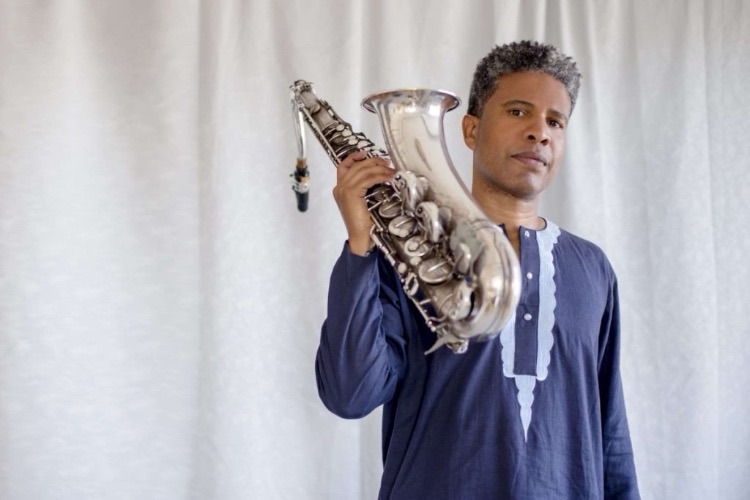

A careful observer may notice that many of Ropeadope’s recent releases are tied to the Third Way Cultural Alliance (TWCA), a 501(c)(3) nonprofit organization which supports contemporary music as art. The TWCA focuses primarily on the album as the preeminent format of recorded musical expression and supports socially conscious projects of power and meaning in furtherance thereof. Saxophonist and composer David Sanchèz’s Tambó (Ropeadope, 2026) is a perfect example of this emphasis. Thanks to a generous donor-directed grant, Tambó, finds Sanchèz, a vital member of the SF Jazz Collective, journeying from Loiza, Puerto Rico, to Haiti and then to San Basilio de Palenque, Colombia. In addition to the recorded album, archival footage from his travels and from the studio will be licensed as a multimedia presentation to museums and community organizations as part of Third Way’s commitment to place culturally important works in their proper setting.
The spiritual successor to Sanchèz’s Carib (Ropeadope, 2019), Tambó digs deeper into the two emblematic centers of African heritage in the Americas, the aforementioned cities in Puerto Rico and Colombia. The communities in both have enduring Afro-descendant roots in which music as a vessel of memory, identity, and freedom. That is true whether manifested in Loiza’s bomba seis corrido and seis rule or Palenque’s lumbalu and its rhythmic variations of mapale and bullerengue. Loiza is the heart of Puerto Rico’s Afro-descendant community, its largest settlement of Yoruban descendants whose ancestors were brought through the trans-Atlantic slave trade. San Basilio de Palenque was founded in 1692 by Benkos Biohó, a formerly enslaved African who led a group of escapees to freedom. It is recognized by UNESCO as a site of Intangible Cultural Heritage. San Basilio de Palenque has preserved its unique Palenquero language and ancestral rituals, such as lumbalú—a funerary ceremony rich in African symbolism—from which other musical forms, including mapalé and bullerengue, have evolved.
In furthering his scholarly and musical pursuits, tenor saxophonist Sanchéz is joined by several artists from his home territory of Puerto Rico: bassist Ricky Rodriguez, drummer Tony Escapa, and percussionists Camilo Molina and Jhan Lee. Venezuelan-American pianist Luis Perdomo and Colombian drummer Franklin Tejedor join as well. Sanchèz – one of the most skilled tenor saxophonists since the late Sonny Rollins to mergr jazz and Caribbean forms – composed these nine compositions and produced the album.

With “Un Belén Pa’ Eddie,” the leader emits lyrical, melancholic lines, before he launches into a more aggressive stance backed by the full ensemble sans Tejedor. Perdomo, long a fixture in Miguel Zenon’s band, comps steadily before brightly soloing, while Rodriguez walks mightily on the acoustic bass. “Biohó en el Magdalena (prelude)” presents a brief, tender ballad, rendered beautifully on tenor, piano, and acoustic bass. Tempo picks up considerably on the staccato, angular “Benkos y Los Cimarrones,” before shifting to a mid-tempo, lyrical form midway. There’s an inspired percussion-bass dialogue, before a return to the opening fervor, ultimately closing with four percussionists letting loose joyously. “Benkos Libertador (postlude)” also features a slimmed-down unit with Escapa and Sanchèz both handling percussion, the former employing Puerto Rican strains while the latter plays the Colombian drum.

“Baquiné En Loíza,” a lovely, lilting ballad, is buoyed by Perdomo’s piano and the Puerto Rican percussion principals. All four percussionists, along with Perdomo’s sizzling piano, drive “El Gran Caribe,” where the leader unleashes rapid-fire lines with unerring tone. As with the alternating tempos of these pieces, “Alma Del Barrio” is a mid-tempo, highly lyrical ballad that features the full ensemble. The percussion is more subtle here, although all four are at play, supporting gorgeous turns from Sanchèz and Perdomo. “Lumbalú” is, rather obviously, the most distinct Colombian contribution to the program. Tejedor delivers a vocal sample, and Rodriguez is especially demonstrative in his bass playing. Perdomo shifts to the Rhodes, as Sanchèz blows softly, floating above the bubbling percussion.

Rodriguez moves to the electric bass to accompany Perdomo’s Rhodes in the explosive closer, “Ozainas Del Manglar.” The piece merges both Puerto Rican and Colombian rhythms with Sanchèz doubling on his horn and percussion, articulating his saxophone lines with a weighty combination of lyricism and acute rhythmic sense.
From Haiti to Colombia, from Puerto Rico to the American mainland, Tambó is a compelling and rich sonic voyage through the Caribbean and a thorough look at the rich African originated rhythms that lurk beneath it all.
Tambó is out now on Ropeadope Records. It can be purchased on Bandcamp.





Leave a Reply