
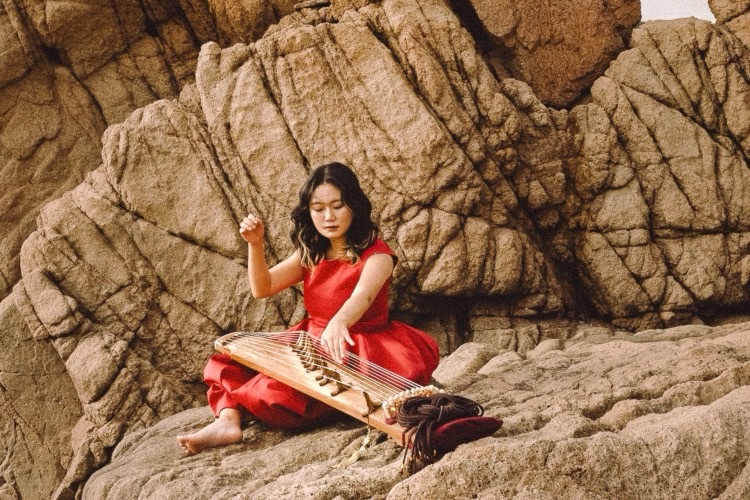

Legend tells that Korea’s plucked zither, the gayageum, was developed sometime in the sixth century by King Gashil of the Gaya confederacy. The word “gayageum” itself literally means “zither of Gaya.” But the historical record suggests otherwise. Archaeologists have excavated fragments of the instrument dating to the first century BC, centuries older than Gashil. Strangely, this apparent disconnect between mythos and fact mirrors what one finds in DoYeon Kim’s Wellspring (TAO Forms, 2026).
Born and raised in Korea, Kim is acutely aware of the gayageum’s history in her home country. Even more so, given her upbringing, including dancing to traditional Korean music, which featured the instrument. And the story of the instrument is indeed rich. It is arguably one of the most important instruments in Korean culture. It has been used heavily in court music, chamber ensembles, and lyric songs. Over thousands of years, scholars and aristocrats became enamored with the instrument’s elegant tones and how they aligned with Confucian ideals of cultivation. However, as with any long-lasting artistic approach of substance, purists have come out of the woodwork to try to limit the instrument’s use. There is a story developed over the years, partly based on fact and partly on myth, that propagates ideas of how and when the instrument should appear.
But like any modern nation, Korea celebrates its history even as it refuses to be defined by it. The beauty of its traditions remains, but society moves onward to incorporate new ideas and growth. South Korea has one of the most advanced digital economies in the world. It is at the forefront of artificial intelligence, robotics, and aerospace. Culturally, its pop music – K-Pop – has found adherents across the globe. This contemporary Korea is the one Kim grew up in, one that loves its history but looks not to be mired in it, instead forging new paths that can be charted from it. Someone with this perspective looks not solely at honoring the past for the mere sake of doing so. They look to what gave the gayageum its power to begin with; the “natural” and human-like quality of its sound and how the power of such continues to endure.
With Wellspring, Kim’s debut as a leader, she hones in on the lasting power of her instrument’s distinctive timbre. Although an ambassador for her instrument to the West, the gayageumist does not pretend to be approaching her instrument traditionally. She takes some of the techniques for playing the instrument and the great features of the music it has defined for so long and puts them in new light. Kim incorporates traditional qualities – including the use of notes the West would dub microtonal, movement by breath, and the conceptualization of her quartet’s instrumentation – in a context that ties directly into Western improvised music. The music is not fully Korean or fully Westernized but a meeting of both. As Kim notes in our conversation, “[T]his is not Korean music. It is my music.”
However, do not mistake the focus on self-expression as one of self-isolation. Especially given the powerful humanity behind her instrument, it is critically important to Kim that she produce music that speaks to the listener, perhaps as much as its creator. It certainly helps that she has tapped some heavy firepower – drummer Tyshawn Sorey, violist Mat Maneri, and bassist Henry Fraser – to pull in the listener. The result for Wellspring is an album that feels intimately personal yet paradoxically accessible.
Consider “Walking in the Dream,” where the leader chants and sings over sparse strings and drums. Most listeners will have no clue what Kim’s lyrics mean in their native tongue. Yet, they reach deeper than words ever could. The piece starts as a lullaby but quickly turns more haunting with a furtive sorrow slowly trickling out of each sung note. By the end of the piece, it becomes clear that perhaps the titular dream is less about slumber than a solemn reflection on mortality. The piece ends with lyrics that translate into “‘so happy, so loved,’ I said. And they said, ‘Lie. All a lie.’” A closing punkish torrent of fury that finally reflects a frustration with how a search for understanding has provided no clear answer.
The first of the album’s two-part closer, “Linear System,” similarly tackles the strength and failures of mathematics to explain our world. On the former, Fraser’s bowed whirs slowly move forward with Maneri’s echoey reflections before the piece hits a rapid-fire pace over which Kim’s pizzicato plucking slowly evokes a long stream of computerized data flowing before your eyes. The mechanized instrumental chant soon falls apart, leading into the second half. “Calculus of Our Souls” slowly builds from splashes of sound into a swaying dance led by gayageum. The message is clear – mathematics can explain much in our world. But we are not machines, and some of the complexities of our mere existence – the meaning of life, death, and love – defy easy calculation.
Wellspring is a powerful recording precisely because it neither blindly worships tradition nor abandons it. Instead, it looks beyond culture and technology to more fully express the emotions and questions we all share. The gayageum has historically brought pride to Korea by plucking the strings of the listener’s heart. In Kim’s hands, it still does.

PostGenre: Wellspring is your debut as a leader. What have you learned the most from working on a record as a leader, compared to a side person?
DoYeon Kim: As a bandleader, I realized how much I need to organize. Musically, being a leader is no problem. But there are so many logistics to leading a band that go beyond music. I had no idea how much work goes into marketing, designing, and just scheduling things to work. It takes so many people to get a record out. And that was a different experience from only performing. I learned a lot.
PG: Going way back, you first started on the piano before moving to the gayageum. Has that background in piano influenced how you approach the gayageum?
DYK: Of course. Playing the piano taught me how to read a score very quickly. It also made me familiar with the treble and bass and how to read music. That was a huge advantage in the very beginning of my playing the gayageum. Expressing the music was so natural because I learned the basics when I was young, under a very strict teacher. I already knew what it means to practice, to focus, and how to make one sound. Mentally, I think I was already prepared in many ways, so that when I started playing the gayageum, I had a lot of musical basics down already. And thanks to that, I was not that afraid to learn and explore on the gayageum.

PG: Understood. But was it difficult to conceptually go from the piano’s equal temperament to the microtonality of gayageum and to move from traditional Western rhythmic structures to a focus on breath?
DYK: Actually, I had learned Korean traditional dance since I was four. And, from that, I had already listened to a lot of Korean traditional music. So, it was not too difficult to understand things like microtonality and moving by breath.
For me, it was difficult to learn to play the piano with a background in listening to and dancing to traditional Korean music. Learning the piano sometimes felt like I was disconnecting from Korean music, and then learning gayageum reconnected me to it.
PG: On Wellspring, you play both the twenty-five-string gayageum and the twelve-string gayageum. How do you determine which to use when?
DYK: The technique is so different for each, and their purpose is different. The twelve-string gayageum uses strings made of twisted silk, while the twenty-five-string gayageum uses nylon inside and twisted silk on top of it. Because of this, the twenty-five-string is also significantly louder.
The twelve-string gayageum is a very traditional instrument. You cannot improvise on it. Everything is written. You can play very soulful folk music on it. Music that is for the king and the ancestors. Music that touches people’s grief or provides some form of meditation.
All the techniques for the twelve-string gayageum are different from those of the eighteen-string gayageum. And both differ from the techniques for the twenty-five-string gayageum. The twenty-five-string gayageum is normally used for modern pieces. Typically, twenty-five strings are tuned in C major or B flat major; it’s tuned in diatonic, so is much more Westernized. I don’t want to say the twelve-string gayageum is pentatonic. People say it’s pentatonic, but it is not. But the twenty-five-string is diatonic, and the eighteen-string is kind of between the two. The eighteen-string sits somewhere between tradition and modernity, so its use depends a lot on the specific composer

PG: So, when you’re writing your own music, how do you know which you want to use?
DYK: It all comes down to the particular sound I have in mind.
PG: Does singing change how you approach the instrument or vice versa?
DYK: Oh yes, of course. Before I sang, I had an incredibly difficult time because I would play with drummers or saxophonists, and they would play very loudly. They would play right over the sound of my gayageum. I had to force my body to make my instrument sound louder, and it hurt a lot to do so. I had a very hard time doing it and still struggle to. But singing gave me bravery and a better ability to be heard.

PG: Has playing over loud drummers made you especially selective about the ones you work with? Tyshawn Sorey, for instance, is among the best.
DYK: Well, Tyshawn is an incredible drummer, but I think of him as more than a drummer when we play together. He really understands the compositions. So many drummers focus on their parts alone, but Tyshawn looks at the bigger picture. He knows what’s coming in the piece and is thinking about it as he plays.
It is the same with Satoshi Takeshi, whom I also love. He actually understands Korean traditional music because he has played with many Korean traditional players. He understands my rhythmic concept and how it is very different. I also love working with Tom Rainey because of Tom’s creativity and amazing sensibility.
When I am choosing drummers to work with, I’m more focused on their sound. I’m looking for someone who can express so much with even just one tone. That is something I look for in not just drummers, but with any musician I work with.

PG: The rest of the quartet – Mat Maneri on viola and Henry Fraser on bass – are all string instruments like the gayageum…
DYK: Actually, in Korea, the viola and bass are called wind instruments, not string instruments.
PG: Interesting.
DYK: That is because they can make a long, sustained sound. If the instrument can do that, it’s considered a wind instrument. So, I’m not looking at them as string instruments. I’m looking at them as wind instruments.
But they can also pluck. My instrument is a percussive string instrument. But I also like using a bow, which makes it more like a wind instrument. So, it is a bit in between a percussion instrument and a wind one. I felt like it could be an interesting bridge between the two on this record.

PG: You conceptualize the ensemble using concepts from traditional Korean music, yet you also embrace Western improvisation. In your career thus far, have you faced objections from purists who believe the gayageum, especially the twelve-string, should stay in traditional contexts?
DYK: Oh, of course, of course. Some people say what I am doing is not Korean music. To which I say, “Yes, this is not Korean music. It’s my music.” While I respect and honor the tradition, I play the music that is true to me. Sometimes that takes from tradition, and sometimes it doesn’t. But, ultimately, I can only be myself.
PG: Do you remember how you first found out about free improvisation and free jazz?
DYK: No, actually. When I was in Korea, I wanted to go to America to learn more new music. I wanted to extend my musical language. At that time, I had no idea that improvisational music even existed. But when I researched the top ten music schools in the US, at that time, the New England Conservatory (NEC)’s Contemporary Improvisation program was the only place where I could audition for performance on my instrument. All the other schools said I could play the gayageum only if I focused on ethnomusicology. But that is not what I wanted; I did not want to become a scholar. So, while I didn’t know much about improvisation, I figured I would give it a try. At least it would let me keep playing.
PG: With that in mind, you had studied with Joe [Morris]. Did you learn anything from him about performance technique that carried over to the gayageum even though he is primarily a guitarist and bassist?
DYK: He taught me how to better perform, but in a way beyond just technique on the gayageum. When I started with him, it became clear that I needed to be more open. What could I do to open my heart? Opening up my heart is the first step because improvisation should be honest. If you are wearing a mask, the inauthenticity is apparent. It was not obvious at first that I was learning how to open myself up more, but as I continued to improvise, it became obvious to me how I needed to be more mentally prepared so that my mentality, my soul, and my thoughts – the reality of who I am – come through the music. And Joe helped me significantly with doing that.

PG: Did the dearth of gayageum players – people you can look up to on your particular instrument – in Western improvised music make it easier or more difficult to find your voice on the instrument in an improvisational context?
DYK: I cannot say which. I think that we are each searching for that one bluesy note, throughout all our lives. Being a master of your instrument is a lifelong study. And finding your path to it takes everything in your life. Both on your instrument and on others. Things outside music entirely too,
While there aren’t many improvising gayageum players, I draw a lot of inspiration from outside the instrument. I love twentieth century [Western classical] music. Before I studied with Joe, back in Korea, my teacher would tell me how some of the things I was playing were wrong. They sounded cool, but they were technically wrong to my teacher. Joe is the first person who said to me, “Oh, that’s one way to go, and it’s great, but let’s try it this way too.” That was, to me, a redefinition of music, how to learn music, and what it means to read music.
PG: What is your process then for composing your own music?
DYK: Each piece is very different. But, generally, first I research a lot. I make a map of what I want to say first and the meaning behind it. Sometimes, I write in descriptions, and once I am sure of my purpose with the music, writing the music itself is not that difficult.
PG: What does your notation look like? Given the emphasis on breath and microtonality, it seems it may be easier to incorporate things like graphic notation.
DYK: I have used graphic notations before. But with everyone here in New York so busy, I feel like it is more effective to write down ideas with as much detail as possible. For a group like the quartet, it is more realistic to write out using traditional notation.

PG: As a final question, the press material for Wellspring features a quote from you that reads: “I wish people hearing this music [receive] energy and comfort. I want to be there with them.” Some composers do not care about the listener, Milton Babbitt most famously. But it sounds like you reject that perspective. How important is the listener to your work?
DYK: Above all else, I talk to people when I perform. I think things should be different in this regard between when you practice and when you perform. People come to listen to my music. They spend their time, energy, and money to come hear me, and I want to be the best I can. As a musician, I deeply appreciate them coming to listen because it means they care. It means they are thinking. I also realized at some point that I cannot live in isolation. We need a society. We need people to be able to live peacefully together. That is how we all survive. It is how we all develop. It is how we, as humanity, go forward. There is so much meaning in that, and I hope my music can help.
‘Wellspring’ is out now on TAO Forms. It can be purchased on Bandcamp. More information on DoYeon Kim can be found on her website.
Photo credit: Hyun Park