

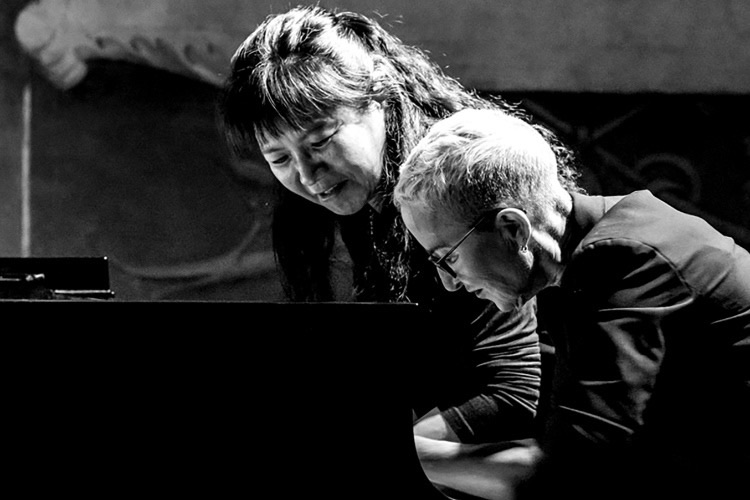

In the Internet Age, we are continually surrounded by words. Statements inundate our every waking moment. But it is rare that the language carries weighty significance. Instead, we are often bombarded with a constant stream of self-serving and aggrandizing thoughts. No wonder our world is a mess. But even amongst the barrage, sometimes essentials can emerge. A listener can better develop as a person by heeding the uncommon, meaningful message sent their way. When such occurs, the dialogue becomes something broader as well. It adopts the careful listener as a silent yet vital additional voice in the conversation. And when it does, the initial statements become larger than their parts. That is certainly the case with pianists Satoko Fujii and Myra Melford’s Katarahi (RogueArt, 2026).
Although Melford and Fujii both play the same instrument, their respective approaches to its keys – and in some instances, the strings inside- are markedly different. Melford often provides a musical parallel to one of her visual art inspirations, Cy Twombly, in that her music reflects the bold bodily action of an abstract expressionist work. Her music blends the lyrical with lively flurries of notes. Fujii’s work tends to be more angular, textural, and percussive. If each artist were heard in isolation, their voices would be fairly readily identifiable. One would expect their pairing, particularly in a live setting where there is less room to hide or manipulate, to be two idiosyncratic voices continually bouncing off one another. Yet, that is not what one finds on Katarahi. Instead, the album finds them merging their distinctive voices into a single unified whole. Neither gives up their uniqueness, yet finds a common ground with one another. Sounding as if one extended instrument, their conversation is given prominence over its speakers. But, besides their masterfulness as artists, how do they so seamlessly come together? There are really two answers to the question.
First, while both artists excel at free improvisation, for the 2024 Jazz Festival Leibnitz performance captured on Katarahi, they forced some structure on their conversation. This came about by each bringing in original compositions to explore together. Some of the pieces were older, recontextualized for their new setting, while others were new for the duo. But all of the pieces have one thing in common – an openness for growth and expansion. The constraints of precomposition are intended not as restraints but merely as points from which each pianist can stretch and build while ensuring neither travels too far away from the other. This approach differs from the greater freedom found on Fujii and Melford’s prior duo recording, Under the Water (Leo, 2009), but it pays off well.
Melford’s “Chalk,” a piece she has also recorded with her Splash Trio, starts as a contemplative reflection of an experienced past. As tempo increases, the artists’ form lines that bouncily spiral and swirl around one another, never quite giving up the underlying melody but instead covering it with a haze, perhaps asking if things were truly as remembered. Fujii’s spikily edged “Signpost” so deftly revels in point and counterpoint and mirrored lines that one would be excused for thinking it is performed by some fantastical four-handed pianist. Even in its most tempestuous moments, the whole piece feels unified.
Part of the singularity of the artists’ voices inevitably also comes from the fact that the composition is used solely as a topic of conversation between two friends. As noted above, Katarahi is actually the duo’s second recorded outing. But in the fifteen years between records, they have continued to converse both on and off the stage. Both in and out of musical creation. Their bond goes back even further to 1994. One cannot help but sense the intimacy of a conversation between old friends – moments of laughter, hushed secrets, comforting of sorrows, and shared celebrations of triumph – on Katarahi. The pianists even swap instruments mid-performance, a sonic affirmation of the reciprocity of their feelings for each other. The album’s title – the Japanese word for a heart-to-heart conversation between close friends – is incredibly apt.
But so too is the album’s use of silence. Despite all the tones at their disposal, the pianists do not nervously fill the air with sound. They allow fragments of their conversations to be wrapped in silence. They allow for space to emerge organically. Like true friends, Fujii and Melford take comfort in their time together, in which presence itself can sometimes say far more than words ever could. And they graciously invite the listener to join them. While precomposition plays a prominent role on Katarahi, the album’s true power lies not in delicately crafted pieces or the mastery of live creation but in the openness to engage listeners in a dialogue that goes far beyond, and much deeper, than a recorded medium.
We sat down with both Fujii and Melford to discuss Katarahi and how their friendship manifests into sound.
PostGenre: Katarahi was recorded in 2024, fifteen years after your first duo album together, Under the Water (Leo, 2009). How do you feel you have both changed the most over the almost two decades, and do you think that can be heard in the new record?
Satoko Fujii: Well, time flies. I can’t believe the last one was already fifteen years ago. But we played together a lot during those years, even if it ultimately wasn’t recorded. So it’s not really like we have a gap between the two.
Myra Melford: I would say that after we made the first record, we started to introduce compositions. We found that using compositions was a good way to focus on how we like to play, both separately and together. We have been evolving in the meantime, determining which compositions work well for two pianos and how we play them.
PG: Do you feel your shared background in classical music may explain part of why you feel more comfortable using compositions as a base, instead of fully free improvisation, when you perform as a duo?
SF: For me, improvisation and composition are different, but the same. There are several ways to make music. But having a composition makes things clearer somehow. Myra brought some of her beautiful pieces this time. I was so inspired by the pieces. I played the themes and they then gave me room to create for myself. It’s a very special thing to have written compositions to work with.
MM: I think a prewritten piece can be helpful because it provides a common focus. When a duo freely improvises, there is less of a shared starting point. But when you have written music, you have material that you can use as a point of departure that’s common to both of you. To me, that’s the real benefit of having the compositions. It is also a lot of fun to play each other’s music.
PG: How did you decide which compositions you wanted to play for the performance captured on Katarahi?
MM: I think we have slightly different answers for this, but personally, I wanted pieces that wouldn’t require a lot of rehearsal because we didn’t have a lot of time before the performance. I wanted compositions that provided minimal material but which would also be enough to hopefully inspire us creatively while leaving significant room for open improvisation or free interpretation.
SF: I agree. I knew I didn’t want us to only follow the written compositions but to instead use them as a starting place for expressing our own feelings. I wanted to make sure the compositions I chose were those that already allow for a lot of freedom but were also not so complicated that we couldn’t use them as a base.
PG: The approach worked well. It is incredible how you are often able to make your distinctive voices form one unified sound, as if it came from a single extended instrument. You both like to use extended techniques on the piano. Does incorporating non-conventional methods make it more difficult to create the effect of sounding as one instrument?
MM: Satoko, did we both play inside the piano or did only you? I don’t remember.
SF: You know, I actually cannot say for sure. For some parts of the album, I can tell if I am the one playing a certain part, but often I cannot. That’s the fun part, I think. We really make one thing together. We just follow the music instead of each of us following our own separate voices. I feel like we just follow the music.
MM: I totally agree with that.
PG: Both Under the Water and Katarahi were recorded live. Do you think the live setting may make it easier to follow the music compared to if you were in a more structured studio setting?
SF: Since we’ve never played together in the studio, we cannot compare.
MM: But I do think that recording live is generally better because it means you can’t go back and fix things after the fact to sound a certain way. Instead, you are fully feeding off the energy of an audience. There’s something incredibly immediate about playing live that I find very exciting. And that something is not always possible to capture in the studio.

PG: But do you feel it was more difficult to create that aesthetic before a live audience, where the listener can see your motions and how you are playing, compared to on a recording, where full reliance is placed on hearing?
MM: I think it would have been easier for the audience to distinguish between our parts to the extent that they could watch our body language.
PG: And perhaps they could more readily identify based on some of the subtleties of the different pianos, since they can see which one you are playing.
SF: The idea to change pianos simply came from how we both wanted to play both pianos. We decided to switch just so we could play each of them.
MM: It also seemed like a fun idea, from a dramatic, theatrical standpoint, to switch mid-performance. It was actually challenging for us to switch them because we sit at very different heights. I like to sit lower, and Satoko likes to sit higher when she plays. So, we had to ask one of the stagehands to also move the benches for us.
But even with an audience who could see us, I don’t know from the sound in the room how easy it would have been for them to distinguish between our parts. I think we were each on a different channel, but because it was open, our sound must have been going into each other’s mics, and difficult to separate. That might contribute to the fact that we sound like one thing.
PG: Do you feel your longtime friendship also contributes to obtaining that singular sound?
MM: It’s hard to know for sure because we have been friends for such a long time. I will say that I’ve gotten to know Satoko so much better over the years. That’s another thing that’s changed between the first recording and the next one. I also know her playing even better now and have formed my better ideas on how I want to interact with her. That’s really evolved for me.
SF: Now, we know each other a lot. But the big thing is that we also know how different we are from each other. Basically, we share many of the same values about music. But we also say things differently in music. We understand each other well because of how we share the same values, even if they don’t result in the same sound.
PG: That friendship also goes back a long time, to when Paul Bley first introduced you back in 1994. Do you feel Paul’s influence can be heard on Katarahi in some way?
SF: I studied with Paul, so he was a big influence on me. But more in terms of idea and philosophy than a particular sound. There is no piano technique or certain materials that I can really identify in my music as coming from him, even though he was a big influence on me. But, of course, when I make music, I don’t think about my influences anyway. They just naturally come out in my music.
MM: I never studied with Paul. I listened to his music a lot and met him several times, including when he introduced us. But I studied with other people who were very important mentors to me. But for my mentors, the idea has been to never play like them, but instead to use what they taught me to play better like myself. Both Satako and I have been fortunate to find our own way to play, even though we are grateful to the people who inspired and mentored us.

PG: Are there other duos that have inspired your work together?
SF: For me, not really.
MM: Me neither. When I think of different piano duos that I’ve listened to, people like Cecil Taylor and Mary Lou Williams, or some of our contemporaries, what we do is pretty different.
PG: Part of that may be how your duo incorporates silence. Satoko’s pieces “Signpost” and “Kaiwa” put a significant emphasis on the Japanese concept of Ma, the use of space and pause.
SF: I always think about Ma, not only on those two pieces. Silence is an incredibly important part of music. Notes and silence are equally important, but most people forget about silence. They only follow sound. We definitely need more silence.
PG: Is it more difficult to ensure silence in a duo piano context compared to a different setting?
SF: The piano has eighty-eight keys, and two pianos means double. Obviously, we have twice as many notes across four hands with two pianos. So we have to be careful. If we don’t focus on silence, we would probably end up without it. But it is worth the additional work. Silence is essential.
‘Katarahi’ is out now on RogueArt. It can be purchased on Bandcamp. More information on Satoko Fujii and Myra Melford can be found on their respective websites.
Photo credit: Michele Giotto





Leave a Reply