

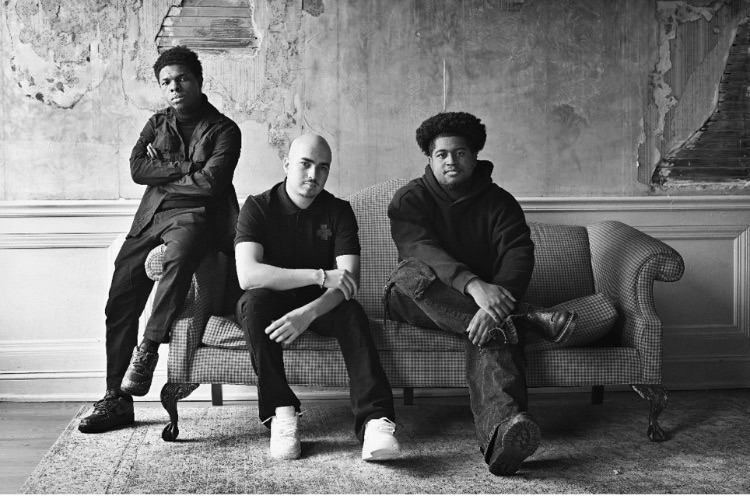

The chordless trio, and especially the saxophone trio, continues to thrive in increasingly adventurous ways. New Jazz Underground (“NJU”), a viral internet sensation of saxophonist/vocalist Abdias Armenteros, bassist Sebastian Rios, and drummer T.J. Reddick, has successfully tapped into a new, younger audience, attuned to the internet and YouTube. The three united during the COVID-19 pandemic to perform in open-air spaces as a way to cope and survive. Their trajectory has been more than impressive, peaking with an appearance at the 2025 Newport Jazz Festival. Now comes their first album, Hoodies (Artwork, 2026)
These three are a thoughtful bunch, too. The title Hoodies immediately evokes hip-hop and Black street culture but the trio attaches more meaning to it as well. The apparel connotes the casual nature of youth amidst an older jazz community generally far more comfortable in suits. The word is also an extension of “hood,” short for “brotherhood,” which these three deeply embrace. Finally, there is a power and call for social change behind the title given its association with Black youth, including Trayvon Martin and “Reefa” Hernandez, two men of color whose lives were taken as teenagers.

All three members of the trio come from Juilliard, bringing a masterful understanding of the musical tradition, which the trio embraces while merging it with Afro-diasporic popular music, including hip-hop beats. These different strains find an equal footing throughout Hoodies, even within a single track. The album has two conceptual halves, mostly authored by bassist Rios, the band’s primary composer, producer, and creative force. The first marries tradition with the contemporary, while the second half forms an unconventional blues suite, conveyed via modern jazz language. Make no mistake. There is nothing casual or offhand about this music. It’s sophisticated, well-crafted, and bears underlying emotion.
The album appropriately commences with “Oney Ones One,” a piece that addresses Black American music in reverse chronology. The opening groove speaks to hip-hop. The mid-section purveys a contemporary R&B sound, and the final third reveals a hard-driving traditional swing. NJU says this, “acknowledging modern influences while declaring swing as the core truth beneath it all.” “Pseudo Latin Vibe” a nod to the trio’s ties to Miami, features excellent drumming by Reddick. The Afro-Cuban rhythms are often subtler than they appear in this piece. On “Sidetracked,” Armenteros switches to soprano sax to give life to one of Ríos’ beautiful melodies. Meanwhile, the bass-drum tandem delivers beats that sonically fill some space between the conventional kit and the drum machine.

The trio dedicates “Ghosts,” a ballad, to lives lost during the COVID-19 pandemic, particularly mourning those whose roles within the jazz community often go unrecognized: the listeners, the audiences, the supporters, and the mentors. The piece has two parts, the first is intimate and reflective, while the second is open and expansive. This track also features special guest pianist ELEW (Eric Lewis), whose judicious chords and notes add calm and a reflective posture. “Hold My Halo (Paint Me Perfectly)” is epitomizes the marriage of tradition with the contemporary, as Armenteros swings mightily on the tenor, to the robust rhythms of his trio mates.

The blues segment begins with “Las Salinas (Prelude),” a lustily struck bass solo by Rios, running for over three minutes. “Luci and I,” a fully trio rendered piece, features poignant tenor and inspired bass playing. The second movement, “Tell Me How You Do,” introduces Armenteros on vocals. He sings with a natural, raw delivery and an inherent feel for blues phrasing. It deceptively complex rhythmically, including a 5/4 second-line feel, swing, and a driving instrumental 7/4. It could be the trio’s way of stating that the blues belong in modern culture. Similarly, “Hoodie Jig,” the third movement, presents bluesy saxophone lines over a mix of looped and Afro-Cuban rhythms. We hear hints of spiritual jazz in “Atonement” with riveting kit work by Reddick. “I Had to Let Go” is so lyrically expressive that Armentero’s tenor equates emotively to the human voice. The saxophonist returns as a vocalist on the closer, “Sake of Love,” far more in the jazz oeuvre than blues, as articulated both vocally and through his soprano.
Above all else, Hoodies shows why the New Jazz Underground is a “hot” band that will appear on many festival bills in the coming months. But they did not need this recording to introduce themselves. If nothing else, it cements a reputation that preceded them. Where the great jazz wars of the 1980s showed a division between tradition and modernity, with Hoodies, the NJU excels at showing that both are ultimately two equally lengthened draw strings sides on the same shirt.
‘Hoodies’ will be out on Artwork Records on May 29, 2026. You can also read more about the story behind the album in this interview with Sebastian Rios before the trio’s performance at last summer’s Newport Jazz Festival
Photo credit: Kasia Idzkowska