

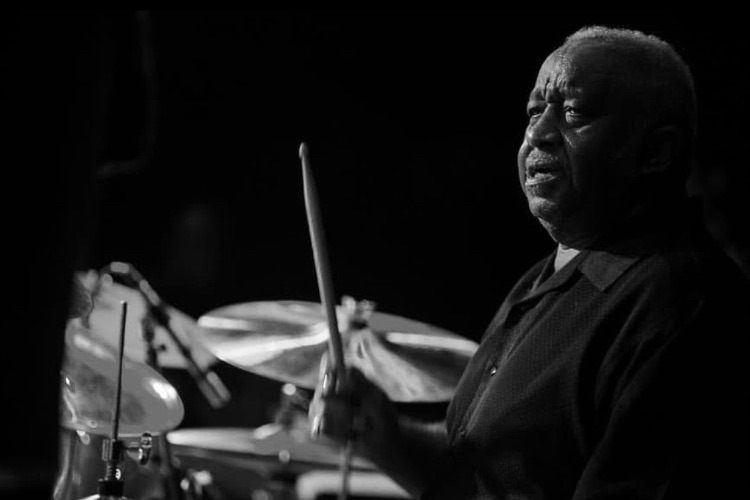

In a recording studio sat a drummer behind his kit with two signs hanging nearby. One read “You done it.” The other: “You done hired the hit-maker, Bernard “Pretty” Purdie.” For anyone unfamiliar with Purdie, the verbiage would seem bold, if not arrogant. But for those familiar with his work, it sounds more like accurate reporting. As a sideman, his fingerprints are all over the grooves that comprise modern music across all genres. James Brown’s “It’s a Man’s, Man’s, Man’s World,” Aretha Franklin’s “Rock Steady,” Steely Dan’s “Deacon Blues,” and The Isley Brothers’ “Freedom” are only the beginning.
He has literally thousands of credits before even considering how his trademark “Purdie Shuffle” of triplets over a half-time backbeat has shaped generations of other drummers. The groove, or a variation thereon, has been borrowed by countless musicians including Jeff Porcaro on Toto’s “Rosanna,” John Bonham on Led Zeppelin’s “Fool in the Rain,” and Stewart Copeland on The Police’s “Walking on the Moon.” But when you have recorded as frequently as Purdie, some weird things start happening when people are assessing your output.
For one, the outer bounds of the artist’s work are sometimes thrown into question. Purdie’s record has become somewhat muddled with reports of artists he did and did not work with. The most notable of such examples is how Purdie has claimed to have recorded with the Beatles while some historians have argued he is mistaken. To some extent, arguments on the veracity of the claims overlook a far more salient point. The mere fact the claim is not facially ridiculous is a testament to both the sheer volume of Purdie’s output and how essential his drums have been to the popular music landscape.
But even limiting oneself solely to the recordings unquestionably in Purdie’s catalog, another problem arises. How can one fully assess his output when there is so much to listen and experience? As such, far too often even some of his best music goes woefully overlooked. Most people point to his work with Aretha, Steely Dan, King Curtis, and others worthy of celebration. But far too often lost in conversation are his collaborations with proto-rappers before the birth of hip hop. Or his serious jazz bona fides, having teamed up with over forty NEA Jazz Masters, including Miles Davis, and countless others. Purdie has even worked with some of the most significant names in jazz’s avant-garde. It is our hope with this conversation to dig a little deeper into some of these corners.
But, perhaps most importantly, the love of rhythm that once drove the child Purdie to hitting cans with sticks and eavesdropping on lessons still keeps him going. The rhythmic flame inside continues to blaze brightly even late into his eighth decade. He’s still performing and recording, as both sideman and a leader. And he’s not afraid to reach for the newest sounds even with artists young enough to be his grandkids. We sat down with Purdie ahead of his Newport Jazz Festival debut as a bandleader on July 31, 2026, and his guest appearance with Vulfpeck the same day.

PostGenre: 2026 will be your first time performing at Newport as a leader, right?
Bernard Purdie: Yes. I performed with Aretha Franklin at the Newport Jazz Festival [New York in 1973]. I also played at Newport with Dizzy [Gillespie] back in the 80s. I was with Dizzy for two years in the 70s, and we got together for a few performances in the 80s. I had a real ball being in his band. A marvelous time. But this will be my first time at Newport as a bandleader. It’s my band now.

PG: As someone who is himself a history maker, what does it mean for you to play at such a historically significant place under your own name?
BP: It’s an honor. It’s also wonderful because I had the chance to play there as a leader quite a few years ago when I was Aretha’s bandleader. I had my little small band at that time, a trio. But the performance didn’t happen. It is a wonderful feeling to have this opportunity now.


PG: Of course, you have been incredibly busy in the years since that trio.
BP: From that trio, I just kept working. There were ten to fifteen different major acts that I started playing with around the country right afterward. And then I toured around the world. It was good for me because I got a chance to work with a small band, a medium band, and then a big band. I was able to do all three because I worked with Galt McDermott. I worked with him for thirty years. Galt wrote not only Hair, but twenty other Broadway shows too, and I played with him in them.
And I can’t complain because everything worked out really well. I also taught at the New School in New York for twelve years. I had a wonderful time. I was local and, at the same time, I was worldwide. I was going back and forth to so many different countries. Then I got married again. My wife and I moved out of New Jersey to North Carolina.
PG: Why North Carolina?
BP: A friend of mine wanted me to play in a new club they were opening there. The whole thing ended up not working out. And now my wife and I are back in New Jersey. Three years later, we’re very happy and are moving into a new place in three weeks. Things are good. I’ve been having a great time playing with so many different little groups and all. I’m tickled pink.
I’ve kept working constantly, writing and making things work for myself. And I’m back to my old band again, which also has Rob Paparozzi. I’ve worked with him as a partner for twenty-five years. He used to be with the Blues Brothers and the lead singer of Blood, Sweat and Tears. And then he came back with me. We’re having a ball.


PG: It sounds like long-term relationships mean a lot to you. When most people think of session work, they typically think of more short-term relationships. Do you feel there’s something special musically that comes out of those long relationships that shorter ones may not generate?
BP: You can form special relationships even with shorter-lived groups. That’s what I’ve done with almost everyone that I’ve played with. Whether I played two months or two years with someone, the length didn’t matter. I got in with them, and did so many jobs working and having a good time.
And I picked up a few awards along the way. The awards I have received in the last few years have been essentially dynamite. Living Legend Awards. And I’ve never stopped recording. I’ve been recording for close to fifty years now and just never stopped.

PG: As far as recognition, you have been a part of so many hits that you are even known as “the hitmaker.” But you also recorded a lot of fantastic music that didn’t get that level of recognition. For instance, many people overlook that you recorded with Miles Davis for Get Up With It (Columbia, 1974). Especially seeing as this year would have been his hundredth birthday, how did you get connected with Miles?
BP: Well, when I was with Dizzy Gillespie, Miles tried to get me to go with him instead. I told Miles no because I had committed to Dizzy, who had asked if I would stay in his band for at least two years. When my time with Dizzy ended, I told Miles that I appreciated his offer, but while I could record an album with him, I couldn’t join his group. I had already committed myself to two or three other bands by then. I was also teaching in Long Island, New York. I ended up traveling back and forth to Jamaica and made records with people in the islands. I was constantly busy. I worked with B.B. King for about a decade, too. I was working with so many bands. I just didn’t have time to join Miles’ band even though I had time to record a little for him.

PG: Are you ever surprised by the music you recorded that was not a huge hit when it came out, but years later has heavily influenced other artists? Going back to Get Up With It, it is not one of Miles’ best-known records, but Flea, who is also performing at Newport this summer, cites it as an influence on his trumpet album. It seems sometimes it takes a while for some music to be fully appreciated.
BP: That’s right. And that recording with Miles was one of them. The day we recorded, Miles didn’t even show up to the recording studio until eight o’clock that evening. We had already pre-recorded the album.
I have recorded over twenty thousand different records. In the beginning, I kept things kind a little low key and told people that I was on over ten thousand records. I later found out that the number was actually more than twenty thousand. I’ve had a wonderful time being able to say that “Yes, I’m the most recorded drummer in the world.” I didn’t know that I was until the union told me. The union won’t let you go. And that’s how I stayed out there around the world. I have recorded for so many different acts around the world for almost forty-five years. And it’s been a joy. Many of those recordings have been huge hits. For some others, it took a while for audiences to catch up.


PG: What about your perspective when recording; could you see the overall trajectory of where music was headed? For instance, you were on Gil Scott-Heron’s Pieces of a Man (Flying Dutchman, 1971) and on the Last Poets’ Delights of the Garden (Douglas/Celluloid, 1977). Both predated hip hop, but looking back, one can see how hip hop developed from their work. Did you have a sense at the time that hip hop was on the horizon?
BP: Everything I played on worked for me. Whether it worked a month later or a year later, the records got made. They got made, and they got put out. My name was there with all the different groups that I had played with.
Of the different artists that I worked with, some were big names. Some weren’t. Some were recording at just the right time. Some were early but could see what was coming. But one thing they all have in common is that I’ve had the luxury and the joy of being able to say that playing with them has helped me not lose my mind over different things that were happening around the world at the time.
I’ve fixed records. Oh, I’ve fixed a lot of records. But the beauty of it all for me is that I have had the opportunity to be around for over fifty years of recording. And I still absolutely love it. I am super thankful that the man upstairs is keeping me working, keeping me alive.
PG: Since you mentioned God, you also grew up in the church. Do you see music making as a spiritual act?
BP: I’ve never looked at it as a spiritual act. I’ve just made the music, and enjoyed it. But I’ve always been spiritual, no matter what, because I learned how to listen to the music that I was hearing. And that let me always play every genre of music.
PG: Do you feel you approach performance in each genre differently in some way? In your book [Let the Drums Speak (Hudson, 2014)], you refer to them all collectively as “dance music.” Are they all one thing to you?
BP: All music is one thing. Everything you could possibly think of in terms of music is all one thing. Every one of them is a concept, and you learn the craft. I have played every style of music there is to be played. Jazz. Blues. R&B, Pop. Funk. Rock. Classical. Gospel.

PG: You even recorded with Gabor Szabo when he was exploring the connections between jazz and Indian ragas [on Jazz Raga (Impulse!, 1966)].
BP: You’re right. I’ve even done country music. People are usually surprised when I say that I play country music too. But one of the first things I ever did was country music. The point is that it’s all still music. And it all still works. When you learn the craft, how are you going to go wrong? I’ve never looked at any genre as being more important than any other. I’ve never looked at it any other way than that it is all music. And I’ll play any of it. Just ask.


PG: It would seem the commonality of a lot of your work is the emphasis on groove. Most people would likely be surprised to hear that you also worked with some avant-garde titans. Although the records you were on are more infused with R&B influences than much of their other works, you were on Albert Ayler’s New Grass (Impulse!, 1968) and also Archie Shepp’s For Losers (Impulse!, 1970) and The Cry of My People (Impulse!, 1972). Was your working in those contexts a message that you can still play freer without abandoning groove?
BP: Mm-hmm, exactly. And I’ll never stop grooving as long as the man upstairs keeps me alive. I owe it to him. Everything that you just asked about, I intend to keep on doing it in any way, shape, form, or fashion for as long as I am here. That’s why people still call me for music. And that isn’t limited to any genre. Actually, the Purdie Shuffle comes partly from country music and look everywhere it has been used.

PG: It is interesting how often people discuss the Shuffle when they talk to you, but do not dig much into its origins. It was inspired by the rhythmic patterns of the train going by when you were growing up. Do you typically take rhythmic inspiration from non-musical sources?
BP: Well, the Shuffle is a major thing. It has come from, and still goes, because of the train. I’ve been teaching the Shuffle for over fifty years. And folks learning about the Purdie Shuffle come in thinking it was simple. It is not. It is not simple. It’s not easy. It is a certain pattern to make things work and keep people focused on what they’re doing. The Purdie Shuffle will always be the Purdie Shuffle. That isn’t going to change. It is at one particular tempo and time in the field.
But, after playing it for so long, I started thinking more about where it came from. It came from my hometown of Elkton, Maryland, where trains stopped often. Hearing the train inspired the Shuffle. And now, I have a huge mural dedicated to me at the Elkton Community Center, because I’m a local boy. It is absolutely wonderful. And I still, all these years later, love music. That’s why I’m able to give lectures around the world.
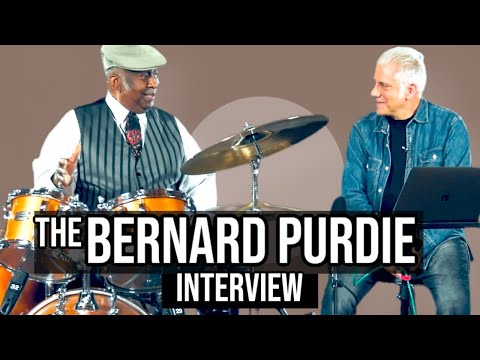

PG: You gave a clinic at Antone’s here in Austin back in 2019. It lasted only maybe an hour, but it was fantastic. You shared so much knowledge in it.
BP: Yeah. And I’ve been doing that since I was four years old.
PG: How do you feel your relationship to music has changed the most over the years?
BP: Oh, it’s changed because the record business changes all the time. The business is always changing. But I learned long ago to never underestimate anybody at all. And I’m still having a ball.
Next week, I am going to be joining the band, Deputy Dan. And I’ve been working with [Ken] “Stringbean” [Sorenson] too.

PG: To mention another group of younger musicians, you will also be performing a few songs with Vulfpeck as part of their set at Newport. How did you get connected with them?
BP: They called me. [Vulfpeck’s bandleader] Jack Stratton is a major fan of mine. I ended up playing with Vulfpeck at Central Park with five hundred thousand people in the audience. And then we went to the Brooklyn Bowl. It was all phenomenal. Some people said to me, “But Purdie, you didn’t know their music.” Know their music? Write it down. Write it down and interpret it. That’s part of the job. And it just so happens that the band is very, very flexible. And they also know music from fifty, sixty, or seventy years ago. They play jazz, R&B, pop, country, rock, all of it. Whatever the songs are that people want to hear, they can do it. Which is why they are so successful.
When they asked me to join them, I was honored. I love what they do and the kind of music they play. I have no problem whatsoever playing whatever music they want to because that is exactly what I have always been doing since I started playing music when I was two years old. And I’ll have a wonderful time doing it – just like I always have.
Bernard “Pretty” Purdie will be performing at the 2026 Newport Jazz Festival with his own group, and with Vulfpeck, on July 31, 2026. You can read more about the Festival here. Stay tuned as we continue our extensive pre-coverage of the event. We will also be providing live coverage from Fort Adams. You can learn more about “the hit-maker” from his website. You can also read his autobiography, ‘Let the Drums Speak.’
Photo credit: Dave Burke


Leave a Reply