

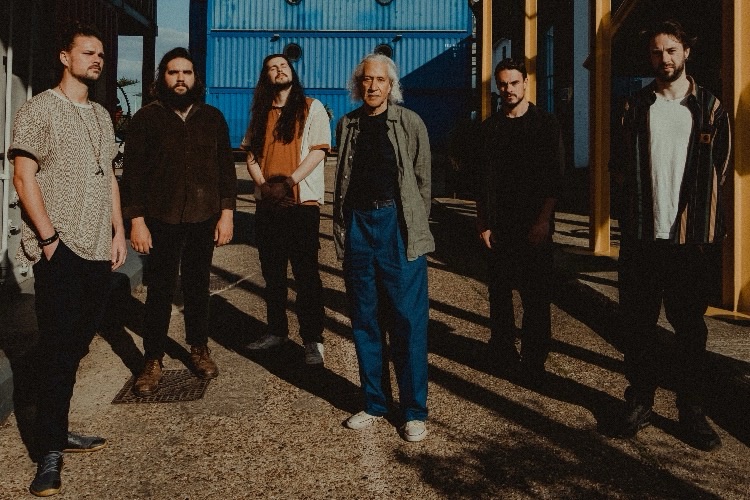

Even well into the second half of his eighties, Gary Bartz remains one of the most powerful and evocative alto saxophonists playing today. He has consistently proven that he can thrive in almost any situation. This author can personally attest to Bartz’s jaw-dropping solos. Recognizing his skills, Brownswood Recordings paired him with a new collective emerging from London’s jazz scene, Your Brother’s Keeper. The label’s intention to place the NEA Jazz Master’s sound within a contemporary next-generation soundscape, resulted in Where Rivers Meet (Brownswood, 2026).
The roots of the album’s collaboration trace back to 2019, when broadcaster and Brownswood founder Gilles Peterson invited drummer/producer Jake Long to have the septet Maisha to back Bartz for a performance at the inaugural We Out Here festival, followed by a concert at London’s Royal Festival Hall. The meeting proved instantly powerful. An album followed in 2020 on the Night Dreamer label. In a sense, Where River Meet builds off of this backdrop.

But Where Rivers Meet reflects a new collaboration, with a collective assembled by drummer/producer Jake Long that includes Ali MacSween (piano, synthesizers, and modular FX), Axel Kaner-Lidstrom (trumpet), Twm Dylan (double bass), Tim Doyle (percussion), and Chelsea Carmichael (tenor saxophone). The set revolves around loosely composed music, with an emphasis on improvisation and inventive use of electronics. At times, Bartz’s playing is processed live through modular synths, with additional shaping in post-production. But beneath the patches and filters lies mode based improvisations. Some new compositions were brought into the live-in-the-studio sessions, but many had grown out of an earlier improvisation the group shared with Bartz several months prior. As Long relates, “The band … arrived early to get everything ready, so by the time Gary walked in, there was already a microphone patched through the modular system. Within moments, Gary had his saxophone out and began playing. As he explored and reacted to the cascading granular delays and pitch-shifted sounds coming from the modular, it was clear that this was the direction the record should take.”
The saxophonist’s distinctive lyrical sound and superb tone remain front and center on Where Rivers Meet, with electronics mostly subtle. But do not mistake the album as a group of musicians supporting a soloist. A full-fledged ensemble is at play here. Bartz’s warm, full-bodied voice is heard from the outset on the opener, “Cauldron,” a ballad with plenty of tension, release, and spaciousness. After about the minute-and-a-half, Long’s drumming establishes a tribal groove, as the piece moves toward a mid-tempo replete with synths and the full ensemble. The spacey, floating “Ground Loop” proves as much a feature for trumpeter Kaner-Lidstrom as Bartz. So, too, does the tantalizing slow-building “Eclipse.” There’s a keen sense of alignment between the two.

Afrofuturism, a staple of the London scene, is best exemplified in “Solar Flare.” The piece epitomizes the marriage of the spiritual and cosmic, boosting the energy level several notches higher. “Locris” is more lyrical, resting on a pendulum that swings between soul-jazz and neo-soul, with feisty turns from the altoist and the trumpeter amidst experimental electronic sequences. The ensemble reaches its apex on “Petricor” with Bartz emerging from a bubbling cauldron of sound much as sunlight splinters through mist. The closer, “Mantra,” the lengthiest piece at over nine minutes, bookends the opener with its balladic tempo and sustained horn lines lying over a synth-heavy backdrop. Tenorist Carmichael is more prominent here than on the rest of the album, with her and Kaner-Lidstrom serving as viable foils to Bartz.

It is easy to see the title of Where Rivers Meet as a nod to Bartz’s enduring composition, “I’ve Known Rivers.” It certainly shares the socio-political power of the older piece. But the title also suggests more. It also reflects the bridging of cross-cultural splits, whether caused by a wide ocean or generational divides. Chalk up the experiment of Where Rivers Meet as a major win for all involved.
‘Where Rivers Meet’ is out now on Brownswood Recordings. It can be purchased on Bandcamp.
Photo credit: Karolina Wielocha


Leave a Reply