

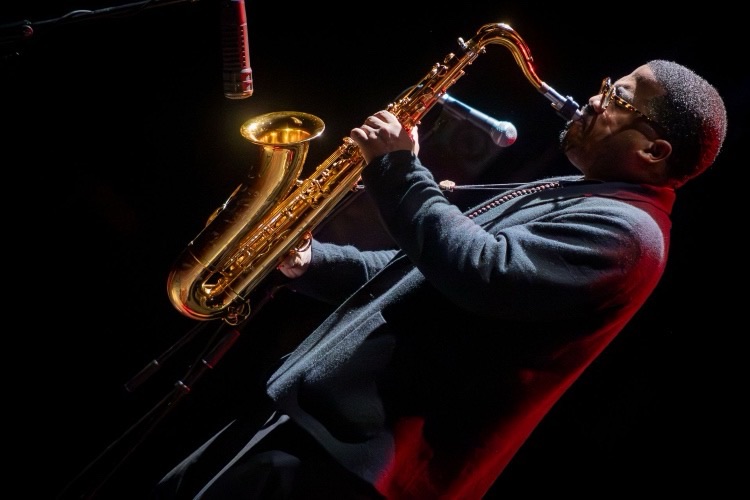

In 1957, composer-educator Gunther Schuller coined the term “Third Stream” to describe music that fully integrated elements of both the Western “classical” and “jazz” traditions. Schuller was unambiguous that his perception was not a mere fusion of two artistic lineages, yet generations later many have treated it as such. A freely improvised trio augmented by strings is suddenly purportedly the form of which Schuller spoke. The term’s overbreadth obscures Schuller’s original intention. But his concept itself rests on a flawed premise: that “classical” and “jazz” are inherently separate worlds that occasionally meet. The labels themselves are both nebulous and reductive. Consider how “orchestration” and “notated composition” are purportedly only “classical” elements. While it is unlikely saxophonist James Brandon Lewis set out to eradicate the flawed concepts behind “Third Stream,” one cannot help but feel that Calling Antonín (TAO Forms, 2026) does precisely so.
From afar, it is easy to describe Calling Antonín as a marriage of “classical” and “jazz.” After all, the central figure behind Lewis’ creation of the work is Antonín Dvořák. A Czech composer who lived in the second half of the nineteenth century and the very beginning of the twentieth, Dvořák is unquestionably within the lineage of Bach and Beethoven. His breakthrough came by way of Brahms presenting his work to the world. But while historical narrative is important, merely drawing these lines effectively lessens the meaning behind why people still listen to Dvořák’els music generations later. Much as drawing comparisons between Lewis’ horn and John Coltrane or Albert Ayler may help provide solace to the intellectually lazy, such connections by themselves do little to actually explain the underlying art.
So then, why does Dvořák’s work actually matter? It is because he let artistic power speak for itself. In 1892, at the direction of the president of the National Conservatory of Music, Jeanette Thurber, he moved to New York. Thurber tasked him with the role of developing a distinctly American classical tradition. In looking to the musical brilliance of marginalized communities, the composer incorporated sounds relatively foreign to Western Europe. The hues of spirituals by a people who, only three decades earlier, were legally chained and enslaved. And traditions from Native American tribes whose older members would have remembered forced relocation from their homes to “Indian Territory” in Oklahoma, after which they were continually moved around as their cultures were stomped on. Even more importantly, Dvořák did not present these elements as some exoticised other, but as artistically equal to his native culture. If de Tocqueville showed the promise of American democratic ideals, fellow foreigner Dvořák highlighted how the concept of E Pluribus Unum could, if fully applied, create a distinctively beautiful art. Works like the captivating New World Symphony continue to show the soundness of his perspective.
With that background, it makes complete sense why Lewis would release a recording dedicated to Dvořák. His own music has continually pushed against the boxes some have tried to place on sound. His collaboration with the Messthetics has minimized lines between the perceived grandeur of “jazz” and the edginess of “punk.” His album, An UnRuly Manifesto (Relative Pitch, 2019), attacked the concept that experimentation and groove are at odds. But perhaps foremost in these conversations should be his continuing Red Lily project, a version of which recorded Calling Antonín.
Started as a quintet with cornetist Kirk Knuffke, bassist-gimbrist William Parker, cellist Chris Hoffman, and drummer Chad Taylor, Red Lily has become Lewis’ vehicle for diminishing the perceived finality of time. With the ensemble, he has shown that historical figures – thus far George Washington Carver (Jesup Wagon (TAO, 2021)) and Mahalia Jackson (For Mahalia, With Love (TAO, 2023)) – are not mere figures of an earlier age. The light they shone in their time continues to illuminate our paths forward. With Calling Antonín, Lewis expands the original Red Lily to add Melanie Dyer on viola. Tomeka Reid and Joshua Abrams also take over the cello and bass seats, respectively. But these amendments are not mere changes in personnel. They are a reflection of how the messages of the ensemble are larger than a single artist or even a series of them.
Calling Antonín brings Dvořák in as a conversational partner, not some mere muse for a younger artistic mind. The result is a work that honors Lewis’ subject without reducing him to oversimplified caricature. It also shows the threads of the past that continue to be sewn into the present. With the old spiritual “Spirit of the Living God,” the ensemble slowly crafts a sparse and wide-open space. At first, the leader almost hides amongst the strings, with the entire unit moving as one. It gradually turns to a more propulsive march at Taylor’s hands. The message: honor and remember losses but continue onward. And by the time of Lewis’ solo, he soars. “Lento,” built off of a phrase from Dvořák’s String Quartet No. 12, funkily saunters forward through a landscape where its compositional shards of European folk music, chamber music, Ornetteish free improvisation, and the Blues matter far less than the language formed where they meet.
Perhaps the most powerful moment in Calling Antonín, however, comes in Lewis’ tribute to poet Paul Laurence Dunbar on “Ode to P.L.D.” On it, haunting vocals are layered into a solemn prayer that concludes with Lewis’ own recitation of Dunbar’s “The Colored Soldiers.” Written only a few years (1895) after Dvořák came to America, “The Colored Soldiers” honors the sacrifice and service of Black soldiers who fought for the Union Army during the Civil War. But it also came with full recognition that emancipation and bravery did not equate to true equal treatment. The piece’s inclusion on a largely Dvořák-focused album seems especially poignant: it expresses gratitude for Dvořák’s recognition of Black musical traditions while acknowledging how far that recognition remains from equality.
So, no, Calling Antonín is not some meeting of “jazz” and “classical.” Nor is it an album where James Brandon Lewis covers Dvořák compositions. It is something more: a powerful statement on how the past is never truly divorced from the present. Just as Dvořák did not allow prejudice to prevent him from recognizing great music, Lewis’s third Red Lily record reminds us that true progress requires us to approach the world with open ears, hearts, and minds.

PostGenre: Your last two Red Lily albums explored science through focusing on George Washington Carver and faith through Mahalia Jackson. Where does Calling Antonín fit within your creative DNA?
James Brandon Lewis: Well, first, it reflects my experience. Roy Campbell, Jr. signed on to a project with the Czechoslovak-American Marionette Theatre Company. But he died in 2014, before the project was finished. William Parker found out about Roy’s unfinished project and thought that I would mesh well with the Company. He asked me if I was interested in working with the Company here in New York. Once I linked up with them, I found out that they were telling the story of Dvořák coming to America. Dvořák championed African American spirituals and Native American songs at a time when that wasn’t the most agreeable to society. So the storyline behind the album is well within my life. As a matter of fact, this album is ten years overdue.
PG: You wrote the music ten years ago, but you are approaching it now with a decade more experience. Has your understanding of Dvořák, or of what you wanted to draw from his music, changed significantly in the process?
JBL: Yes. Originally, the music on the album was made for a trio. But then, I started Red Lily and, over time, I’ve doubled down on appreciating the simplicity of melody. I don’t always feel like I’m the most complicated writer. One thing a lot of people don’t realize is that I also never write music from my horn; I write all of my music from the piano.

PG: Why the piano?
JBL: I feel like I can operate in a deficit on the piano compared to the saxophone. That helps me get to a true sense of melodic simplicity because it forces me to rely on my musicality to lead the way. If I started writing on my horn, everything would become a bit more complicated only because I have so many years of material at my fingers. The mechanism of the horn itself would make things more complicated. And I’m shying away from that.
I only wrote from the horn once. It was for my piece “Helix,” which is on Molecular (Intakt, 2020). One day I’ll probably write from the horn. But for now, I try to stay away from it because I enjoy having a singing melodic vibe to my music, whether I’m playing inside, outside, or whatever the music requires.

PG: Calling Antonín adds viola to Red Lily’s sound compared with the group’s last two albums. What prompted that addition?
JBL: Melanie Dyer was in Heroes of Gang Leaders, my group that brought together poetry and jazz. For Calling Antonín, I felt I should add more strings to the group’s sound. Sometimes you casually meet and work with musicians who you feel an artistic connection with and would love to have on your next project. Melanie’s addition came about very organically in that way.


PG: Dvořák drew inspiration from African American spirituals and Native American music, and his own music later entered jazz through compositions like “Going Home,” including Alice Coltrane’s version. When making Calling Antonín, were you responding strictly to Dvořák himself, or also to the musical interpretations that followed him?
JBL: No, I was focused only on my own interpretation of Dvořák’s work. I wasn’t necessarily being referential to anyone else. I don’t really operate in that way. I just spent time with the melody and then came up with an arrangement that spoke to me. I was only paying attention to my own voice.

PG: What did that process actually look like? Were you working directly from Dvořák’s scores, or spending time with the melodies until they suggested their own possibilities?
JBL: That’s an interesting question. I just like sitting in front of the piano and coming up with ideas. I don’t know how people come up with arrangements. I just came up with my own stuff. At forty-three, after going to music school and playing live for many years, my natural inclination is to spend time with melody. Because I play the saxophone, a single-line instrument, I can hear melodies pretty well and all the accompanying parts and counterplaying. It’s a trained intuition of how to put things together. So I don’t really think about how other people approach things. You just like what you like. Spend time with the melody, and certain things develop naturally in my mind. I don’t know how else to explain it.
PG: How much of that process do you feel is directed by you, and how much seems to come from somewhere else? Charles Lloyd, for instance, has described his role as being in service to the music.
JBL: It just comes to me. I feel like when I’m drawing on ideas, that I am very much like a scientist or somebody in a flow space where they’re almost receiving information from somewhere else. There’s no quantifiable thing that I can tell you. I think some people get tripped out on a metaphysical understanding of things. But people tell each other they love one another every day. That’s metaphysical too. None of us can explain love using data or science.
There are certain things that are simply unexplained, and we just embrace the mystery of it. I feel like the idea of being in service for the music is a tricky trope to some people. Some people are data-focused, and they need to quantify material in order to see it as accurate. Not everyone’s like that. And no offense to anyone who is like that. I’m just saying that there are other ways to spend time with this material.
It is also important to note that the music on the album was written ten years ago. So, I’m reinterpreting where I was ten years ago. And, of course, I have gained knowledge since then. I’ve studied music since then. But, even so, that mysterious part always inexplicably comes in. I think that anybody who has a relationship with music is in service to it. Training can only take you so far. You have to get to a place where music is a lived experience. You can study the science behind a flower all day, every day. But that will never tell you anything about the beauty of when it starts blossoming. That’s a special experience. At this point in my life, I’ve studied, have been mentored, and am now in a flow state. I see things as a conversation; a comment. I’m walking in my environment and finding what interests me and that I would like to explore further.

PG: That focus on conversation also reflects an interesting part of Calling Antonín. Rather than simply making Dvořák’s pieces your own, you’re engaging with his music in a dialogue.
JBL: You’re absolutely right. My natural inclination always makes me go the other way in terms of ideas, not merely taking what already exists and making it my own. That avoidance is not so much a calculated decision on my part to do something different. If you are going to force yourself to just do something different, you will drive yourself crazy. Approaching things differently just comes naturally to me. I’m not saying that from an ego standpoint. There’s no way that I could be as productive as I’ve been if I were so calculated. I’m just breathing these ideas. I’m just in them.
We recorded Calling Antonín in a day and a half. I’m not an Antonín Dvořák scholar. Nor am I a classical musician. I just wanted to give a nod to something that I found inspiring. I was inspired by Roy Campbell. I was inspired by William taking the chance on even recommending me for this opportunity. I had never been a musical director before. The Dvořák project was my first time doing something like that.
And like anyone else with their own, I am fascinated by my life. Everyone should honor their curiosity, or they risk caving into doing the same old thing. If church is open on Sunday, then I guess I’m just going to keep going to church on Sundays. But there’s got to be a church open on Mondays, Tuesdays, and Wednesdays, too.

PG: Dvořák’s music itself was a series of conversations. In his time, drawing on African American spirituals and Native American musical traditions in symphonic works challenged prevailing assumptions about musical hierarchy, including racialized distinctions between “high” and “low” art.
JBL: Yeah, for sure. I think that’s a very accurate assessment. But it wasn’t only from a racial standpoint that he tried to bring those barriers down. In his home country, he took the Czech folk songs and really built on them in the concert hall. That’s why he was a rock star. When I think about folk music, I think about the music of the earth. Things that are by many people, whether that manifests as the Blues or Irish folk tunes. Those meetings through sound are all part of a multi-layered conversation.
So, I think you’re absolutely right that he was also trying to have conversations. He wasn’t going to be praised in his time for treating different cultures as equal, but I feel like the woman who brought him to the United States, Jeanette Thurber, felt like he could contribute here using the source materials we had. His approach to different sounds from different cultures was an easily transferable concept, but he did face backlash, of course.
I definitely relate to Dvořák’s sense of folk music. Now let’s keep in mind that Dvořák wasn’t a slouch. He was very capable of many things. I think sometimes people might view him within a musical hierarchy. They may say he’s not Bach or Beethoven and minimize who he is.
PG: Those same hierarchies exist in jazz, where comparisons to John Coltrane or Miles Davis can cast long shadows over subsequent generations. That’s not to diminish their legacies, but to recognize how difficult it can be for other voices to emerge.
JBL: Right. Each of those figures is amazing, but I think that, over time, focusing too heavily on them doesn’t leave any breathing room for other voices to be heard. No one’s trying to tear down anything. I’m not trying to tear our heroes down. But I think there’s a way to balance respecting the past and allowing people to grow and experience their time on the planet. Let’s keep growing.
‘Calling Antonín’ is out now on TAO Forms. It can be purchased on Bandcamp. You can learn more about James Brandon Lewis on his website.




Leave a Reply