
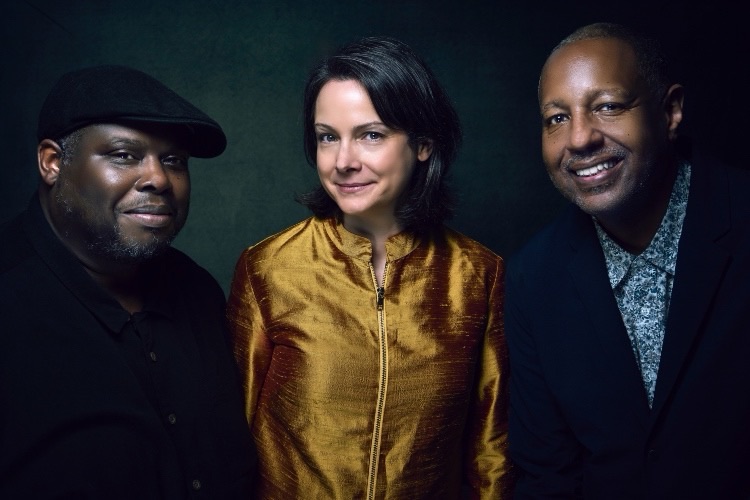

Lost in Geneva (4166, 2026) is only the second album – the first for the new 4166 Records Imprint – by the world-renowned trio of pianist Kris Davis, bassist Robert Hurst, and drummer Johnathan Blake. Since releasing their acclaimed debut, Run the Gauntlet (Pyroclastic, 2024), the group has logged countless hours of gigs at festivals and concerts throughout the States and Europe, culminating in the 2026 Deutscher Jazz Preis, one of Germany’s highest music awards, as “Live Act of the Year International.” The trio’s adventurous spirit led Davis to compose pieces with her bandmates in mind. Hurst and Blake each also contribute a piece to the album to complement Davis’ new or reimagined originals. Rounding out the recording is an inventive reinterpretation of a piece by Morton Feldman.

Davis starts Lost by swinging hard on “The Subtext,” soon joined by the surging, pulsating rhythms of the bass-drum tandem. Together, the three as explore the secret meanings behind double-talk. Davis slows things down with a repetitive figure before yielding to an invigorating dialogue between Hurst and Blake, into which she inserts emphatic chords into the blurring rhythms. But the animated Davis emerges while the engine room stays steaming. The effect is that immediately upon turning on the Lost, one can already sense that it is a departure from the stereotypical piano trio recording.
With “Congestion Pricing,” a steady, spacious space gradually turns hectic, intended to represent the recent imposition of tolls on cars entering Lower Manhattan. As Blake’s beats grow more intense, so do Davis’s piano runs and Hurst’s plucking, mimicking the frantic nature of traffic.

The title track begins more calmly. But, like its predecessors, its emphasis is on disorientation; in this case, jet lag and the confusion of being in a new place. Some may recognize the piece from the trio’s recent NPR Tiny Desk Concert. The composition highlights how the trio can create a lush, curious mood, perhaps ready to set out on an exploration of the Swiss city. “Where Does the Tunnel Go?” originally appeared on the leader’s Good Citizen (Fresh Sound, 2010) with John Hebert and Tom Rainey. The version on Lost is a sweaty workout, with all three artists soloing enthusiastically.
“Ballerina,” true to its name, is more gracefully delicate. Davis carefully chooses resonating notes which are echoed by Hurst’s bowed bass and Blake’s subtle brush and cymbal flourishes. Davis previously explored the piece in duos with Ingrid Laubrock and Craig Taborn, but never recorded it in its entirety. There are also two trio collaborative improvisations. “Mourning Dove” leads into Hurst’s “The Bluesy Bird in Bob’s Backyard” while “Northern Flicker” closes the album. The former is contemplative and light-hearted, finding Hurst playing both arco and pizzicato while Davis introduces prepared piano to simulate bird calls. The tempo picks up considerably on Hurst’s piece, named for the soulful calls of an avian visitor to Hurst’s Michigan home. Here, Davis also uses the prepared piano to shape the bird calls while Hurst’s fluttering kitwork simulates the animal’s movements.

Feldman’s “Nature Piece 5” continues the nature theme that colors much of the album’s second half. Its driving, angular groove sets it apart, providing a seamless segue to Blake’s propulsive bass-drum tandem prevalent in “Clues.” The menacing “The Deer Fly,” named for the blood-sucking creature that clouds New England’s hiking trails in mid-to-late summer, is a suitably relentless piece. Even the amply protected hiker has difficulty escaping the insect’s fury. A bevy of trio interaction, call-and-response, and tension and release reveals astute listening and continues into the closing “Northern Flicker.”
With Lost in Geneva, the Kris Davis Trio again demonstrates why it is one of the most imaginative and adventurous ensembles performing today. A strong sense of unbridled fun comes through the recording. If this is what it means to be lost, don’t bother sending a search party.
‘Lost in Geneva’ is out now on 4166 Records. It can be purchased on Bandcamp.
Photo credit: Adrián Ruiz Hierro
Leave a Reply