

The idea of “jazz flute” too often carries a bad reputation in the public consciousness. To some, the thought may even be a punchline. Consider, for instance, Will Ferrell’s Anchorman: The Legend of Ron Burgundy (DreamWorks, 2004), in which the titular character jumps from table to table, sipping alcohol and blowing fire out of his instrument. Public perception hardly aligns with artistic reality – otherwise, Kenny G would indeed be a jazz saxophonist. But Burgundy’s ridiculous visuals certainly came from somewhere. Herbie Mann’s sleazy attempt at seduction on the album cover for Push Push (Atlantic, 1971) is as apt a target as any. But the shirtless spectacle aside, Mann was actually an incredibly gifted artist, one of many who expanded the flute’s vocabulary. On her leader debut, i hope you feel it too (self-release, 2026) Elena Pinderhughes does more than provide a great record; she boldly aims to rewrite the instrument’s trajectory.
For most of its history in improvised music, the flute has been too often relegated to the role of a doubling instrument for saxophonists. Indeed, even the first recorded “jazz” flute solo was made nearly a century ago by someone known primarily for his work on saxophone and clarinet. A significant part of the sidelining of the flute was initially rooted in practical limitations. Early jazz ensembles frequently performed in noisy venues in which, especially pre-amplification, the flute lacked the projection of louder instruments. Balancing it with louder instruments proved particularly difficult. But the rise of microphones and amplifiers has seemingly changed little in terms of putting a spotlight on the instrument. A cursory look at the flute category in DownBeat’s Annual Critics Poll reveals a familiar pattern: most of its leading names are better known as saxophonists.
At the same time, a long run of remarkable flutists – Mann, Hubert Laws, and Jamie Baum to name three – have built substantial bodies of work entirely around the instrument. Yet their contributions remain far too underrecognized. Why? Perhaps the answer lies in how jazz itself has increasingly been academicized and intellectualized, with the flute losing some of the emotional immediacy that once made it so compelling. The flute’s breathiness and sustained lyricism distinctively mirror the human voice in a way few instruments can. Its emotional weight has transfixed humans for millennia. Long before ink and parchment, ages before theories of rhythm or melody, early humans carved holes into animal bones to produce the sounds for which they yearned. As technology advanced, the humanity behind the flute has unwaveringly remained. But “jazz” largely moved in the opposite direction. Conservatory culture, academic discourse, and the marketing of virtuosity increasingly prioritized theoretical mastery over pure emotional connection. It increasingly became a music that valued logos over pathos. Artists in the creative music scene – including the AACM’s first female president, Nicole Mitchell – have continued to push both the emotional and technical capacities of the flute forward but often, this occurs in a space well outside the purview of the average listener.
With i hope you feel it too, Elena Pinderhughes seeks to move her instrument back to its emotional roots. A gifted performer whose credits have ranged from Herbie Hancock and Kenny Barron to Common and Childish Gambino, she easily could have emphasized her prowess on the instrument. But to Pinderhughes, such skills prove more a pathway than the ultimate destination. Critical, instead, is finding ways to connect with audiences who may regard “America’s Classical Music” as too stuffy or esoteric. And she does so largely by drawing on her cross-genre background, to show stylistic interconnectivity. She emphasizes that “jazz” is but one of several colors used when she paints her intimate soundscapes. R&B grooves and the repetitiveness of sampling are complementary to the tradition represented by Frank Wess, not competitors. The meditative “Charm” featuring Pinderhughes’ longtime collaborator Chief Adjuah sounds as much an 80s pop hit as it does something within the “jazz” mainstream.
Further, just as i hope challenges the meaning of “jazz” in “jazz flute,” so too does it contest stereotypes on how the instrument is supposed to sound. Across the album, she moves well beyond the delicate elegance traditionally associated with the flute. For instance, “510” begins with an echoingly buzzy fanfare that evokes a trumpet far more than her instrument of choice. On “yours, still,” she sounds at times more like a synthesizer. On that same track, as well as on “if i’m being honest,” she even effortlessly blurs wordless vocals and dulcet flute. In so doing, she reminds the listener that the soul behind her breath matters far more than the metal under her fingertips. The humanity that once led the ancients to carve holes in bone so long ago remains in the timbres and tones still with us.
i hope you feel it too is not a conventional jazz flute album. And that is precisely why it prevails. It would be an overreach to claim that any single album can eradicate longstanding misconceptions about an instrument. And yet, one cannot help but see the record as planting seeds for new growth. In our conversation with Pinderhughes, she mentions how now, with her debut released to the world, many more records are on their way. It will be incredible to see what grows from here.
PostGenre: You have been a go-to sideperson for over a decade now. Why did it take you so long to release your own album?
Elena Pinderhughes: That is due to a combination of a few different things. In full transparency, I had a few little industry bumps, as have many of my peers. But I have also received so many amazing opportunities to learn and be mentored by incredible people. I feel those opportunities were well worth it. They greatly helped both my artistry and my compositional skills. I wouldn’t be the artist I am today, releasing this body of work, had it not been for those experiences.
For example, I did an incredible film scoring internship for two years with Laura Karpman’s studio, Art Farm West. Then I toured with Herbie [Hancock]. I did all of these different things that took a lot of time. Working on different bodies of work and having those experiences gave me the opportunity to develop a lot as an artist. The film scoring internship, particularly, inspired me greatly from a storytelling perspective, which has since become such a big part of my music writing now.

Some people release their own records while busy with many other projects, but I wanted more time to focus on mine. I’ve been writing a lot over the years, but as I did other things, those clarified my priorities. I really wanted to give myself the time to take a deep look into the artist I wanted to be and how my music should sound.
I am incredibly grateful to be able to put out i hope you feel it too at this time because I’m realizing that I’m one of only a few people, especially in any generation, who have had these opportunities to study with the greats and to be mentored by them. Because I started on the flute so young, I felt that I had a lot of time to figure out what I wanted to put out into the world. So, there have been many different iterations of my debut album. Some were closer to coming out than others. Many of them probably won’t see the light of day. But, now, I’m releasing this one, and I have a whole boatload of music coming out soon.
PG: Do you feel the work you do not plan on releasing shaped i hope you feel it too? Or were they completely separate from the final album?
EP: I think everything shapes what comes after it in one way or another. I’m always writing music, even if it is not in preparation for a specific album. Those earlier pieces I wrote certainly helped me find my sound; the most honest version of who I am. They allowed me to use a little trial and error to find what I really wanted myself to be.
Often, there is a perception that if you write something, what comes of it necessarily reflects the most honest version of who you are. But the beautiful thing is that we writers can actually write so many different things. Each reflects a piece of you, but they might not be exactly what you want to contribute to the world to represent who you are. It was a beautiful thing for me to have so many opportunities to write different things and see if they really represented me fully. It was a chance to experiment and figure out how I wanted to sound in my body of work.

PG: Part of honing your own voice would also seem tied to your life experiences. As you mentioned earlier, you started on the flute at an incredibly young age.
EP: I first wanted to play the flute when I was four years old, but at that time, I was too small to play it. So, I started on the recorder. We used to check every six months to see if I was big enough that my fingers could reach the flute’s keys. I was finally big enough to play it when I was seven.

PG: Does it ever irritate you that even today you are often mentioned in reference to your youth and the future of the music?
EP: No, I am not bothered by it. I feel like it comes with the territory of starting young. But I also have to say I feel very respected by my peers, and I am incredibly grateful for that. I also still feel very young. That doesn’t come with any air of not being ready or not reaching a certain point yet. It comes more as a reflection on how other artists have known me since I was so young and have seen me grow up. The respect for my musicianship is still there. So, no, it has never bothered me.
I am very excited to start putting my bodies of work out because I think they reflect parts of me that most people haven’t seen yet. I’m excited for people to see me in these contexts; to see me as a different type of artist with my own music, story, and world-building.
PG: And, of course, how you do those things has changed over time as well. Did traveling the world – touring – help you further hone your voice too?
EP: I think so. I had so many opportunities for self-expression when we traveled. The beautiful thing about this music we play is that it has so much improvisation. I’ve been incredibly fortunate to work with bandleaders who fully encourage true freedom within the music and for us to find new things every night. For us to work within the groundwork of a song to develop our own ideas. That definitely helped me find my own voice.

So, too, was simply having conversations with the people with whom I’ve been able to work. I’ve had conversations with everyone I’ve worked with, from Chief [Adjuah] to Herbie to Common to my brother. We would talk about what it looks like to find your own sound. When you have so many things to say, how do you narrow things down? What does it look like? And I took those things and put them into the music. I am incredibly grateful for those conversations. I think that in terms of composition, those years as a sideperson were the time I needed to sit down and truly focus on all of those things. It was an incredible opportunity for me to grow and find my own sound.
In addition to honing my writing, in some ways, there was a lot of growth I wanted on the instrument itself, too. I needed that to be able to find the voice I fully wanted to present to the world. Honestly, flute-wise, I don’t think I would have found my sound without all of the opportunities I have had.
PG: As far as finding your voice on flute, it is interesting because the instrument has a rich history in improvised music but it is a bit more hidden compared to something like a tenor saxophone or trumpet which stands more prominently in the public consciousness.
EP: Right.

PG: As an example, you studied with Bennie Maupin, who is an incredible flautist, right?
EP: Yes, I did. As a young person, I was blessed to be in a music program called the Young Musicians Program. It now goes by the name Young Musicians Choral Orchestra. It gave me free lessons from when I was eight until I was eighteen. The program used to bring Bennie Maupin in to come work with us. And I studied with him. I also studied on the classical side with an amazing woman named Michelle Caimotto, and then later Linda Chesis.


PG: But as far as the use of flute in improvisational contexts, do you feel the instrument’s less prominent role is more freeing in terms of finding your own voice compared to if you were playing something like a saxophone?
EP: I have found it both more freeing and a little more difficult because there is less obvious guidance on the instrument. I would imagine sounds that I had never heard before on the flute and would try to find things I had heard on other instruments as a guide.
For example, I was deeply infatuated with and inspired by how trumpet players can use their mouths to almost bend a note. I found it incredible. I think there’s so much emotion in the sound a trumpeter can get from doing so. And I wanted to find how to do that for myself. So I went on a two-year journey to figure out how to do that for myself. From that search, I found that my version of it was to use a combination of open holes and covering the mouthpiece a little more. It was a different technique than I would normally use, but I had to find it for myself. A big part of putting this album together and the road that led to it was partly that journey to figure out how to get some of those sounds I heard l on other instruments to translate to my flute. And then there is also an incredibly prolific history of flute players who deeply inspired me as well.

PG: Those developed techniques presumably shaped how you compose as well. When you wrote the pieces on i hope you feel it too, were you doing so on the flute or the piano?
EP: A little bit of both. Sometimes I start on the flute. Sometimes I start on piano. The scenario largely dictates which instrument I use to write. I don’t have an exact specific style of writing, but instead use a little bit of everything.
PG: You mentioned how you first became interested in the flute when you were four. That was after you attended a concert of Venezuelan musicians. Do you see their music in your own at all?
EP: Oh, yeah. Growing up, we listened to so many different types of music. My parents played us a ton of music from all over the world. Brazilian music….

PG: Growing up on Brazilian music, it must have been incredible to have worked with Milton Nascimento on esperanza spalding’s album [Milton + esperanza (Concord, 2024)].
EP: I was so honored. It was like a dream when esperanza called me for that. I didn’t get to actually meet Milton when we recorded. I first met him when we did a show in [Los Angeles], which was amazing. But when I called my mom and told her that I was recording an album he was on, she was so excited. He is a treasure in our household. I’m so grateful to esperanza for that call. And what a beautiful album. That was one of those ones for the books for sure.
PG: But music from Brazil is just one influence on your sound.
EP: Right. I am massively inspired by the African diaspora and all parts of it. I’ve studied rhythm, harmony, and melody of the diaspora, including from West Africa and Cuba. Actually, before playing jazz, I played a ton of Afro-Cuban music. For me, all of those musics deeply come from the same tree. They are such a huge part of my writing and my sound. My first teacher, Donna Vescusa, was in an incredible Venezuelan group, too.
I think those sounds and ideas are a part of every aspect of what I do for any genre of music. When I’m doing hip hop sessions, it’s there too. Same with R&B sessions. For me, it all comes from the West African traditions, and those rhythms made their way to all those different places that we now call jazz, blues, hip hop, or R&B.

PG: Given their shared roots, do you feel you play differently depending on which genre of music you are exploring?
EP: I definitely approach each differently to some extent. Each has its own history and language that informs how I play. The things that I might play over something more in the hip hop or rap tradition will definitely be different than something from the jazz tradition.
But often the worlds do come together. In a lot of the recording sessions I have done, I have been asked to do something historically from different traditions than most would label the underlying music. Jazz and hip hop have had so many meetings in so many amazing ways through the years, for instance. For me, it’s all been about making sure I am well studied in all different genres so I can still bring myself to the table in all these different places while still honoring the tradition and also bringing something new to it.

PG: To go back to your focus on storytelling, you described the single “ring ring” as focused more on something you feel than overtly think about. Is that emphasis on feel above overintellectualizing a recurring theme in your solo work?
EP: Yes, especially for this album. The title i hope you feel it too is very much descriptive of how I hope listeners will experience this music. The jazz that raised me and the way that I was taught to relate to the music was for it to be music for life. It’s music for going out on Friday nights with friends. For dancing in your kitchen. For falling in love. For date night. For family time. It is music for everyday life. It’s a soundtrack for your life.
As I’ve talked to different audiences around the world, I have found that sometimes people feel like they might not have much reverence for jazz even if they have a lot of reverence for the musicians who make it. They know that we are incredibly talented. They know we have so much musical ability and technique. They also recognize that the music is important. But they sometimes feel like they might not understand the music or relate to it in some meaningful way. They feel like they need to have a deep musical knowledge to enjoy the music or fall in love with it. I see this album as me wanting to tell them that they don’t need to have a deep knowledge to enjoy it. The music itself is going to hit you in your heart.
I want to lead with feeling. I want to center feeling. I want this music to hit people in a way that opens up a genre that they maybe didn’t know they could relate to in the same way. I’m not asking them to study; I’m asking them to simply meet me where they are.

Artists want people to engage with their music in different ways. For me, I don’t think you need to sit down and find a quiet moment to listen to this album. You can do it anywhere. I want people to live with the music. I want them to move with it. I want it to be able to be in both the background and the foreground. It’s really for people to have as a soundtrack to their lives. And that’s how I hope that they engage with this album.
PG: Why do you think it is that jazz became so overintellectualized? If you go to its earliest moments, so much of it was built on the Blues. Early Blues and jazz musicians were not any less intelligent, but they seem to have been more comfortable emphasizing the feeling and emotional aspects of the music.
EP: Oh, 100%
I don’t really have the answer as to why it happened. I think that’s a study in itself. But I do hope to close that gap a little. I think that the more intention that we have to close that gap and the more opportunities we give people to know that they are more than welcome and invited to be a part of this music, the better that we’ll be. It is music you feel. That’s how I fell in love with it. And when I talk to elders, many feel the same way. Ultimately, I hope for the music to serve as a place for gathering, joy, and a very alive culture. That’s what I hope to evoke with both this record and my live shows.

PG: You also get a sense of that from the titles of the tracks on i hope you feel it too. It seems like each is almost poetic and designed to evoke particular emotions.
EP: Thank you so much for noticing that. There’s definitely a thought behind them. I really appreciate you noticing.
PG: Why are the track names all in lowercase letters?
EP: That is part of the invitation to meet people where they are. I’m giving the music to them and hoping they find themselves inside of it and feel something inside it. Because the album is called i hope you feel it too, I wanted to give listeners that experience. And yes, as you said, I was very intentional about naming them. Some of them I named in the studio and some I named afterward. But it was all very intentional.
PG: Is that emphasis on feeling also part of why you have been increasingly using vocals in your work as well?
EP: Yeah, I think that’s definitely part of it. There’s so much similarity in the way that I sing and that I play. The vibrato is even the same. I try to mirror tones. But as you said, there is something so innately human and beautiful and relatable about singing.
There’s also something incredibly communal and inviting about singing because you can immediately see yourself there. I intentionally chose to make this a completely lyricless album; even when I’m singing on this album, there aren’t words. But I still wanted to give people an opportunity to hear me sing and hear my voice vocalizing over the flute and give them kind of that extra dose of just straight humanity on top of the instrument itself.

PG: What do you feel you have learned the most while working on i hope you feel it too that may carry to your future projects?
EP: I learned, and am continuing to learn, about my own process for recording, post-production, and the ways that I like to put something together. I fell in love with that process while making the album. I saw the album take shape in so many beautifully different ways as I worked on it. And I found my own groove in that. It was great. I also learned how much I love world-building in terms of an album and within the context of what the music means, the stories behind each song, and the stories behind the album. I’m trying to think a lot about that both inside and outside of the music. What can we do with visuals? What can we do with our live show? What can we do to bring people inside of the world that I’m hoping to get to within the music? Yes, there is a recorded product that I’ve finished, but it’s just the beginning of building this world. There are so many pieces left.
‘i hope you feel it too’ is Out Now. More information on Elena Pinderhughes is available on her website.
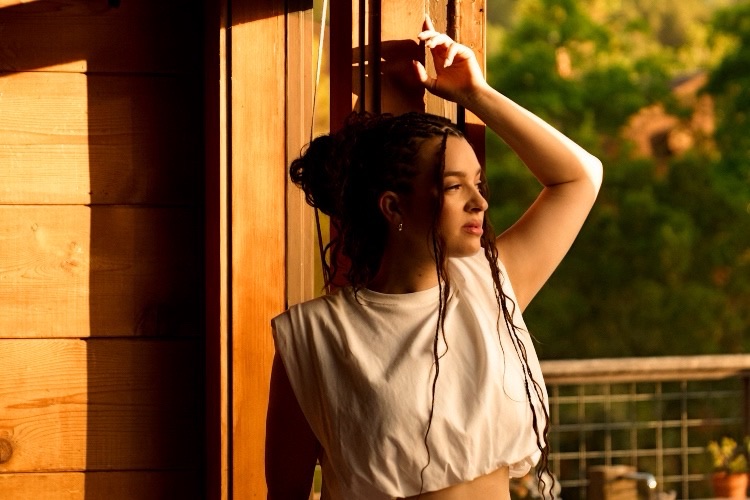
Photo credit: Darrin Baldrige


Leave a Reply