
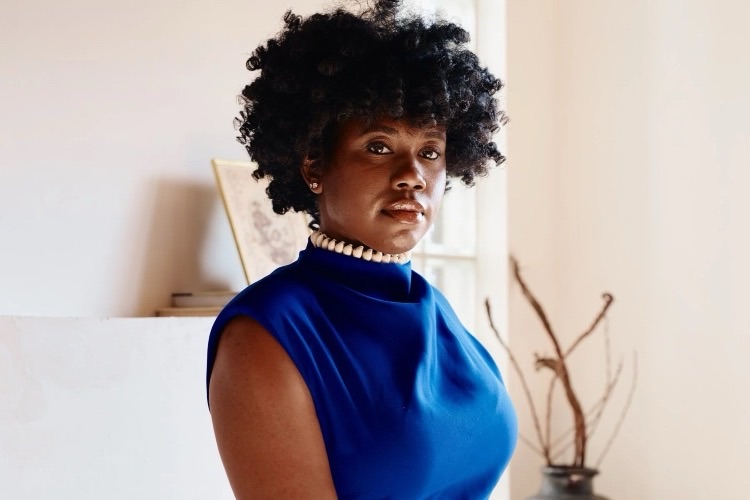

Cameroonian-American Ekep Nkwelle is quickly becoming a well-known name among vocalists. She has appeared some of the most prestigious festivals in the world, including the Newport Jazz Festival, Montclair Jazz Festival, Hudson Jazz Festival, Jazz on the Narrows, North Sea Jazz Festival, Exit Zero Jazz Festival, and DC Jazz Fest. She has also appeared at the iconic Carnegie Hall. But perhaps the most impressive part? Those all came before she had even recorded any album under her own name. Those who have heard her sets will also recognize the repertoire on her debut, Caged Bird (Mack Avenue, 2026). An album of covers, its scarcity of original material may disappoint some listeners. However, one must consider the fact that most new vocalists set their foundation with familiar material before unleashing original fare. Ostensibly, original material will be soon forthcoming.

Having personally witnessed her Newport performance in 2024 and, more recently, at Exit Zero last spring, this author also found himself impressed by the vocalist’s skills. As written elsewhere, “She has it all, a superb sense of dynamics, intonation, phrasing, poise, and charming charisma. People have already compared her to greats and role models such as Abbey Lincoln, Sarah Vaughan, and Betty Carter. Yet, she has a little bit of Dianne Reeves’ flair as well.” In hindsight, strains of Nina Simone’s influence seep through too. Caged Bird finds Nkwelle backed by the same trio as at Newport and Exit Zero: pianist Luther Allison (though with Julius Rodriguez filling this role on several tracks too), bassist Russell Hall, and drummer Brian Richburg, Jr. Note that while Hall and Richburg Jr.

Maya Angelou’s “I Know Why the Caged Bird Sings” inspired the album. Nkwelle details a journey from sorrow to inspiration, freedom, and a better future. She explores forms of grief, displacement, and resilience. Beginning with the gospel hymn, “His Eye Is on the Sparrow,” the album takes its starting point in the strength inherent in the works of gospel great Mahalia Jackson. Nkwelle’s phrasing and dynamic range are immediately compelling in the duet with Allison. She then channels Abbey Lincoln in the title track, performing with the full trio, featuring Richburg’s impressive percussion. The group captures the piece’s empowered place as a protest song, as exemplified by this verse: “The birds who live in cages feel the morning sun/Shining through the window where the captor lives by gun/And it stretches forth its body and it warbles for the day/And looks around from side to side and listens for the way.” Nkwelle seems more relaxed in Lee Adams and Charles Strouse’s “Night Song.” She conveys intimacy by taking a conversational approach, rather than rendering a straight-out jazz vocal. She takes protest in a different direction with the environmentally centered, foreboding, chord-structured “Amazon Farewell,” getting animated on the choruses and emphasizing the word “stop.”’
Caged Bird’s centerpiece is “Good Morning, Heartache,” a tune mostly associated with Billie Holiday. Nkwelle explains her interpretation in live performance by stating that while the title and initial lyrics dwell on mourning, that mourning offers a new perspective. One has endured the suffering and can take solace in knowing survival. The hand-clapped “Early, One Mornin’” is a love song, with Nkwelle totally commanding both the phrasing and rhythmic cadence of the tune, exclaiming joy. The piece evokes Nina Simone, though Nkwelle is far too animated and joyous than her predecessor.

Nkwelle reveals a deep sense of balladry on “The Sad Ones,” by Roger Wendell “Buck” Hill. The track features Nkwelle’s own lyrics, which again speak to a transformation from grief to the “sunshine of a new day.” She uses space adeptly and even flirts with vocalese. She then interprets Pharoah Sanders’ “The Creator Has a Master Plan” with an inventive arrangement designed for audience participation. The accent is on the phrase “the power of love.” She uses parts of the song without getting overindulgent in long scatting sequences. Again, space is her partner. She lets the song develop and breathe. Rather than culminating in an explosive climax, she fades as she began, with “the power of love.”

Totally aware of the trinity of gospel, jazz, and the blues, Nkwelle closes her first outing with Ma Rainey’s “See See Rider,” which sounds like she is again channeling Simone. There’s no grandstanding. She is absorbed in the power of the blues, letting the talented Russell Hall deliver an outstanding bass solo.
Caged Bird showcases Nkwelle’s many talents, leaving listenets eager to hear how she will navigate more original material her next time out.
‘Caged Bird’ is out now on Mack Avenue Records. It can be purchased on Bandcamp.

Leave a Reply