

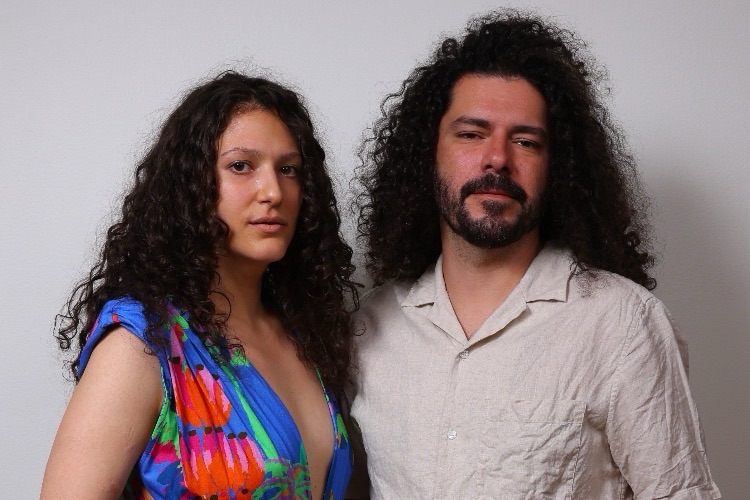

The drum-less duo of vocalist Jamile and guitarist Vinicius Gomes, joined by bassist Joe Martin, puts a new spin on the rich legacy of the Brazilian vocal-guitar sound on Boundless Species (La Reserve, 2026). In extending their music beyond a bossa-nova framework, the augmented duo cites the touchstones of Wayne Shorter, Herbie Hancock, Johnny Alf, Guinga, and even Stevie Wonder. In other words, their sound is closer to Caetano Veloso’s than Joao Gilberto’s. Yet, strains of these and other Brazilian notables, such as Gilberto Gil and Milton Nascimento, run through their music as well.
Jamile has one of those distinctively whispery, seductive voices not unlike the sound Astrud Gilberto first popularized in the 1960s. She has an expansive vocal range, a flair for phrasing, and mastery of both lyrical – in Portuguese and English – and vocalese renderings. Vinicius is a master of the Brazilian acoustic guitar sound and showcases an intricate fingerstyle technique. Martin’s accompaniment and solos demonstrates an impressive feel for the music that well complements Vinicius.

The program begins with Guinga’s “Mar de Maracana,” a dreamy, intimate track that immediately demonstrates the tight linkage between Jamile’s vocals and Vinicius’ guitar. The other Guinga piece, “Mingus Samba,” couldn’t be more different. An upbeat tune played at a breakneck tempo, it has a remarkable pacing as it runs for two-and-a-half minutes with Jamile seemingly not even taking a break.
Herbie Hancock’s “Actual Proof” from his funk-fusion Thrust (Columbia, 1974) is an interesting choice. Jamile, with her vocalese, and Vinicius’s guitar begin in unison before the guitarist rips off an aggressive solo, anchored by Martin’s steady bass accompaniment, before the bassist makes his own declarative statement. Later, the trio tackles Hancock’s “I Thought It Was You” from Sunlight (Columbia, 1978), where the original was sung through a vocoder. Again, they do a stellar job of translating a synth-driven original into their acoustic realm, with Jamile clearly articulating the lyrics as Vinicius plucks the strings precisely.
Wayne Shorter’s “Someplace Called Where” from Joy Rider (Blue Note, 1973) was originally recorded with Dianne Reeves on vocals. Vinicius has an introspective intro, later joined by Martin. Jamile emerges two minutes in, exhibiting considerable range and poignant emotion in her vocals. She never tries to emulate Reeves in the least. Their interpretation of Shorter’s “Endangered Species,” originally from Atlantis (Columbia, 1985), is punchier, with fluid guitar runs and sharp, rhythmic phrasing from Jamile. Martin keeps a steady rudder in this complex, undulating piece. Most listeners will immediately recognize the melody of Stevie Wonder’s “Where Were You When I Needed You,” which may well be the most straightforward reading of these nine covers as Jamile mirrors Wonder’s vocal inflections.

Of course, the triumvirate nods to Brazilian composers as well. They are Ivan Lins and Ronaldo Monteira (“Essa Mare”), Johnny Alf, and Milton Nascimento. While Nascimento (“Outubro”) is practically a given, the notable one is Alf. While Alf’s harmonic innovations shaped the DNA of bossa nova, he has continued to be marginalized as a gay, Black pioneer. The treatment of Alf’s “Nos” marks some of the album’s most tender moments.

Jamile and Vinicius Gomes are on the vanguard of a new wave of Brazilian musicians in New York. They prove without a doubt that there is a strong connection between jazz and the Brazilian guitar-vocal traditions of their native country. There are no lines musically, emotionally, or even rhythmically. Their ability to navigate a challenging repertoire from the elegant to the dynamic is most impressive.
‘Boundless Species’ is out now on La Reserve Records. It can be purchased on Bandcamp.
Photo credit: Vinicius Carvalho





Leave a Reply