

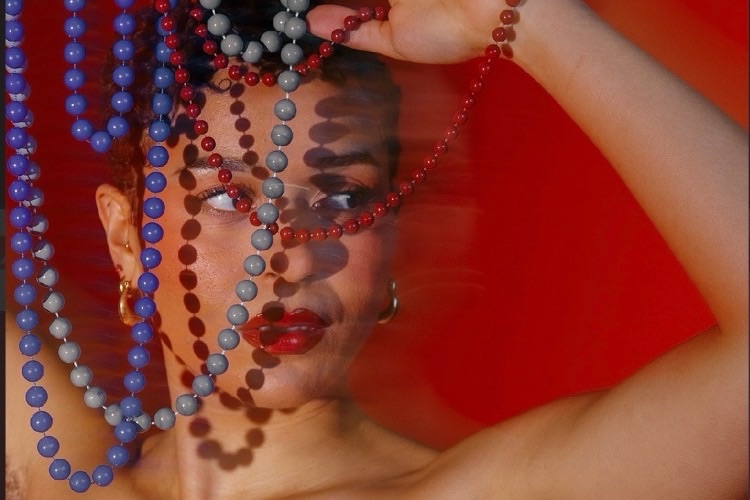

Lauren “Lo” Steele’s debut, Only a Drop (Little Village), is in some respects the female equivalent of Kurt Elling’s Superblue, though invariably even harder to classify. The album doesn’t fit very well into jazz, blues, gospel, or R&B, while crossing them all in a way comparable to Nina Simone. Now wait, that’s high praise and perhaps too much hyperbole. First, Steele has not earned Elling’s reputation and is certainly a long way from reaching Simone’s iconic status. She is just starting. Yet, her album brings both to mind. Just as hybrid guitarist Charlie Hunter was the driving force behind Superblue, he assumes the same role here in tandem with co-producer Marcus Finnie, a mainstay on Elling’s tours. Other than backing vocals from two others and violin on select tracks by Eleon Dobias, Hunter, and Finnie are the vocalist’s only accompanists.
That spare approach and Steele’s distinctly Black activist messaging, not to mention her smooth, soulful voice brings perhaps Meshell Ndegeocello, to mind. Steele has it in her DNA. She is the daughter of LaRhonda Steele – Portland’s First Lady of the Blues – and Mark Steele. With a background in music, theater, and writing, Steele already has considerable touring experience, including opened for Tank and The Bangas, Dianne Reeves, Esperanza Spalding, and Patrice Rushen.

The leadoff track, “Greenz,” speaks to the heart of Steele’s artistry. Finnie finds a pocket in his percussive approach that breathes. He uses subtle timing and never dominates, allowing the leader’s words to rise toward the forefront. Hunter’s one-of-a-kind hybrid guitar provides basslines, chords, and melodies, serving as three-in-one: lead, rhythm, and bass. Steele doesn’t merely recite lyrics. She inhabits the social commentary embodied in the quiet monologue, delivered with grace and soul, about people replicating recipes – or, in this case, music – while removing or diluting flavor and color. These two stanzas reflect both her stance and way with words: “Hyper analyze my language/Overwhelm me with your rules/Strip me of my foundation/Take the music out of the schools… Somehow I remain creative/Ain’t got the logic or the tools/But I can sing the blues/And now you say you love the blues.”
The remainder of the album follows suit, forged in spontaneous live sessions. The stomping beats for “Stockholm” are in sync with Steele’s vocal cadences, explaining the direness of the Stockholm Syndrome, where the hostage often forms a weird bond with the captor. We hear Dobias’s violin accompanying the infectiously rhythmic “Made New,” a love song that revels in meeting one in her stage rehearsals. She continues in this gentle, affectionate way on “7 Wonders,” replete with imagery such as “Where’d you get your soul from/It’s got to be the ocean/I’d like to dive as deep as/Your current allows.”

The funky “Step Out on Faith” reignites her protest stance, railing against shallowness and the use of religion as a wrong excuse. The chorus “Take a step” adopts gospel overtones, not unlike the famous Civil Rights anthems of the ‘60s. “Will We Ever Know How It Feels to Be Free” is Steele’s song, yet its message inevitably reminds us again of Nina Simone, specifically the song “I Wish I Knew How It Would Feel to Be Free.” Hunter displays some of his best fretwork on “Just Say You Want Me,” a plea to avoid a breakup. “Garden Floor” expresses the wariness of love, impacted by the wounds of a prior relationship. Steele stakes her ground, almost in bookend form, with the closing “Freedom Song,” again championing Black music, the spirit of resistance, and the need for such voices, best expressed in these lines: “While I’m only a drop in the ocean of history/My song will live on in whoever is listening.”

Yes, we desperately need Lo Steele’s voice in these times, and we best heed her messaging, too.
‘Only a Drop’ is out now on Little Village.