

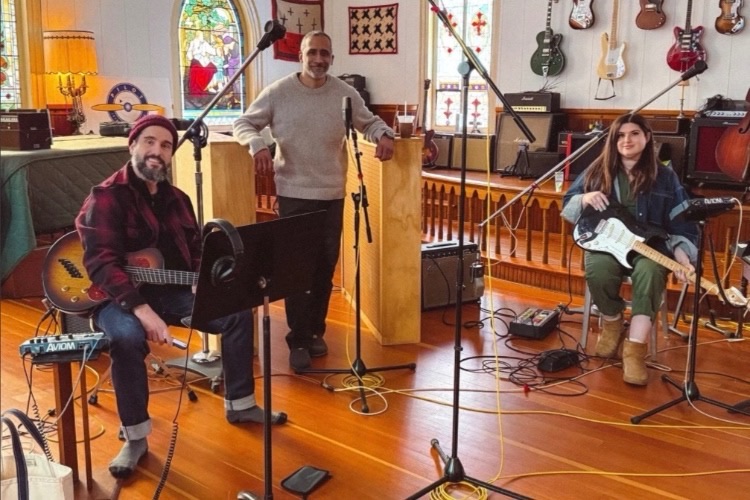

When most “Everyday People” think of funk, they perceive it in a maximalist sense. They soundtrack diaper-clad spacemen tearing the roof off “the sucker” before returning to the mothership. Or music that boogies on down through the elements of the universe and across pyramids. The GAP between grooves drops heavy bombs on you. Even the gentlemanly godfather’s funk was so heavy he was “Doin’ it to Death.” Multiple layers, over-the-top production, and textural abundance thrust you to “Outa-Space” even without the stereotypically large horn sections. But it doesn’t have to be this way. Minimalist funk, music with an emphasis on intimately interlocking rhythms and space over flashy solos, is an equally compelling approach to the style. Different Strokes for Different Folks (SideHustle, 2025) by guitarists Charlie Hunter and Ella Feingold is a welcome reminder that “Funk not only moves, it can remove, dig?”
Often, the biggest criticism against minimalist funk is that it is so polished and clean that hard grooves disappear into the ether. While Different Strokes does present a duo that is a bit more laid-back than its maximalist counterparts, it hardly loses its edge. There is a grittiness that emerges throughout the recording, whether the distorted warbles on “Agitated Fonk” or the staccato stabs of “Sanford N’ Anybody.” At no point is the duo’s funkiness in question, even if they occasionally speak in more hushed tones. In this regard, it certainly helps that both artists approach the outing with the broadest perspectives possible.
Since the early ’90s, Hunter has forged a distinctive path that blurs jazz, funk, blues, and rock into a singular voice. Whether voyaging experimental pathways with the trio Groundtruther, deconstructing pop hits with Omaha Diner, or backing Norah Jones or D’Angelo, no one else sounds quite like Charlie Hunter. It also helps – but only partly – that he has often eschewed a traditional guitar in favor of an unconventional hybrid instrument that is essentially half bass and half guitar. Sometimes, he even takes over the drum chair too.
Feingold, in turn, is a fountain of knowledge about guitar history of all styles. Indeed, despite working with Prince, George Clinton, and Silk Sonic, Feingold is perhaps best known for her voluminous Instagram and TikTok reels where she breaks down classic grooves. The mere titles of some of the tracks on Different Strokes – specifically “Brownie McGhee,” “Malaco,” and “Tamla” – openly reference the musical lineage. But, like Hunter, Feingold also approaches the guitar from a more unusual perspective, serving as one of the strongest advocates of inverted tuning.
Unsurprisingly, the duo’s music, while inherently funky, also defies categorization. Different Strokes for Different Folks’ centerpiece track, the hypnotic “Nasty Ain’t It?!” deceptively invokes both sample-based grooves of 90s nu jazz and the “avant-groove” of a group like Medeski Martin and Wood, all with a tinge of Prince’s dirtiness. “An Inch Wide & A Mile Deep” equally suggests the smoothness of George Benson and the danceability of Stevie Wonder. And the general idea of repeating and slowly mutating a motif finds a parallel in the minimalism of Western classical composers like Steve Reich and Phillip Glass.
Another criticism sometimes levied against minimalist funk is that it lacks the cogent messaging of its more maximalist counterparts. “Say It Loud, I’m Black and I’m Proud” and “Everyday People” both cogently spoke to a world of racial justice. So too do P-Funk’s calls for the sweet chariot to stop and let them ride. Different Strokes, in many ways, even in the absence of lyrics, does so similarly. Of particular importance are messages about embracing diversity and accepting people’s differences. “Shirley Chisholm” is named for the first Black female congressional representative, known for her firmness against economic, social, and political injustices. “Feel No Shame for Who You Are” and “This is How We Rescue Each Other” both speak to the yearning for a more accepting society for everyone, including people like Feingold who are in the LGBTQIA+ community.
But the true glue of Hunter and Feingold’s duo comes in the way they are able to set everything aside and fully engage one another in musical communication. The two were friends first, and their care for one another can be felt throughout the recording. The artists often move as one, letting the listeners in to witness their private dialogues. Their performance at the Newport Jazz Festival on Sunday, August 2, 2026, will be particularly special as one of the first opportunities they will fully let a live audience join those conversations.
We sat down with both artists, as they are working on their upcoming second album together, to discuss the Newport date and what is to come.

PostGenre: So, you are currently working on your second album together. Are you able to share anything about it, or is it too early?
Ella Feingold: No, we can.
Charlie Hunter: We’re just getting stuff together right now. We’re going to record in September.
PG: Do you think it will be similar to Different Strokes for Different Folks?
CH: Well, we’re going to have real drummers on this one instead of me playing drums. That should be nice. It will be a little different, but it’s still the two of us conversing in the way that we do. We’re just trying to work some songs out at the moment.

PG: You had initially desired putting a drummer on Different Strokes for Different Folks, and both Questlove and Steve Jordan expressed interest. But you ultimately decided to have it be only the two of you instead. What made you more comfortable with using a drummer this time?
CH: I feel we just needed to work on our identity as a duo first. It was just the two of us, and I think that was actually a good way to go about making our first record.
EF: We knew that we wanted the first one to be a duo record in terms of the musical conversation. We didn’t want to make a typical guitar record. We wanted it to be more about the two of us. And, for that, we would need a very specific type of drummer. We needed someone who would only play time and not insert themselves too much into the conversation. But if you’re going to have an amazing drummer, they should insert themselves into the conversation. So, we went without one.
Charlie’s playing drums on the album wasn’t even planned. We just started with the little funk box that we have over here and used it to lay some stuff down. I also brought my MPC to program stuff, and it just happened that Charlie played drums. It wasn’t planned at all.
PG: So, for your performance at Newport, will you have a drummer with you or will it just be the two of you?
EF: We’ll have a drummer.
CH: Corey Fonville is going to play with us.

PG: Oh, nice.
EF: But having spent the last four or five days writing with the Rhythm King, we also definitely want to do some intimate shows as just the two of us with, if not the Rhythm King, some kind of little funk box drum machine. It’d be fun to do some more stripping down of our sound. Since we haven’t played with a drummer before in this kind of conversation, it will definitely be interesting to see what happens. I know Charlie and I can just sit and play while focused on one thing for ten to twenty minutes straight. It won’t move around but will still keep your attention and keep you engaged and focused on what’s next.
PG: Ella, this will be your first time at Newport, right?
EF: I think it is. Certainly, my first as a performer. I feel like I’ve always known about the festival. I grew up hearing about the Newport Jazz Festival, the Newport Folk Festival, and the history behind both. That was always in the background as someone into music who was growing up in New England.

PG: Charlie, you performed at Newport in 2023 with Super Blue with Kurt Elling. But you have been there before that, too, right?
CH: Yeah, I think I did it a couple of times in the 90s. I’m not sure exactly when, though. But my knowledge of the festivals came from long ago, too. My mom came up in the whole Greenwich Village folk scene of the early 60s. So, I grew up listening to people like Mississippi John Hurt, Bucca White, Son House, and Skip James, who recorded at the Folk Festival. And then, of course, there are all those great records from the Jazz Festival, like Duke Ellington at the 1956 festival and Count Basie at the 1957 festival. Really great stuff.
PG: One thing that makes Different Strokes for Different Folks stand out is that the album is very funky, but also intimate. Do you think, compared to in a studio, that intimacy will be difficult to achieve at an outdoor concert setting like Newport, where people are moving from place to place?
CH: We’re going to see.
EF: It’s crossed my mind. But the festival also has a jazz or jazz-adjacent audience. They are coming in as people who are more likely to listen deeply more than the average person. I do think our music lends itself to smaller acoustic spaces because of the intimacy and nuance that comes when we play our instruments. But we will find out. We’ll play to the crowd.

PG: Even though you approach funk differently, Newport has a long history of presenting some of funk’s icons. There was James Brown in 1969….
EF: That’s my favorite live recording of his.
PG: It’s fantastic. And it is amazing because there has never been an official release of it either.
EF: There hasn’t. I think Sex Machine (King, 1970) was partly recorded in James’ hometown of Augusta, Georgia, not long after. But I think his fans really need to hear his 1969 Newport performance. Have you listened to that one, Charlie?
CH: I have not.
EF: He has [guitarist] Jimmy Nolen in the front. You feel like you’re sitting right on the stage. It’s incredible.
CH: Wow!


PG: So, you had that performance in 1969. That same year, Newport also had a memorable Sly and the Family Stone performance. Especially since Different Strokes for Different Folks makes a few references to Sly in terms of song and album titles, do you see your duo’s performance at Newport as a continuation of the festival’s funk lineage?
EF: I feel like, together, Charlie and I are the sum of our record collections. I don’t think what we do together is any conscious continuation of something. Nor is it an overt attempt to avoid what came before. As far as Sly specifically, to me, he is the greasiest, funkiest musician ever. His music is in my bloodstream, whether it comes out in my own music or not. When we went in to make the record, I don’t think there was any initial plan to name it in reference to the Family Stone. Same with song titles. I think all of that came out naturally instead.
CH: Right. I’m just a little bit older than Ella.
EF: I’m forty-five.
CH: I’m almost fifty-nine. So I came up in the seventies, surrounded by all different kinds of music.

PG: Charlie, if you go back to some of your earlier projects – your Blue Note records, your work with T.J. Kirk, or your earlier recordings with Garage a Trois – those were two or three decades ago. The records were a little edgy and pulled from different genres. This duo with Ella is also rich in stylistic influences but more laid-back. Do you feel that today you can make a more laid-back cross-genre project than decades ago because now there are fewer people adhering to those genre labels than in the past?
CH: I hope so. But I also think that shift, for me, also reflects my own personal evolution. I’m always practicing. I’m always trying to get better. The fact I play a weird-ass instrument also has something to do with it. Earlier on, I was always behind the curve of all my contemporaries because it took so much for me to learn this weird hybrid instrument that I had developed. There were so many problems and issues. But now in my late fifties, I feel like I play well. I feel like I’m good at what I do. Twenty years ago, I could do a lot of stuff, but foundationally, I feel like what I’m doing is more aligned with what the instrument was intended to do. It just took me a few decades to figure that out.


PG: It is interesting how neither of you perform on a guitar set up in a traditional way. Ella’s guitar uses inverted tuning, while Charlie’s hybrid guitar is effectively half-guitar and half-bass.
CH: Yeah, but both of us also obviously came up on more conventional guitar music. We both have done incredibly deep dives on the instrument and bass as well. Both of us needed to do that to be able to do something a little weird and in left field. It certainly helps to have the history and understanding of the history of the guitar when you go out further.
One cool thing about playing guitar is that it is the folk instrument of the world. As a guitar player, you’ll meet so many other people who play it and become friends with them. There’s so much musical information out there for the guitar, from somebody like Joe Pass to somebody like Charlie Patton to Joyce Moreno from Brazil to a Cuban tres player, to Ali Farka Touré. The guitar is the folk instrument of nearly everyone. And that wider guitar vernacular is included in what you would call funk, soul bossa, or even jazz. There are so many streams for the guitar. Ella and I are also outlier people as well. Every musician should honestly play who they are. To go back to your question about the lineage of funk at Newport, where we do or don’t fall into it is, ultimately, not of primary concern to us. That we play who we are matters far more.
EF: I think, ultimately, with Different Strokes for Different Folks, we made a record we wanted to hear. I like things that feel good. I like things that are instrumental. Often, I like things that have a lot of space in them. I feel like we made that kind of record. There’s a lot of funk rhythm-adjacent music out there that takes up a lot of space in the funk world that is not really funky to me. I wanted to make something that was greasy and funky and would hit people in the chest. That’s what I wanted to do. And I feel like we need that.

PG: If you look solely at instrumentation, the group is somewhat more like a quartet – two guitars, bass, and drums – than a duo. How much do you consider instrumentation when you are putting together pieces as a duo?
CH: It all just goes back to the communication between the two of us, and everything else fills the blanks. Our whole goal is not to overthink anything. We just want to play whatever is generally the first thing that comes to mind to each of us. Our first impressions will usually be the best thing to come out anyway. Then we go back and tweak things a little. We’re a complementary set of ears to each other, in a way. We balance each other out really well.
EF: Charlie’s very, in his words, focused on the big picture. He zooms out and sees what the music is, what it needs, when it’s enough, and when it is too much. I’m more in the details; the small moments and little things. But it’s nice that we’re not two insanely detail-obsessed people who can’t let go of things. At the end of the day, it’s all about whether the music feels good and whether we conveyed the emotion of what we wanted to say within our conversation. Maybe we didn’t say it perfectly, but if the feeling and the sentiment are there, it’s cool.
PG: Charlie, you previously referred to your music as a duo as “minimalist funk.” Most funk is very maximalist. Do you have any sense of why a more minimalist approach is not as common?
CH: Both of us have a background in jazz in a lot of ways. It’s a big part of our vocabulary. It was a big part of my experience to work with people who are incredible improvisers, not only within a bebop framework or whatever, but people who improvise on a grand scale. I think because we spent so much time in the trenches grooving, playing the blues, whatever it is, we know how to hit the groove without excess. From my standpoint, I’m bringing whatever I’ve got from jazz, without really wanting to play too quietly in that manner.
Ella’s coming from – and she can speak to this- an orchestration side of things. Her ears for the sonic aspects of how shit actually sounds and how people receive it are much more developed than mine. I always defer to her in that kind of zone.
EF: I tend to like a lot of music that doesn’t have tons of contrast. I’ll listen to Stravinsky, don’t get me wrong. I do like things that have quick cross cuts. But I also love a lot of J Dilla beat tapes where you’re riding out a beat for four minutes. Or minimalist music by people like Philip Glass or Steve Reich. I like music that feels like a place where there is no need to constantly get up and move around. I think some of my interest in that comes from hip hop. I also think that things are funkier when there’s more space. I feel like the grease in funk is all the little inflections and ghost notes. It is the space in between notes. How do you get off of a note? All of those things, to me, are what make up funk. And I think when you bloat the music with too much stuff, the funk gets obscured very quickly.
CH: Having too many elements in the music potentially removes some of the most powerful aspects of music. And that also ties into solos. With Different Strokes for Different Folks, we made a duo guitar record with no solos. We are both capable soloists, but the album isn’t about solo statements. It is about the conversation. We’re not doing an overt burning over the changes kind of thing, which many of our friends – people we love and totally appreciate – do incredibly well. What we are doing is, in many ways, the exact opposite. But we put the same amount of energy and intentionality into our conversation. I hope people understand that what we’re playing is functionally what the solo is. The solo is in the grooving conversation and in how it’s received by the audience.
The only thing that worries us is if audiences think they are going to come see us and hear these burning solos over the top. You can always get that kind of pressure from an audience. But that’s not what our duo is. That’s not our goal. Our goal is to create whatever magic there is within the conversation of where we are going.
And, as Ella said, we did not approach our record with some grand plan of what we would do. We simply started playing, and it all came together. It felt cool. Only afterward did we notice that there’s not a damn solo on the record. I was most proud of the fact that we made a guitar record with not one solo on it.
EF: Yeah, the record is the first time we played together.
CH: Literally.
EF: Literally. We’ve been great friends for a few years. But the record came about because we just decided to sit down and hit record. A lot of it was first takes. The song “Nasty Ain’t It!?” is an eight-minute conversation of solely theme development, sitting somewhere that feels good, knowing when to contrast something, and knowing how much contrast you need. I feel that’s a good introduction to what we do together.

CH: We also need to remember that there’s a bully pulpit of jazz education that generally demands certain outcomes. People who come from a specific background with a certain amount of money end up being able to control the narrative of the music.
But if you look at the history of where all this music came from, it all goes back to Africa almost exclusively. And from there, in the New World, you have Candomblé in Brazil, Regla de Ocha in Cuba, and Vodou in Haiti. But it all goes back to West Africa with the three drums, a bell, a shaker, and a chorus. There’s no such thing as a saxophone solo. Instead, there’s a conversation between the three drums. The lower drum and the middle drum are, most of the time, connected in a beautiful weave that creates a type of trance-inducing mantra.

EF: They’re like funk mantras.
CH: Yeah, funk mantras. And you have the top drum, whether it’s the okónkolo in Cuba or the lé in Brazil, which does most of the narrative. But they are each only one note. It’s all rhythm. The majority of music for so many years was either that or folk songs, where the song was whatever the chorus sang. Music has evolved so much over the last thousand years, but it is nice to give some love to how things used to be. We’re just using a different way of doing things and adopting a different way of listening.
PG: It is interesting how you suggested earlier that maybe formal music education is not a great way to learn. Ella, you studied at Berklee College of Music but dropped out. Did you learn a lot more after Berklee than during your time there?
EF: The thing I got the most out of my time at Berklee came in meeting other students and getting exposed to other people’s record collections. Truly. I had one good teacher there, but the stuff he taught me was very based on intuition, not anything scholarly that the school was generally teaching. The most important thing to me was meeting other students and being turned on to all different genres of music. That’s where I learned about gospel quartets and all kinds of music.

PG: As far as that more minimalist approach to funk, Ella, Prince once said you play “too funky.” Is it difficult to tone it down to something that fits a more minimalist approach?
EF: No, it’s not actually. I get asked that question a lot. I look at funk and the stuff we do as a really good view, sitting at a table looking out at something beautiful. I have no interest in getting up and moving. I’m just enjoying the place I’m in. When Charlie and I play a lot of music with contrast, we know when to contrast something and how much contrast we need, but also how to stay centered in our rhythmic kind of mantra place. But the article referencing Prince’s statement miscontextualized what he said. When I worked with him, he did say what I was doing was “too funky,” but he meant it as a compliment. I know he enjoyed my playing.
CH: To add to the minimalist and maximalist discussion, we also think of minimalist in terms of it as a compositional approach with people like Steve Reich and Philip Glass. But we are also maximalist in terms of little things of nuance, touch, and inflections. So, we are kind of both in some ways. [The drummer] Bobby Previte is another great minimalist and incredible maximalist at the same time. The point is that everyone sees the landscape differently, but improvisation doesn’t have to be about playing every idea over a set of chord changes that repeat themselves. It can be a phrase or a groove that keeps going with little variations over time that keep things interesting to both the artist and the listener. Those little variations can make a big difference.


PG: Earlier, you mentioned how you were both friends before you started working together. What was the biggest surprise to each of you in terms of one another’s musical ideas that came out as you started to collaborate as well?
CH: I don’t know because we would nerd out for hours talking about stuff long before we started performing together. So, by the time we did record, we already mostly knew where each one of us stood. That’s the beautiful thing about what we do. Every artist connects with the ideas of great musicians, and those influences form a core set of values and musical experiences. But everyone also has stuff that their collaborators really don’t know.
Ella takes deep dives into the whole rhythm guitar universe. I don’t know how much I like that term rhythm guitar, because it is a rhythm instrument, but also so much more. But she digs into Motown guitar parts and all these things that I had heard and played growing up. The amount of work that she does in terms of isolating all those things is incredible. I can ask her something like “Hey, what did Ray Parker Jr. play on this thing? Can you show me?” and she’ll know exactly what it is. Or one time she called me when I was practicing Charlie Patton’s music – I love stride guitar- and was like, “Oh, it sounds like you’re partying like it’s 1929.” [laughing]. I like that we have common points of musical interest, but then also go deeply into different areas from each other.

EF: I think us being good friends and the comfort of knowing each other for a year and a half to two years before we made the record certainly helped. Charlie was, and still is, an influence on my playing. He has always respected that rhythm was first, regardless of what he is playing. And the boldness of his genre crossing. That was especially true on his Blue Note recordings, which definitely left a mark on me as well. It’s cool that it’s worked musically a bit beyond, having an admiration for each other as people. And, ultimately, I think you can hear that in our music too.
‘Different Strokes for Different Folks’ is available on Bandcamp. Experience Charlie and Ella’s minimalist funk at the 2026 Newport Jazz Festival on August 2, 2026. You can read more about the Festival here. Stay tuned as we continue our extensive pre-coverage of the event. We will also be providing live coverage from Fort Adams. You can learn more about Charlie Hunter and Ella Feingold on their respective websites.
Photo credit: Soren Smedvig

Leave a Reply