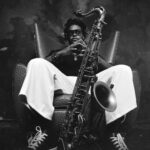

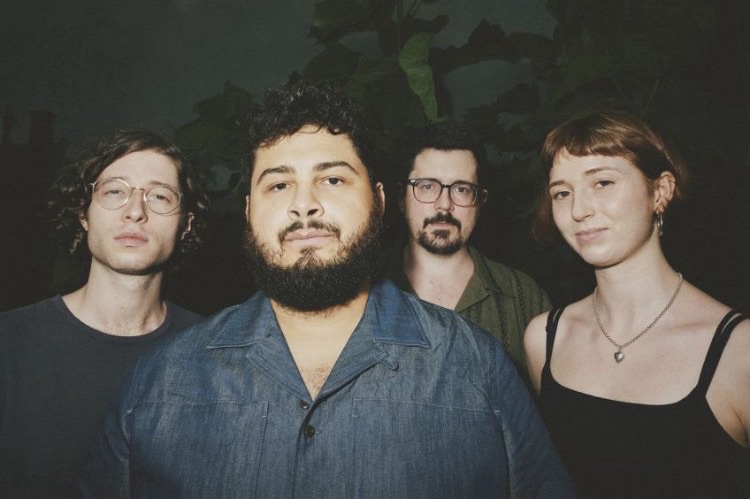

Most are probably familiar with Adam O’Farrill for his sidemen work, including with Hiromi’s Sonicwonder, Mary Halvorson’s Amyrillis sextet, Anna Weber’s Shimmer Wince, or with his dad, Arturo O’Farrill’s ensemble. But the trumpeter has been a leader on five albums. The last of these was a collective of creative music standouts for For These Streets (Out of Your Head, 2025), featured many collaborators from the aforementioned bands: Patricia Brennan, Mary Halvorson. Tomas Fujiwara, Tyrone Allen II, and David Leon. For his six album as a leader, Elephant (Out of Your Head, 2026), he presents a new quartet of emerging stars: pianist-synth player Yvonne Rogers, longtime collaborator bassist Walter Stinson, and high school friend, whom O’Farrill dubs as co-leader, drummer Russell Holzman.
As suggested by For These Streets’ emphasis on literature and film of the ‘late ‘20s and 30s, O’Farrill has a wide range of artistic tastes. Musically, those encompass Afro-Cuban, film scores, electronic, and art rock. Some of those influences, non-jazz if you will, are present on Elephant. For instance, with house beats in Holzman’s drumming. A piece, the only non-original one on the record, is also credited to Japanese electronic pop artist Ryuichi Sakamoto. For extra-musical influences. O’Farrill also credits the game Legend of Zelda, and filmmaker David Lynch, especially Twin Peaks, for shaping the album. As Nate Chinen pointed out in a recent interview with O’Farrill, the album feels more like a ‘composer” album than the usual assumed fiery trumpeter backed by a rhythm section suggested by the group’s instrumentation. As O’Farill himself pointed out in the same interview, he intended to develop emotional contrasts throughout, relying on his bandmates to bring things back to more uplifting tones when needed. The album is filled with more tender, layered cinematic moments than blaring trumpet solos, though they are present as well.

Having seen O’Farrill on stage, one can’t help but be struck by the dazzling array of effects he uses with his trumpet. Those are found here, far less subtly. Note that on the opening “Curves and Convolutions,” O’Farrill also plays Fender Rhodes. Rogers’ piano begins with an ostinato figure, with Stinson and Holzman providing a steady bed of staccato rhythm. The leader enters just shy of the two-minute mark, playing in unison with Rogers until we encounter a giant pause. From here, the music stretches into elongated phrases, becoming more mysterious as it unfolds, both eerie and beautiful. O’Farrill then enjoins the opening motif in his solo. The band becomes much more aggressive in turn, with Rogers comping dense chords, and an intensely growing support from the bass-drum tandem.
The three-part “Sea Triptych” is yet another glowing example of the rapidly changing, flowing music. “Along the Malecon” – a reference to Cuba’s famous sea wall – rings with a pulsating rhythm as O’Farrill’s echoing horn simulates the rush and receding waves. “The Three of Us, Floating” is meditative with trumpet shifts between low and high registers as Rogers strikes her keys in minimalist fashion. The piece references the leader and his brother and father’s vacation to a lake in upstate New York. The third part, “Iris Murdoch,” references the harsh character, Charles Arrowby, from Murdoch’s book, The Sea, The Sea (Chatto & Windus, 1978). Music abruptly shifts into a percolating, Afro-Cuban rhythm, featuring O’Farrill in sharp, darting unison lines, to represent the titular character’s jagged edge.

Standout “Eleanor’s Dance” borrows from atmospheric rock, with a thick underlying pulse. High-pitched trumpet floats above the dense undercurrent imbued by synthesizer and sparkling piano that bubbles up from the gray mist. “Herkimer’s Diamond” reflects this author’s friend’s derogatory remark about jazz – “Four people playing completely different stuff.” In this case, the demarcations are a positive and emblematic of O’Farrill’s uncanny composing. The bass-drum tandem set a steady pace. Rogers seems most directly linked to Stinson, while O’Farrill soars on his own with his muted trumpet. No worries; the separate pieces glue together nicely in the end.
“The Return” and “Thank You Song” are exceptions to the earlier statement about the record being ‘composer’ oriented instead of a heated trumpeter backed by a rhythm section. O’Farrill shows his horn chops on both tunes, reaching stratospheric, volcanic heights. The former, almost twelve minutes in length, builds slowly. It features solos from Holzman, rock-solid comping from Rogers as well as her ‘tolling bells’ solo, a blistering attack by O’Farrill. “Thank You Song” is chord-driven, with the pace gradually quickening to a monstrous crescendo, powered by soaring trumpet and thunderous drumming.

The closing Sakamoto tune, “Bibo No Aozora,” offers a contrast to the two preceding tracks. It’s atmospheric, cinematic, and airy. Rogers’ comping is far more gentle, and O’Farrill’s use of echo and reverb effects makes his singular instrument sound like a full trumpet choir. Holzman beats insistently, almost out of character with the drifting piece, yet he and Stinson are the glue that keeps things coherent.
If For These Streets looked backwards, Elephant feels very forward-thinking, even futuristic, in places. Only a gifted composer could pull a project like this off. O’Farrill’s compositional skills are superb, and at age thirty-one, we can only expect innovative music from him going forward.
‘Elephant’ is out now on Out of Your Head Records. It can be purchased on Bandcamp.