
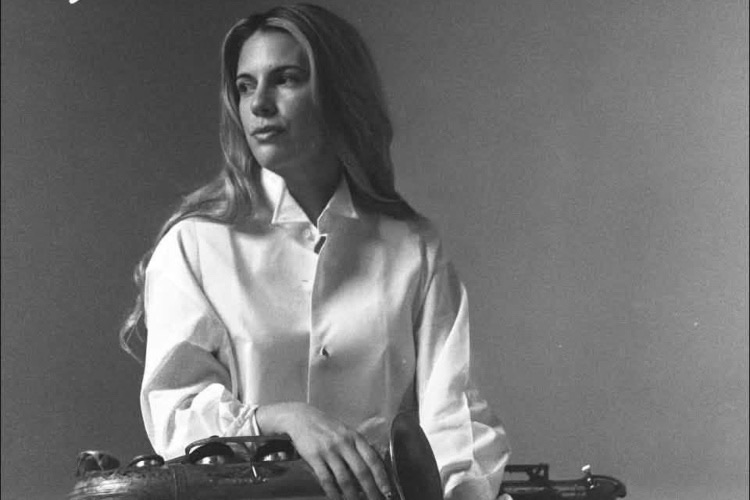

Mi Boathouse (Dox, 2026), the third album by Julieta Eugenio, expands the Argentinian-born, New York-based tenor saxophonist’s chordless trio to a quartet by adding pianist Glenn Zaleski. The underlying trio with Matt Dwonszyk on bass and Jonathan Barber on drums goes back nearly a decade and the addition of keys and electronics breathes new life into the ensemble. In this new endeavor, Eugenio writes for nine originals and rearranges Otis Rene’s “I’m Lost” with an eye towards piano and pedals.
Eugenio’s first two albums – Jump (Greenleaf, 2022) and Stay (self-release, 2024) – often found her in beast mode, blowing her tenor with abandon. But on Mi Boathouse, a restrained calmer mood prevails. That’s partly due to the addition of the piano but also to her thematic quest for solitude. As the artist notes, the title itself reflects tranquility, “When the chaos of the world becomes all-consuming, I seek this place –a bubble wrapped in time and space, where music flows in and out, where pain dissolves with nature’s breath, and a melody can carry me somewhere within this dimension. I call this sacred place Mi Boathouse.” As a result, she explored more contrapuntal lines between the instruments while also seeking colors, textures, and space.
While Mi Boathouse is the first full album of her group with piano added, it came as a natural progression from her live performances. Having won the 2022 DC Jazz Prix for her tenor-bass-drum debut, she added Leo Genovese to select tracks on her second album, Stay. Since then, she has not only expanded her piano writing but also incorporated electronics with pedals used as a composing tool. As to the latter, she created bass lines, recorded them, played over them, built counterpoint, and reharmonized melodies with the goal of carrying the listener through, in Eugenio’s words, “an ocean of rising and falling waves.”
Throughout Mi Boathouse, piano and tenor keep returning to the same figures but without letting the phrases linger. With the opener, “Tree Breath,” the bass works underneath with drums adding accents, often in unexpected places. The leader’s tone is robust and lyrical. Zaleski and Eugenio intertwine their lines on “Brisa,” playing to another lovely melody that is briskly propelled by Dwonsysk’s bass and Barber’s drums. Patterns repeat as Eugenio explores the full reach of her horn, especially the lower registers. Compelling interplay between the supporting trio develops towards the end of the piece.

“A Talk With the Trees” puts tenor front and center in a low-register searching line with a touch of vibrato. Pedals and electronics envelop the melody with Eugenio’s horn ascending. The gorgeous piece, inspired by a walk in Prospect Park where the leader imagined herself becoming one of the trees, moved gently and dances with the wind.
“Mantra” and the title track are Mi Boathouse’s two centerpieces. For the former, Zaleski starts with a short repeated phrase while Eugenio’s tenor floats over Dwonszyk’s compact bassline. Barber subtly attacks his kit with taps, rim shots, and occasional bursts. Zaleski’s notes blur into one another, creating a wave effect. Eugenio keeps embellishing the melody, twisting and deconstructing it, but always returning to its major theme. She seems tempted to improvise more aggressively, but stays contained, even gently fading out at the end. For the title track, Dwonszyk’s lusty bass introduces the piece, one of the program’s more vibrant compositions. Eugenio’s melancholic searching lines are offset by Zaleski’s rollicking repeated phrases and rolling cascades of notes. The rhythm section, anchored by Barber’s kinetic activity, builds the rhythm until Eugenio slips animatedly back in before bringing the piece to an abrupt close.

“Hurtwave”’s title alone implies tension and the music matches it. Rising and receding ripples cascade through horn and keys for the extended piano feature. Interestingly, “The Bee” has patterns that trace to Coltrane’s “A Love Supreme.” “Healing,” another brief track, brims with liveliness and a bit of uncertainty, suggesting process and journey more than a final destination. Zalesski’s piano lines are ragged as Eugenio constantly searches, never quite reaching contentment.
Across Mi Boathouse lie pieces whose titles revel in the beauty of nature – ‘Tree Breath,” “A Talk with the Trees”, and “The Bee.” But “The Heart’s Time” reveals how starkly they stand compared to human constructions. It finds the band revved up and further moved towards the urgency of metropolitan life. “I’m Lost,” the album’s sole cover, seems misplaced conceptually in a record otherwise focused on the search for refuge. Yet its contemplative nature perhaps indicates how being “lost in thought” is a boon, perhaps even a relief, enjoyable only in that sacred space.
Through the immense talent of one of today’s top emerging tenor saxophonists and her bandmates, Mi Boathouse will sail even the most highstrung listener to tranquility.
‘Mi Boathouse’ is out now on Dox Records. It can be purchased on Bandcamp.



Leave a Reply