
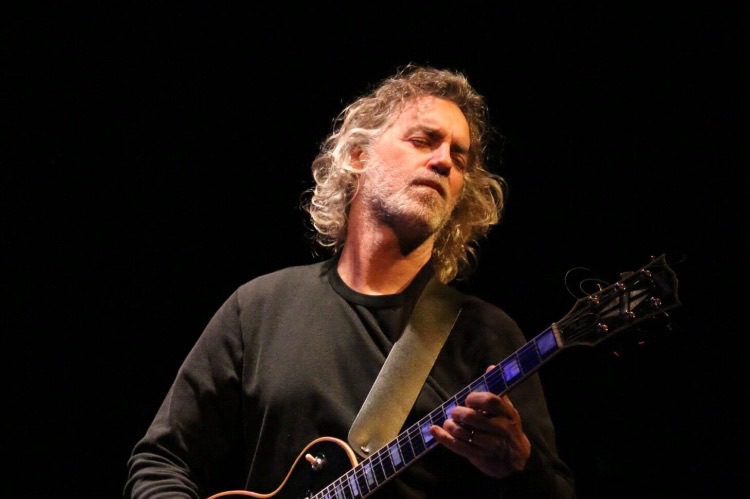

We continue with the second half (read part one here) of our conversation with Joe Morris to discuss some of his recordings, improvisation and composition, and the hidden creative music gem that is New Haven, Connecticut.

PostGenre: Earlier you mentioned how you don’t want to sound like other guitar players. You have recorded several duo guitar albums, including those with Mary [Halvorson] [Traversing Orbits (RogueArt, 2018)] and Elliott [Sharp] [Realism (ESP-Disk, 2025)]. Is it the differences in individualized voices on the same instrument that interests you most about that setting?
Joe Morris: I don’t know. I’ve been lucky to play with people who are friends of mine. Or, in the case of Mary, she was a student of mine. I did a duo years ago with Bern Nix, who was also a great guy. And I also played with Derek Bailey in his house, which was amazing. Derek felt that two guitars sounded like one big guitar.
The album with Elliott came about because the label decided to put it together. It clicked really well. But I also do a lot of guitar duos with people who are students of mine. There are a number of them up on Bandcamp.
I like the idea of playing with other guitar players because it’s a bit of a challenge to figure out how to make it all work. I feel pretty confident that although I sound like myself, I’ve never done a guitar duo that is the same as any other one. And I like to have that in my playing: that I’ve never made the same record twice and have never done the same gig twice.
PG: Many musicians only release an album a year or so. You often release several. Any sense as to how you are so much more prolific in releasing recordings?
JM: Well, I’m lucky that I get to do them. I’m also clever about getting them out when somebody isn’t helping me. I’ve had my own record label- well, now, two – since 1983. Again, my non-linear way of thinking is unbelievably valuable to me. The properties of free music that come from that way of thinking enable me to quickly figure out what’s going on with people I’m playing with and pushes me to not give up anything of myself. I can hear those properties in play. Sometimes more than others. And I can engage with many different people. I don’t have to show up and force a thoroughly preplanned idea that either works or doesn’t. Ultimately, I do what I think will be interesting. Sometimes what I think will be interesting also pays. And sometimes it doesn’t pay anything, but creatively, I want to go in that direction regardless.

PG: Is there a recording that you are particularly proud of?
JM: Well, of my more recent work, I would say the duo recording I did with Wadada Leo Smith called Earth’s Frequencies (Catalytic Sound, 2024) stands out. I’m very proud of all of my work, but that album is one I wanted to make for years because Wadada had an impact on me even back when I was a teenager in New Haven. He’s lived here, I’ve known him a long time, and I have always looked up to him. With the album, I finally got to record with him, and it worked beautifully. It was recorded live, and I’m pretty sure that at about a minute into it, he looked over at me and said, “Wow, this is really good. This thing’s going really well.” I’m really proud of that.
I’m also really proud of the duo record I did with Evan Parker called The Village (Fundacja Słuchaj, 2019). That was really good. So was Four Improvisations (Duo) 2007 (Clean Feed, 2008) with Anthony Braxton. And also a duo I did with Matthew Shipp years ago [Thesis (Hat Art, 1996)]. I think it stands up.
PG: You also have a fantastic trio recording with Shipp and Marshall Allen [Night Logic (RogueArt, 2010)]. How did that project come about?
JM: It’s interesting. Matt and I were thinking about doing a trio with an older, well-known horn player. We considered a few people and then came upon the idea of it being Marshall Allen. We talked to the record label, Rogue Art, about the idea and ultimately found that Marshall wanted to do it. So, we ended up playing and recording the album at Roulette. That was back when Roulette was on Mercer Street or Green Street, before it moved to Brooklyn. Anyway, the album came out really well, and we got a gig for a smaller stage at the Newport Jazz Festival, then another at Yoshi’s in San Francisco, too. At the Yoshi’s gig, Sunny Murray joined us while I played bass.
PG: Wow.
JM: It was cool. The three of us, Marshall, me, and Matt, played but knew Sunny was probably going to come out to join us. When he did, so did Eddie Gale and the cellist Kash Killion. It ended up being one of the greatest experiences I ever had because I love Sunny Murray so much. We all started playing, and I looked back, and Sunny had his eyes closed and his head back. He was swinging like crazy for forty-five minutes. It was spectacular, and then Matt and I said, “Okay, that’s enough; let’s let Marshall and Sunny finish,” and we left.
Matt and I are close friends and talk a lot. We have been friends for maybe thirty-seven years, and I think I’ve talked to him on the phone more than anyone else in my adult life. We’ve managed to work really well together, through thick and thin. We’re very different in terms of how we think, but we could even play with a cardboard box and make it sound like music. We have also done some incredible work together with Anna Weber, who is also terrific. We’ve also done a bunch of things with Ivo Perelman and other people. Matthew is a great improviser and also an incredibly smart, very unique person. There’s no one else like him, and he’s “the real deal,” as William Parker would say. There’s never been another one like him, and there never will be.

PG: To go back to some of your albums, what can you share about Abstract Forest (Relative Pitch, 2025)?
JM: The album features a trio of me with Brad Barrett and Beth Ann Jones. Beth Ann’s great. She is a classically trained bassist and just finished her master’s degree. She had switched her studies to improvisation only about a year and a half ago. And she’s extraordinary. I don’t think we’ll hear the full range of what she can do for a while, but I’ve been lucky to work with her and hear what she can do.
Brad, of course, is a great cellist. He is also a great bassist who has played cello with me in a bunch of situations. I asked him to play only cello on this album. I’ve had discussed all kinds of ideas with Brad for years.
Over the years, I’ve worked with many different people with my arch-top guitar kind of thing, and it’s grown in a lot of different ways. I’ve had to decide that certain parts of it can be left behind and others incorporated into my other music. I think I finally figured out how to integrate a whole bunch of things musically. With this trio, I have a company of people – an ensemble- that can do so with me. I gave the album the name Abstract Forest to reflect that part of my music right now, and that the record represents my years of developing these ideas in many different ways, to the point that I now have enough control over them and a group of people who understand them well enough that we can fully work with them.
PG: But at the beginning of your creative relationships, what interests you in working with someone?
JM: Well, I always listen to people. My main criterion for who to work with is whether I can have a conversation with them. Is there something they do that we can share? Will we be able to listen to each other and interact well? Sometimes that means playing with a saxophone player who will solo the whole time, but makes music that is interesting and that I can play bass with.
Logistically, sometimes people and labels come to me, and other times I go to them. So, for instance, I knew about the harpist Jacqui Kerrod before she came to me because I had heard her play with Anthony Braxton in New Haven when they did his ZIM music. But Jacqui asked me to record a duo album with her. I listened to Jacqui to get a good idea of where she was going. And I agreed to do it because of what I heard in her music. I also know that people who work with Braxton tend to have material that I think is essential in the way they work with other people.
PG: You have mentioned both Braxton and Wadada now. Both use their own systems of graphic notation. You used some graphic notation yourself for the INSTANTIATION albums (Glacial Erratic, 2019). Is that something you’ve been exploring more?
JM: A little. I try not to do things that don’t have a real purpose, so, need a good reason to use graphic notation. For the graphic notation I used with INSTANTIATION, I spent a lot of time trying to figure out what I thought could deliver some of the information I wanted to deliver without traditional notation or without direction. I came up with a few ways to do that, which, I think, are different from how other people approach graphic notation. My approach requires that the player improvise with an image in a sequence, like they’re reading music, and not with other players. It’s a juxtaposition notation and works really well. I have some other graphic things that are like maps. jaimie branch adopted my mapping approach, and some other people use it as well.
I don’t think of graphic notation the same way as some other people, like Braxton or Wadada, do. I think they’re more of composers than I am. I compose, but they’re composers. I’m comfortable being an improviser who sometimes needs to convey some information to some people and give them enough control to do so.
PG: So, you do see a big difference between improvisation and composition? Wadada refers to both as just creation.
JM: I don’t think composition is more important than improvisation. What I like about improvisation is for me, that it’s more efficient in facilitating a performance of complex music than composition. I am deeply interested in methodology and how that informs the way I can use improvisation to make music. Every methodology for improvisation has some compositional component.
I just did a bunch of stuff in Chicago with some people whom I knew as students. I wrote a bunch of music, some of which uses traditional Western notation while the rest is a mix of that and graphic notation. I gave the musicians almost no instruction because I’ve spent quite a bit of time working with these people before, and they knew what I wanted to have happen. At this point, I’m thinking a lot more about writing and using that stuff as a bass player. As a bass player, it gives me an opportunity to play very differently than I often do with other people. And it went really well in Chicago. It was incredible.
The first version of that project was done with Rob Brown, Anna Weber, and Matt Rousseau at Firehouse 12. We recorded it, and it is coming out on a Polish label I can barely pronounce, but it is going to be great too.

PG: Firehouse 12 is a fantastic presence in New Haven. It is one of those places that seems to be finally revealing to people everywhere else the great improvised music scene in the city that many people elsewhere are not hip to.
JM: Nick Lloyd at Firehouse 12 is like a saint. He’s an unbelievable person. We have some unbelievable people here, like him, who support us. And it’s kind of a miracle that we do. Growing up here in the 70s, there was a ton of stuff going on in New Haven, and it’s really been an inspiration to me. When I moved to Boston [in 1975], I organized a ton of stuff. And then when I returned to Connecticut in 2000, I went to New York and organized stuff. I went back to Boston and organized stuff. People like Mat Maneri and Ken Vandermark were involved in some of those things that I organized and clubs that I opened. A lot of the young people doing things in New Haven were people that I had worked with when they were students, who knew each other or found each other, and drew influence from things myself and others did in New York or Boston. I’ve tried to be one of the people who organizes things. And so when I moved back to New Haven, I went to work organizing things around the same time Carl Testa, who played bass with Braxton, was beginning to organize things too. And that brought in some people.
Now, there are a lot of people around here and hardly any place to play. But everybody uses everything they can, and people are very generous. We all participate in this community at places like Never Ending Books, where young free improvising musicians play regularly. I went in there to play percussion one night, and Anthony Braxton was sitting in the front row. We have a really healthy scene here. And that is amazing. Young artists here are getting bombarded by people all over the world who want them to play elsewhere, but they often stay here.
But there are great young artists everywhere. You’re in Austin, and there is a young bassoonist there named Joelle Wagner Morales who is incredible. She’s my favorite bassoonist. And there are people in Philadelphia, Chicago, in the Bay Area, Seattle, Toronto… they’re all over the place. In 2016, Stephen Haynes and I co-ran a series called Improvisations at Real Art Ways in Hartford. We invited people to play. We had an incredible group of musicians play with us. At the end of each season we had a one day ad-hoc festival called Spectacle that combined young people who are starting out on the scene with well-known professionals. Since 2021, I’ve had my own series there which is now called Instantiations. For it, I invite people to play with me. I’ve had Braxton play in it. Wadada, Tyshawn Sorey, Nicole Mitchell, William Parker, Tomeka Reid, Mary Halvorson, Nasheet Waits and many others have played with me in it, and a lot of tremendous young people play in it too.

PG: Why do you think the series isn’t generally more discussed?
JM: It doesn’t get a lot of attention because a lot of things that happen in Connecticut don’t get attention in other places. You lived here, so you know what I mean. This is not the type of place where people make a big deal about anything outside of what is their favorite pizza joint.
I still do things like work in New York and tour Europe. I play all over the place. But we always have a great audience here. I remember years ago, when I was seventeen or eighteen years old, Miles Davis and Dizzy Gillespie would play here in New Haven. One afternoon, Rashied Ali played at Sprague Hall at Yale, their chamber music hall. I went, and it was packed. And his group played pretty challenging music. But there was still maybe a ten-minute standing ovation at the end. That’s New Haven. That’s how I see New Haven. And there are a lot of young people who work in Boston and New York who think about moving here. They all want to come here and play. Isn’t that amazing?
PG: As a final question, you started playing guitar in 1969. Now, nearly six decades later, how do you feel your relationship to the instrument has changed the most?
JM: I think it goes back to the first question you asked me. I grew up in a family that liked music. I had an uncle who was a famous drummer. And both of my parents loved music. They didn’t really like each other, but my older brother and my older sister brought a lot of music into the house. I listened to the radio all the time. I was really into the Beatles. I watched them on Ed Sullivan the first night they played in America. And when my friend’s cousin came to West Haven, where I lived, he showed me some chords. I had played trumpet before; I wanted to be a trumpet player, but I had trouble in school. I was a truant and couldn’t take lessons anymore. The guitar seemed like something I could do on my own, as a lot of people did. And it gave me a completely different focus in life.
I was thought of as somebody who couldn’t learn because I had all these other things going on with me. The practice of the guitar focused me to learn all kinds of things in a real autodidactic kind of way. And I think that’s what it still does now. Playing the guitar provides me with a way to focus on a lot of things. Whether I’m thinking about music in general, playing the guitar, or playing the bass, it all helps me understand everything else. I think that’s, again, the artistic sort of disposition. I have to take whatever else is going on in the world and in my life and bring those disparate things to a point that unifies them. Music does that for me. It’s a normal human trait to have an artistic outlet, and the guitar is still that for me, even when it’s frustrating and difficult.
There’s an awful lot of doctrinaire dogma around playing the guitar. That is unfortunate, considering that everything that happened on the steel string guitar was invented by a person who played it. It’s too bad that there is so much emphasis on a narrow idea of how to play the instrument. People should instead be able to pick it up and figure it out themselves. I’d like to figure out another way to play it today. I’d like to find another way to swing. I’d like to do something that I’ve never heard of before. And I’m always going to keep trying.
Joe Morris will receive Arts for Art’s Lifetime Achievement Award on June 23, 2026 at the Abrons Arts Center in Manhattan as part of the Thirtieth Vision Festival. During the evening, he will also be performing in a variety of duo (with Nicole Mitchell), trio (with William Parker and Matthew Shipp), quartet (with Tomeka Reid, Melanie Dyer and Solomon Caldwell), quintet (with Rob Brown, Hery Paz, Matt Rousseau, and Hidemi Akaiwa), and octet (with DoYeon Kim, Dan Blacksberg, Jonathan Paik, Selendis Johnson, Nick Neuberg, Noah Campbell, and Lemuel Marc) settings. More information is available on Arts for Art’s website. You can learn more about Joe Morris on his site.
Leave a Reply