

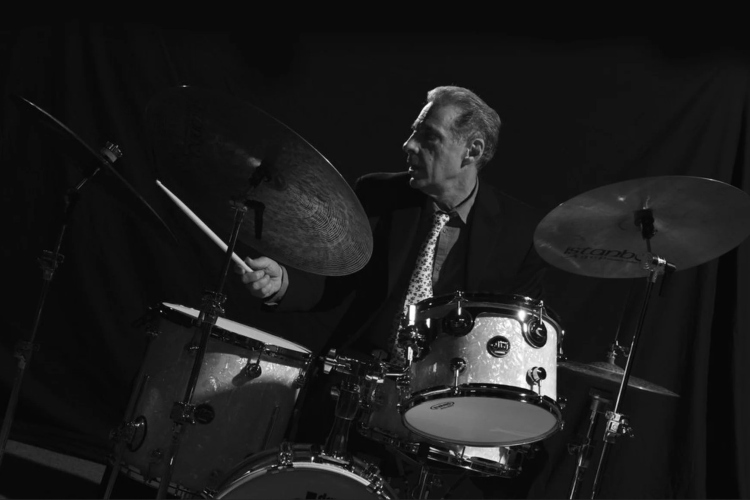

Success. We all seemingly yearn for it. We want validation that our hard-fought battles have been won and the casualties of time and sacrifice worth the war. And yet, success and notoriety bring their own problems. Mastery in one realm far too often overshadows the subject’s expertise in others. This problem is especially prevalent in the realm of artistic expression. Success can be a strange curse for an artist as the very thing that makes the world pay attention can distort how that world sees you. Mike Clark knows that bitter sting of accomplishment all too well.
Over the last half century, few have approached the drumset with as much tight, heavily grooving precision as Clark. In the 1970s, he played a central role in the Headhunters as the band increasingly moved beyond the shadow of Herbie Hancock. The Flood (Columbia, 1975) of funkiness quickly gave way to an ensemble moving Straight from the Gate (Arista, 1977) toward a distinct sound of its own. A two-decade recording hiatus would seemingly slow the band’s influence, but the rise of sampling only further exposed their ideas to new generations. And over the last three decades, the Headhunters’ funkiness has been reconceptualized in everything from hip hop to second line. Given the drummer’s background, it is all too easy to label Clark a funk drummer. His mastery behind the sticks has even led some to call him the “Tony Williams of Funk.”
But that is all only part of Clark’s story. Deep beneath the Headhunters’ Forcible Thrust (Columbia, 1974) lies a man as skilled at more traditional jazz and its progeny. Underdiscussed is the work with Vince Guaraldi on Peanuts soundtracks, collaborations with masters like Eddie Henderson and Henry “The Skipper” Franklin, and a series of fantastically vibrant quasi-straight-ahead records. For those truly in the know, it becomes evident that Clark’s heart beats as much – perhaps even more – to songs like “Cherokee” as it does “God Make Me Funky.”
What you are about to read is a conversation with Clark from November 14, 2025. For one reason or another, it sat unpublished for several months. The conversation itself is nominally tied to the release of Itai Doshin (Wide Hive, 2025), a fantastic ensemble outing with Henderson, Franklin, Patrice Rushen, and Craig Handy. But, more importantly, it reveals a fuller picture of the artist than is typically portrayed. It shows a man who grew up on the music of Duke Ellington and Count Basie and how much that music still means to him. With the recent announcement of his forthcoming autobiography, God Make Me Funky: Confessions of a Headhunter and Bad-ass Buddhist Drummer (Backbeat, 2027), written with Bill Milkowski, it seemed like the perfect time to look a little deeper at the artist beneath it all.

PostGenre: The title Itai Doshin comes, in part, from your practice of Nichiren Shoshu Buddhism. It is interesting how many musicians have practiced Nichiren Shoshu – Herbie Hancock, Wayne Shorter, and Michael Brecker, to name a few. Do you have any sense as to why it particularly speaks to musicians?
Mike Clark: I had a long history with meditation before I met Herbie, but he’s the guy who really turned me on to chanting. I was a talented guy, but I was not very focused. I would be relegated to having good nights and bad nights. I couldn’t seem to get into the arena I had designed my music for. I told Herbie, and he said, “Well, you need to start chanting. Check that out and see what it does because you’re going to find some tremendous benefit.” Once I started to do that, I was immediately freed up. I played like a caged bird who could sing. I no longer cared about things like who was in the audience. I was completely focused and could access all of my ideas without the slightest outside thought. I could react to whatever came my way musically without thinking too much about it. That’s a huge benefit, man. I thought it was luck, but as I kept chanting, I kept finding that kind of energy. It is an energy where you’re not self-conscious, unlike I was before then.
The other thing was fortune. I needed the fortune to play the kind of music I wanted to play. I mean, when I auditioned for the Headhunters, I was not very interested in funk. I was interested in Herbie Hancock. And Paul Jackson was my best friend. Paul and I shared a house, and he didn’t really play electric bass back then. He was an upright bass player along the lines of Ray Brown, believe it or not. That was his thing.

PG: Wow.
MC: So, when Paul and Herbie got together, I thought they were going to play jazz. I came in sounding like a cross between Tony [Williams] and Elvin [Jones], which was my thing at that time. I was trying to emulate those two guys in one guy, or that is how I looked at myself anyway. Of course, that view is ridiculous because they, especially Elvin, were geniuses. But Herbie instead told me to put a pillow up against the bass drum and play it. Paul told me to play some backwards, upside-down funk. I said I’d do it and see what happened. And after I did, they hired me. When I found out they were going to play funk, I told Hancock that I wasn’t sure I should be in the band because, at that time, I was playing with Joe Henderson and Bobby Hutcherson. I thought that being in the Headhunters could screw up my jazz career, which it did.

PG: Too many people labeled you as a funk drummer?
MC: Almost every musician after Herbie went to Rhodes and Funk City. I’m one of the few people who seems to get stereotyped for it though, as if I can only play funk. C’mon man, what are we, nineteen? I don’t know what it is, but a lot of people seem to limit their view of what I do to only funk.

PG: Why do you think that is?
MC: Well, Herbie’s record [Headhunters (Columbia, 1973)] sold a million copies, and my records sell a couple thousand, if I’m lucky. I think that has a lot to do with it right there. Everybody loves the Headhunters, and I was rather shocked when we played that stuff.
PG: That concern over being labeled seems prescient given how young you were at the time.
MC: I was quite young – twenty-four years old – though I had been working professionally since childhood. My father was a drummer, and he got me working in music.
But to go back to my chanting, I saw that chanting could remove the things in my life I would hide from others. It removes the things that block me from getting where I want to be. The lifting of those blocks was visible to both me and to others. I visited my mother after I’d been chanting for two or three months and she asked why I seemed so different. She peeped it, you know?
Part of the payoff of this particular type of Buddhism is what they call the human revolution. The parts of you that are already good are enhanced, and the parts that are not working for you can be overcome. You get it to actual proof through inner reformation. Through that, you are able to achieve the things that you’re searching for. It’s not magic. You’ve got to do the work. But it does work. That was what “Actual Proof” was about; the fact that it actually does work.

As far as Itai Doshin, the name of the album, it means many in body, one in mind. It doesn’t mean that everyone thinks alike. But it does mean you can have many people coming from different backgrounds and different points of view who can be unified to get a common result, such as world peace. Of course, it is just a jazz record. It’s not by itself going to stop war. But that’s an example.
But the band felt so unified. We didn’t even rehearse. We just did a gig; I had the charts, and we just played. We felt like one organism and nobody was struggling. Nobody was trying to be understood. We just freely moved as one.
PG: Is it easier to move as one mind when the group is made of musicians you have worked with a lot, as with this band?
MC: It always helps if you have a rapport with the musicians, and you’re all compatible. Some people are hard for me to play with. Or I’m hard for them to play with, and I can immediately feel that I’m not the other person’s cup of tea, and that’s natural. Not everybody’s going to fit together.
But my experience with Buddhism tells me that I don’t have to know people for a long time to be comfortable playing with them. If there’s a vibe – it doesn’t have to be perfect – we all have some type of understanding, and if the bass player’s got a good swing and quarter note, we can come together. I think one thing about New York is that most people are really conscious of swing and having a fat quarter note. You don’t have to spend a lot of time waiting to get to your stuff; you can get the groove up right away.
For the group, I did pick people I know and have a common understanding with. I especially have that with Eddie Henderson, as we have been playing together since the ‘60s. By now, I know well how he reacts, and he knows how I react. I also know Craig Handy very well. And I was glad to get Henry Franklin, “The Skipper,” on this date as well. He and I had history in LA; I had stayed in LA for a while, and he used me on a lot of his gigs.

It felt so good to make the record. I don’t remember any of the tunes being a struggle. It all kind of just played itself out right then and there. And it was fun. We were screwing around, laughing, and having fun. So, yes, I do have history with all these people. But it is really the synchronicity of the universe through chanting that is a central part of it all.
PG: As for Dr. Eddie Henderson specifically, because that relationship goes back so far, do you feel the way the two of you communicate has changed and evolved over the years?
MC: Absolutely, because we’ve both changed and evolved. You’re always going to bring all of the knowledge that keeps growing with you to anything you do. But we have always had an open line of communication between us. He plays very openly, and so do I.
But back when we first started working together, it was hip to disguise your bebop roots and play along the lines of Tony and Elvin, who were, at that time, considered modern. I would edit a lot of that out earlier because I was young and trying to be hip.
Eddie and I have lived a lot of lives since then. So when we’re having a musical conversation – this is true of everyone in the band – we know what that dialogue is. We’ve all been playing all our lives. There are very few curveballs anyone can throw at us. Nobody’s perfect, but we know the language pretty, pretty damn well by now.
We also recorded Itai Doshin in the same studio that Patrice, Eddie, and I each kind of started our careers. It was a bit of a fluke the way that came down, but it was interesting that we all got back together in Studio A [of Wally Heider Studios]. That’s where Eddie started with Mwandishi. I started with [Herbie Hancock’s] Thrust (Columbia, 1974) and, even before that, with Vince Guaraldi on music for the Peanuts.

PG: Your time with Guaraldi certainly does not get as much attention as your work with the Headhunters, for several reasons. But it also has a power behind it from exposing so many young ears to music they probably have not heard elsewhere.
MC: Guaraldi was a very close friend of mine. I played with him for years. The Charlie Brown stuff was fun, and kids like it. I like it too, and it was fun to do. We played with some great musicians for it.
A lot of people don’t know about Vince beyond the Peanuts stuff, but he made a lot of great music. Even as a guy on the West Coast, he had a New York beat. He could really swing as he played with Charlie Parker. He could play tunes and sound similar to Hampton Hawes or Wynton Kelly. He was able to do a lot beyond the music for the Peanuts.

He was also a crazy cat to be with, man. He was a really different kind of guy. He was a self-made guy. He made a lot of money right away, so he was in his own lane. A great guy, though he had a terrible temper. The worst temper of anybody on earth. He was a handful, but I loved him, and we were like really good friends. Guaraldi was a trip, man. He would just call you to watch TV over the phone together, stuff like that.
PG: Do you think it ever irritated him that most people who knew of him probably thought first about the Peanuts and not his other work?
MC: Hell yeah. But, at the same time, he lived in a gorgeous home and had a Porsche. He loved that. He knew what a hard-swinging piano player he was, and he always wanted a drummer with a New York beat. That was me. His earlier drummers were great, but each had a more laid-back West Coast thing. The first time he played with me, he said, “You’re my guy.” And that was it.
PG: Even though you are from the West Coast?
MC: Yeah, but I always had that heavier kind of groove. I grew up in a lot of different places. My father was a railroad man, and we lived in Pennsylvania, New Orleans, and Atlanta. He would take me to jazz clubs constantly to sit in and play when I was only eight or nine years old. I had seen Art Blakey and all those guys live by the time I was ten. And that was my ideal. I can’t play like Blakey, but that dirty swing was my ideal. I also like old tunes. I like Thelonious Monk tunes. I like the Great American Songbook. I have a library of big band stuff, and all kinds of original stuff. I just like playing tunes, man. When it’s my date, I like to swing.

PG: You can certainly sense your love of the songbook on Itai Doshin, particularly on “Cherokee.” So many artists approach that piece at a breakneck speed. But you play it slower, showing how there is still more to explore in the piece.
MC: There is always something new to discover. I feel that way all the time, especially on a gig with a guy like Mike LaDonne where we play old tunes but create brand new experiences out of them. I never feel like I’m tired of playing a certain tune even though I’ve been playing many of them since junior high.
But for “Cherokee” specifically, my friend Towner Galaher is a great drummer and arranger. He arranged some of the pieces on the album for me. At one point, he was at my house, and we were sharing a couple glasses of wine. He said to me, “Hey man, why don’t you do Cherokee as a ballad?” I rejected the idea at first. But when we were in the studio, I realized my rejection was a knee-jerk response. And I decided to use it for a ballad. We recorded it in ¾ time with no rehearsal.
PG: Wow.
MC: And it unfolded beautifully. Patrice really made it happen because of the way she played the chords she used. She got the sound we wanted immediately, and it made Cherokee a ballad without anyone having to think too much about it. It just went right down. We asked the producer if we should record another take just in case, but he said we got it on the first try. When you do something you haven’t done before, as we did on that first take, everyone’s brain chemicals light up, and they start coming up with stuff. We all lived that song in that moment. We had all played “Cherokee” at a burning level since junior high school. And all of a sudden, here’s this beautiful lush ballad, but it’s still “Cherokee.”

PG: So as far as Patrice, how did you first get hooked up with her?
MC: I did Eddie Henderson’s record Heritage (Blue Note, 1976). When Paul Jackson and I were with Herbie, Eddie and I always played jazz together, not funk. And all kinds of different jazz, too. Straight ahead and also free. Everything. But because Eddie had just left Mwandishi back then, we also played “Hornets,” “Toys,” and all those kinds of things from that band. At that time, Paul and I were garnering a reputation for playing some kind of weird funk. Eddie was looking for that sound, and [producer] Skip Drinkwater had us come in on the date. Patrice was on that date too. I’d heard of her before then, and I’d heard her jazz thing, but I had never heard her play in this vein. It was a great date.
That’s how I met Patrice, and then we did a few things together. I went to a club in Los Angeles one night and heard her playing straight-ahead music, and it was incredible. Ever since our first session, I never forgot her sound and feel. Her feel is incredible, man. She can play anything and can translate my insanity immediately. I don’t have to explain anything. I can kind of say, “Here’s the tune, here’s the way I’d like it to unfold, and see you later.” I always felt that way with her from that very first record date. I didn’t have to look for anything or change anything. I thought of her immediately for this date, and it worked out great.

PG: She is an incredible piano player. Do you think she has similarly been pigeonholed by the success of songs like “Forget Me Nots”?
MC: Definitely. I heard her with Buster [Williams] and Lenny [White] a couple of years ago at Dizzy’s [Club Coca-Cola at Jazz at Lincoln Center], and she was slaying. I could be wrong about this, but I believe she was a straight-ahead jazz acoustic pianist at the beginning.
PG: Which also, in a way, goes back to the problem of labeling that you were mentioning relative to you and the Headhunters. You can play jazz music of all styles but are often labeled as a funk drummer. Patrice can do the same, but is too often categorized as R&B or pop due to some of her better-known work.
MC: Yeah, but no use crying about it. People who keep open ears and minds know what we can do. Look, I’m seventy-nine years old. In the ‘50s, when I was a child, in grade school, I played in a big band. We played music by Benny Goodman, Count Basie, and Duke Ellington. There was no funk. The closest thing to it would have been someone like Louis Jordan, but we didn’t play that kind of stuff in school, just as you didn’t play Elvis at school. So, my jazz background was well developed before the funk craze hit in the ‘70s.
It all reminds me of a story about Leonard Nimoy. Once, Nimoy was on Broadway with the Royal Shakespeare Company. He was delighted to be playing his role as Sherlock Holmes, and he was killing it. But some guy in the audience yelled, “Yo, Spock!” It is the same thing. What are you going to do?

PG: To be fair though, it is not entirely true that the Headhunters was your first funk gig. For one thing, you worked with Betty Davis before you even met Herbie.
MC: To keep working and stay alive when I was in California, I played with people like Joe Tex and did the Chitlin Circuit. There were organ trios on those gigs, and I was in a lot of organ trios. To do that, you had to play some Wes Montgomery music, “Tequila,” “Mercy, Mercy, Mercy,” and stuff by Horace Silver and Hank Mobley. So, yeah, it wasn’t like I’d never played a note of funk before.
As far as Betty, I played with her when I lived in Texas. At that time, I was playing with Albert King, Albert Collins, and Jimmy Reed. Blues music. Along with that, you’d have to play some backbeat stuff too, not just shuffle blues and slow blues. At some point, Buddy Miles called me. I knew who he was because we lived near each other in a hotel. I knew he was a drummer because I would practice in my room. Because there was no air conditioning, my door would be open, and he would come by and say, “Hey man, you sound really good,” and we’d talk. But I wasn’t too familiar with his music. Anyway, he asked if I had played some funk. I told him I had done some with Guaraldi. And from that, I got hooked up with Betty.
But, even so, playing electric is not something I am a fan of. I’ve never loved electric instruments. And it is a bit of a challenge for me to play with them because my language is not fusion language. I come from bebop, man. When you’re trying to play the language that I play, I’ve had to soup it all up to get through the Headhunters. However, we have Craig Handy in the Headhunters now, and he has really opened the door to allow the band to get extremely expansive. Now, we play something like “Humpty Dumpty,” but we will also throw in standards or something by McCoy [Tyner] or an original. We play funky stuff but also non-pocket funk. We can get really loose and very expansive. We have a great band right now.
But it is also not a jazz band. And, to be honest, if I could just play jazz all the time, I would. That’s just how I am; I’ve always been that way.

PG: So, since you have been with the Headhunters for so long, have you ever gotten to the point where you feel like you just don’t want to play with the band anymore?
MC: Yeah, several times. Many. When I quit Herbie’s band the first time, I never wanted to play Headhunters music again. But then Bill Summers called me years later because he had decided to put the band back together; I thought, “what the hell?” By then, I had been in New York for somewhere between ten and fifteen years and had played so much bebop. So, I went back to it. And it’s been a great experience. It’s a great band. It’s hard not to like it, even if it’s not a jazz band. These cats can play, man.


PG: And it seems like every record the Headhunters comes out with explores a different idea or style. Platinum (Owl Studios, 2011) drew heavily from hip hop and Speakers in the House (Ropeadope, 2022) from New Orleans music, for instance. There are a lot of things that come out in the band’s music.
MC: Oh, yeah. Sometimes we play avant-garde, totally free too. Anything can happen. When you’re on the road and exhausted, that’s when musicians will throw caution to the wind. We just finished a tour of Europe, and it was musically very satisfying. And for me to say that is a stretch because of how I’m always apprehensive about electric instruments. For how I play drums, it sometimes takes a lot to cut through those instruments. I’m used to the sophistication of swing, which has a very different feel than funk. And that difference is even more exaggerated because the Headhunters use giant amplifiers and are louder than a jazz band or an organ trio because of it. The Headhunters is challenging for me, somewhat, because of that.

PG: So was Brand X even more difficult for you because of that? The band is certainly even louder than the Headhunters.
MC: Well, Brand X to me was a difficult life. They were louder. Live was difficult for me because the band was super loud. But most of our work was in the studio. In the studio, everything went through the [mixing] board, and you had earphones on. So, while it was loud, it didn’t feel loud.
Playing with Brand X was an amazing experience. But they were getting to the point where they wanted me to shut down and play two and four pockets. They were trying to make money, and everything was becoming commercial. They hired a rhythm guitar player. And it just wasn’t for me anymore. I dug when the band was very creative, open, and crazy. I loved it. For me, Brand X was such a change after the Headhunters because they were playing anything they wanted. So, when they asked me to just play time, to keep it on the two and four, I was out.

PG: To ask you about another project, Discogs indicates you were on Prince’s Love Symbol (Warner Bros., 1992). How did that collaboration come together?
MC: It didn’t. He sampled a song Paul and I wrote years before for the Headhunters called “God Make Me Funky.” Santana sampled my drums from the Headhunters’ recording of it. So did N.W.A. They were the first to sample us, actually. For a while, our song was a big sample, and most people never paid us for it. They ripped us off. I definitely had some feelings about that, but there was a lot of internal Headhunter stuff that was also going on at that time. There was some skulduggery amongst some of the Headhunters that blocked us from getting a payday. I’m not hurting. I’m making a good living, so it is what it is.


PG: But you do have a great quote on it from back then from your interview with Vibe Magazine.
MC: Yeah, they had asked me if I was proud to be one of the first artists to be sampled. My exact quote was “I dug the cred, but I’d rather have the bread.” They printed it. My phone was ringing for months after that with people asking me if I was serious when I said that. Of course I was serious. The money was a problem early on for hip hop. Once, Snoop [Dogg] asked me to come out to the studio and lay down some tracks, but his engineer told me not to do it because I wasn’t going to get paid. I don’t know whether the engineer was telling the truth or not, but I didn’t do it.
PG: Was it also frustrating that the samples were, in some ways, reinforcing the label of “funk drummer” on you? Presumably none sampled your straight-ahead work.
MC: I don’t think they even knew about my jazz stuff. I don’t know whether they even listen to that kind of music. I’m not gonna mention any names, but I’ve been to a few sessions where I played, and they sampled me right there. One guy – he was very well known, but I’m not gonna say who – and one of his friends came into the studio. There was a keyboard there, and the friend didn’t play any instrument. The friend was smoking some weed, put a couple fingers on the keyboard, and played random notes. He was just stoned. And the engineer was like, “Man, that’s great!” and put it on the track. Something like that is not happening across the board but was way too common early on for hip hop.

PG: To return to your current band, where do you see it going in the future? Will you be recording again?
MC: We’ve already made a new record that will come out at some point. We’ve recorded some nice stuff for it, man. “East Broadway Rundown.” Wayne Shorter’s “Beauty and the Beast.” Some really great stuff.
I’m also talking to the people who run the San Jose Jazz Festival to see if they would like to book the band. I’m definitely trying to become a bandleader who plays festivals and big jazz clubs. That’s my goal, just as Art Blakey and those guys did. I know SF Jazz wanted us to come back, too. So, we’ll see what happens from here.
‘God Make Me Funky: Confessions of a Headhunter and Bad-ass Buddhist Drummer’ with Bill Milkowski will be released on February 4, 2027, on Backbeat. More information on Clark is available on his website.


Leave a Reply