

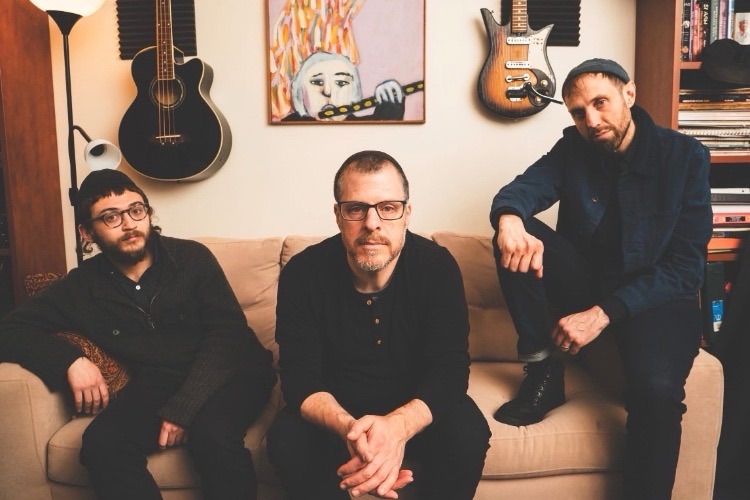

In Hebrew, the word Netzach (נצח) holds several overlapping meanings. Some, like “eternity” or “perpetuity,” point to spiritual existence beyond the here and now. Others, like “endurance” and “victory,” appear more contemporaneously focused, but inevitably carry the weight of a much longer Jewish history from forty years in the desert to the present day. The seeming malleability of the term’s definition should, however, not be perceived as a weakness. Instead, it speaks to breadth. Just as Judaism is equally a faith, a culture, and a people, multiplicity does not diminish significance. Similarly, the title Netzach (Tzadik, 2026) is incredibly apt for guitarist Jon Madof’s new trio record as it fully encompasses the breadth of his music.
Underlying Judaic roots invariably nourish Madof’s art. An observant Jew, Madof views Jewish spirituality, texts, culture, and communal life as not just theoretical underpinnings but a lived reality. They are an inescapable part of his music that he probably couldn’t entirely step away from even if he tried. Others in the broader Jewish community have also shaped his views on both music and life. His frequent collaborator John Zorn, for instance, has done more than probably anyone else to expose the interrelation between klezmer and jazz. Madof is also attentive to the news of the Holy Land. For one, he was only a few degrees of separation away from Hersh Goldberg-Polin, one of the hostages taken and killed by Hamas on October 7, 2023. He invokes the need for perseverance in the struggle in Israel, not to make some grand political argument but as an advocate for a peace yet to be achieved.
But the multiple meanings of Netzach should also be interpreted as a reflection of how Madof’s music also reaches beyond his Jewish identity. Even while borrowing from the historical music of his people, the guitarist has avoided overly binding himself to tradition. Instead, he looks to where his culture morphs and intersects with the other sonic ideas that interest and guide him. Perhaps the best example of this can be seen with his ten-piece Zion80, a group equally indebted to the sounds of Fela Kuti and Tony Allen as it is Rabbi Shlomo Carlebach. Indeed, any careful observer of much of his music will pick up on the cues left by the sway of surf rock, the fierce independence of punk, the razor-sharp edges of metal, and the fearless experimentation of avant-garde jazz.
The album Netzach similarly highlights the guitarist’s broad and malleable scope. “The Beautiful Six,” dedicated to the six Israeli hostages killed by Hamas, defies easy definition. It begins quietly with finger-picked guitar that slowly builds into distortion and a thrashingly heavy motif. The unavoidable sorrow quickly meets with anger about the senselessness of such loss. The gentle lyricism of “Urim” suggests the peace denied to those six. “Shimi” hints at Led Zeppelin, Jimi Hendrix, and psychedelia. The album closes with a laid-back bluesy jam on “A Pure Heart.”
With the dectet of Zion80 cut back to only three voices, one may be inclined to think that Netzach is a pared back affair. That its scope is somehow less ambitious. Less expansive. The album is anything but. The boldness that defines the larger band’s marriage of Afrobeat and Jewish music remains, just filtered through different-colored lenses. Netzach is as much an album interested in convention as it is actively working to defy it. And, in so doing, Madof ensures that his musical lineage remains vibrant and evolving.

PostGenre: Why did you first decide to fund Netzach through crowdfunding instead of a more conventional release through Chant Records?
Jon Madof: That’s a good question. Basically, Chant has been on a bit of a hiatus for the past few years. During the first few years we ran the label, we released so much music and the related administrative tasks became a lot to manage. The more albums we put out, the more things that we had to keep track of. At some point, we decided to pause the label. So, Chant was never going to release this album.
Originally, I planned to get Netzach out independently and put it out through crowdfunding. At some point after I had crowdfunded the album, I reached out to John Zorn – whom I’ve worked with in various capacities over the years – to see if he could put me in touch with some festivals that may be interested in booking the trio. At that point, the album had already been recorded and mixed but not yet mastered. John told me he had heard the music, and suggested that it might work for his label, Tzadik. It seemed like a great opportunity to release it through Tzadik, so we did.
PG: Any idea why you did not reach out to Zorn to begin with, given your history working together?
JM: Oh yeah, that’s funny. Actually, I had reached out to him very early on. He was extremely encouraging, but told me that Tzadik had slowed down a little in terms of its release schedule for various reasons. So, I didn’t see releasing it on Tzadik as a real possibility at that point. I also had already set my sights on crowdfunding it, putting it out myself, and seeing what happens.

PG: Netzach finds you with a new trio. What led you to create a new group instead of recording with your other trio, Rashanim?
JM: When I started working on the album, I was mostly focused on Zion80. During the pandemic, I started a solo project with electronics and Logic. But I found myself wanting to get back to playing more actively in a band with other people. I also felt inspired to do a Jewish-focused project. Like many artists, when I have song ideas, I like to put them on my phone just to grab the ideas. I will leave them there and come back to them later. I found that I kept having ideas for songs for a trio and even gave them titles like “Rashanim Song #3” or “Rashanim Song #4.” Up to that point, I hadn’t thought about writing anything for Rashanim in ten years.
Then I serendipitously met a young drummer, Nate Rappaport, and started writing with him. I asked Yoshie [Fruchter], an old friend, to play with us on bass. We all clicked and none of the trio’s formation was incredibly deliberate. I simply found myself going in the direction of performing and recording with the trio.

PG: Do you have no sense of why, after ten years, you were starting to write music for a trio again?
JM: For one, it was a desire to showcase the guitar. I’m very happy with what Zion80 did, the people in the band, and the music we made. But the focus for Zion80 was less on the guitar. It even took me a little while to realize that. We played the Jewish Culture Festival in Krakow [, Poland] in 2013, only about a year after I formed the band. After our performance, somebody sent me about twenty pictures he had taken at the festival. Of those, thirteen were of our horn players. It was when I was looking through those that it hit me that the horns were the core of the band, not the guitar. The front person of the band is the horn section. And that was a little bit of an eye-opener for me. I leaned into that for the next several years and worked with the horns to make the music centered around them. The guitar took much more of a supporting role. At some point, I found myself wanting to present the guitar in a more prominent role. I’ve also always wanted a Telecaster guitar. And once I bought one, I became even more inspired to release recordings that are more focused on the guitar.
I also wanted to return to making Jewish music. Even though Zion80 had Jewish music in its DNA, for the last several years, it wasn’t as much of my focus. Instead, I was listening to electronic music by people like Brian Eno and Jon Hassell. But once Hamas invaded Israel on October 7, 2023, I found myself leaning more and more into wanting to do Jewish music again. The invasion reinvigorated me and I started paying attention to what other musicians were doing and putting out.

PG: Your music generally pulls from many different stylistic ideas. Is it more difficult to get Jewish music to the fore in a group like Zion80 given the band is so heavily tied to Afrobeat?
JM: Yes and no. Ideas, from wherever they come, just pop into my head. When I find something interesting, I go with it. I think, in a lot of ways, focusing on particular stylistic ideas helps me limit myself a little. I have many different ideas and limiting them can sometimes be a good thing, almost like putting guardrails on them.
There is one song on Netzach, “A Pure Heart,” that does not sound like a Jewish song at all. I like having that piece as the final track on the album because it sticks out. I love playing it all the time. But I consciously don’t want to play other songs that sound like that with this band. Not that it’s a bad song, but it does not exactly match the voice of this trio.
It reminds me of the band Morphine. They have a very specific sound that I’ve always loved, though it’s also super limited in a way. Most of their music is a weird bass part, a baritone sax, voice, and drums. But then they had one song on Cure for Pain (Rykodisc, 1993) called “In Spite of Me” that’s essentially a folk song with a mandolin. I’ve never liked that song, though I’ve come to appreciate it. But if they had four different songs like that, it would be weird.
PG: So, in terms of when you do get a band together, how do you know what will work musically? Most people probably would not think of combining Afrobeat and Jewish music as you did with Zion80, for instance.
JM: That’s a really good question. I don’t know. I wish I did. I do know what excites me. And there has to be a fertile ground for something to take some root in. But it is all very much a step-by-step process.
I randomly thought of Zion80 one day back in 2011. Rashanim was still somewhat active at that time. Greg Wall, who ended up in Zion80, asked me if I wanted to come play a show he was booking. I agreed and told him that I had an idea to put Afrobeat and Jewish music together. From there, we actually ended up playing as a band on Christmas Eve at Greg Wall’s synagogue. Zorn performed as part of that bill too and did his Christmas music with me and some other people. That night was a proof of concept of my original idea and I really enjoyed it. The audience seemed to really respond to it too.
PG: Do you put much weight on the audience’s perceptions of your music?
JM: No. I think that it can be dangerous artistically to focus too much on what listeners respond to. It can get you away from your original spark. Obviously, I want people to listen to my music. But that can’t be a motivating factor for me in making it. Otherwise, too much of it is not coming from me.

PG: Do you use the same process for writing for a larger group like Zion80 as for a smaller group like your trio?
JM: Basically, yes. Actually, a lot of the process that I’ve been using with the trio is something I worked out previously with Zion80. With both Zion80 and this trio record, I basically made demos myself in Logic and tried to get the song as close as possible to what I thought of with those demos. With Zion80, that approach proved incredibly helpful because I didn’t have the bandwidth, time, and energy to work out things with the whole band.
Even doing so, the music evolves and develops. But the fact that I could come in with an arrangement mostly worked out ended up making the whole process go a lot smoother. For Zion80, the horn players are all very strong personalities, which was great. I would listen to what they did, then go and revise what didn’t quite work. But I would always first come in with something somewhat formed.
I did that with the trio too. But I found that approach did not fully work. The drummer – maybe because he’s much younger than me – is in a different place artistically than I am. That is usually a great thing. He heard the demos and asked me “Do you want me to play exactly like you have on these?” I told him absolutely not. I’m not a drummer. I was just coming up with a drumbeat that hints at the basic feel of the song. Over time, he has – thankfully – ignored me more and more and instead brought his own thing. He has an incredible voice. But maybe because of the age gap, he was initially a little hesitant to fully bring his own spirit to the music.

PG: So, writing for the trio going forward, do you think you will focus more specifically on him as a particular voice compared to a more generic drum part? Or will you just give him the freedom to do whatever he feels is right in that moment?
JM: It’s more about him having the freedom to do what he wants. That is the same with Yoshie and me too. If things want to go in a different direction, I don’t feel a need to be held down by what I initially planned. There is always a balance between what’s written and composed and what comes out of our improvisations.
But I also do not cede too much to improvisation. As much as I might want to think of myself as an improviser, I’m not a free improviser. I’ve been in situations where I have to freely improvise and, unless I’m really comfortable, I completely choke when I do. I need a composition to root me and serve as a jumping off point.

PG: As for some of the compositions you created for the trio, “Invisible Alchemy” is dedicated to John Zorn, whom you also mentioned earlier. How much do you feel your approach to composition or improvisation has been shaped by working with him especially given how prolific he is as a composer?
JM: Probably more than I care to admit. He’s probably the biggest single influence on my music and working with him has helped me find my own voice.
I do use some of his techniques. I straight up stole some of his conducting techniques and a few of his ideas on how to use the band as an instrument.
But most of his influence on me comes from seeing the almost meta process he uses to find what makes him tick. I get more from him than a particular set of ideas or sounds. There’s a Zen Buddhist saying that you should not “Seek to follow in the footsteps of the masters but seek what they sought.” In that sense, he has heavily inspired me to find my own voice.

PG: What about Nick Cave and Derek Trucks? You dedicated “These Broken People Are the Messengers of God” and “A Pure Heart” to each respectively. Any sense of how either has shaped your approach to guitar?
JM: With those two songs, I sought more to capture their spirits than overtly technical aspects of their work.
I have seen Derek play live many times. I have seen Tedeschi Trucks probably six or seven times now. There are not many bands that I’ve seen that many times. While I love Derek’s playing, the biggest reason I have seen him so often is because I have a very good friend who goes to his shows. My friend is a taper; he tapes the live shows he attends. Having seen Tedeschi Trucks so many times with him has had an effect on me musically. For “A Pure Heart,” I wrote the song first and found that something in the vibe of the piece reminded me of Derek Trucks.
Nick Cave is one of these people whose music I can listen to for only two minutes and be deeply affected by it. There are only a few artists who can do that to me. When I was younger, I was obsessed with Jimi Hendrix and got every vinyl and every tape and read every book on him that I could find. I was obsessed. I have never been like that with Nick Cave and there’s a ton of his music that I haven’t heard at all. He has an incredibly deep catalog with all of his different bands and projects.
But every time I see him, hear him talk, or watch the film This Much I Know to Be True (Bad Seed, 2022) about him and Warren Ellis, I find myself incredibly affected. That film, for one, is so beautiful. How they mix the visuals and music is incredibly powerful. “These Broken People Are the Messengers of God” was especially inspired by that movie. I don’t think that the song sounds like his music. But, to me, it is evocative of his art.

PG: The title, Netzach, translates in Hebrew to “eternity,” “victory,” or “endurance.” You also have the composition “The Beautiful Six” dedicated to the six Israeli hostages who were killed. Where do you see the role of music in trying to make things better when it seems like all kinds of hatred, including anti-Semitism, is on the rise?
JM: It’s difficult to say. On the one hand, I’m a little bit of a purist with music in terms of making a statement. Even with “The Beautiful Six,” I was a little hesitant to make a statement with the music.
This is not to compare myself to him at all, but I remember reading an interview years ago with Bob Dylan. Someone asked him about his songs and how they are topical, which, to me, is codeword for political. And he said, almost with disdain, “No, I’m a poet and I play the guitar. My music is not political. It’s not topical.” When I first read that, I thought he was being sarcastic. But, at some point, I realized he was actually telling the truth. “A Hard Rain’s Gonna Fall” isn’t really about the politics of anti-nuclear war. It reflects his feelings as a human being about a phenomenon that exists in the world where people can drop a bomb on each other and obliterate so many people who just happen to live somewhere. His music responding to that is almost like a visceral reaction.

That, to me, is also where “The Beautiful Six” comes from. I don’t want to cross the line where my music seems like it’s a means to an end. But at the same time, I don’t want to hold back on anything because it might be perceived as political. As long as it is a genuine expression for me, I want to express it.
Not to go too far into it, but one of those hostages who was murdered, Hersh Goldberg-Polin, was part of my extended community. My family has been to Israel several times, including last April. On that particular trip, we went to my wife’s friend’s house and had some coffee. In our conversation, our friend mentioned that the people who lived in their apartment before them were Hersh and his family. She is close friends with them. After he was captured, but before he died, we were in Israel and every ten feet, there was a sign that said “Bring Hersh home.” It’s all very close. Expressing that reality in my music isn’t me trying to make some grandstanding political argument. It’s about expressing and musically reflecting the reality in which we live and hoping for something better.
‘Netzach’ is out now on John Zorn’s Tzadik Records. It can be purchased on Bandcamp. There will also be a record release performance on Wednesday 9/9 at NuBlu in New York City. You can learn more about Jon Madof on his website.
Photo credit: Bryan Sargent Photography

Leave a Reply