

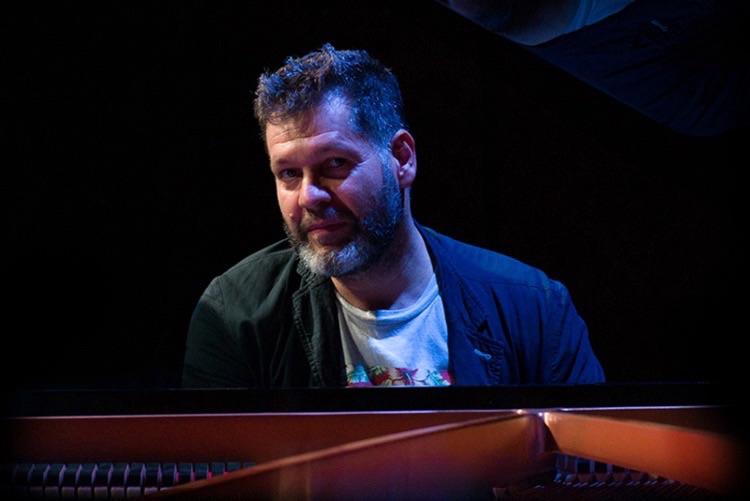

The third release by Lucian Ban & Elevation, Rush (Sunnyside, 2026) finds the Romanian pianist-composer leading a group with tenor saxophonist Abraham Burton, bassist John Hébert, and drummer Eric McPherson. The group’s first album in a decade mainly came about in time to celebrate the band’s twentieth anniversary. Going back to 2006, the ensemble formed from the newly arrived-to-New-York Ban’s desire to have his original material played by Burton. These pieces, like much of Ban’s work, were steeped in European folkloric traditions and classical music as well as contemporary jazz player and improviser. So, too, are the pieces on Rush, with most directly inspired by the leader’s heroes on his instrument.

The program commences with “Dark Blue.” Dedicated to Abdullah Ibrahim, who died two months prior to Rush’s release, features a piano part that slowly builds into a haunting blues that underpins full-rounded tenor. Burton’s horn can sound as imposing as his physical stature, but here it is gloriously delivered, emotive, and lyrical. “Serenade for Andrew” takes as an obvious reference point Andrew Hill’s early ‘60s Blue Note recordings. Here, Hill’s angular off-kilter swing, and advanced sense of melody, rendered most vividly by McPherson’s kit work, accents, snare breaks, and cymbal swipes, mostly in dialogue with Ban. Burton steps away for “Christine’s Hope” as the trio gently renders Ban’s ballad from his solo piano album Ways of Disappearing (Sunnyside, 2022), revealing the pianist’s strong intuitive melodic sense, further shaped by Hébert’s sympatico bass and McPherson’s tender brushwork.

The album’s title cut is an energetic groover where the band goes full throttle. The mention of Burton’s imposing style applies with his roof-raising approach. Ban’s driving pedal points inside underscore the tune’s rhythmic complexity. It’s a sharp contrast to his playing on “Dark Blue” and “Christine’s Hope.””Elevation,” for pianist Larry Willis, is another sensitive, straightforward ballad that reveals both Burton’s lyrical bent and Herbert’s earthy, resonant bass.
Interestingly and probably only coincidentally, “Congestion Tax” revolves around the same idea as “Congestion Pricing,” on Kris Davis’ newly released Lost in Geneva (4166 Records, 2026). The initial free-form, feisty dialogue between Ban and McPherson soon escalates to raucousness, reflecting traffic and New York’s unmatched energy. Furthering the well-thought-out sequencing, “Chakra” is Ban’s tribute to Billy Strayhorn. The ballad is an ideal vehicle for Burton’s golden tone and reverence for all things related to Ellington. Accordingly, “Syndrome” finds all members playing unhindered, delivering a buoyant, mostly improvised, groove-heavy vibe, kicked off by Herbert and McPherson. Ban solos percussively, as if sparring with McPherson. Burton blows with the depth of the R&B saxophonists of the ‘50s, sounding more like a Texas tenor than a New Yorker. He’s on fire.

No Ban album would be complete without a nod to his homeland. Here, he offers the Romanian folk song “Golden Oriole,” sung by vocalist Gavril Tarmure, one of the foremost interpreters of this folkloric genre. This dreamy, bi-level love song uses a modal lyric progression as McPherson and Hébert apply conversational rhythm around piano and saxophone. Burton’s lines directly respond to Tarmure’s emotionally centered ones. Tamura has a deeper baritone than Kurt Elling and is equally expressive. It fits especially well with lyrics like “You rock me tender still/you rock me so I won’t fall/For this is how I learned to be/In my mother’s arms/dreaming while swaying free.” It’s a lovely, sublime closer.
Rush is a consummate blend of tradition and modernity, sequenced brilliantly. Let’s hope we don’t have to wait another decade for the next installment.
‘Rush’ is out now on Sunnyside Records. It can be purchased on Bandcamp.




Leave a Reply