

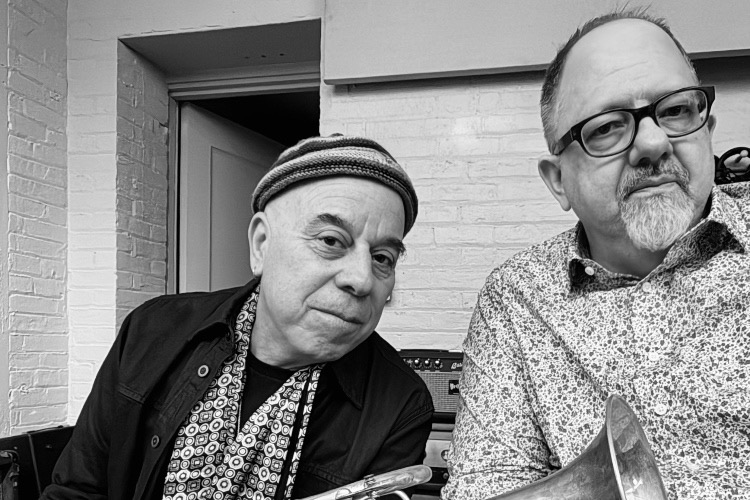

Charlie Parker and Dizzy Gillespie. Miles Davis and John Coltrane. Clifford Brown and Max Roach. Herbie Hancock and Wayne Shorter. The history of modern improvised music is replete with examples of artists whose synergistic energies produce a rich dialogue that, regardless of the setting, creates something powerful and distinctly shared between them. These shared conversations are perhaps most noticeable between two instruments, but they actually extend far beyond brass, ivory, and wood. They also appear behind the scenes of the bandstand, in the compositional process as seen with Duke Ellington and Billy Strayhorn. And, sometimes, those ties even begin to question the very meaning of composition. Where does one artistic mind’s page end and the other begin? Is the difference even perceivable? Consider Miles Davis’ work with Teo Macero, specifically during the trumpeter’s electric period. From 1969 to 1975, the Dark Prince of Jazz would often create broad soundscapes which producer Macero would, among other things, splice with a razor blade, reassemble using multitracking, and loop pieces together. Once loose, free-form jam sessions kicked into another terrain, forcefully grabbing the listener with them. Together, the duo took brilliantly executed pieces and, by pushing the envelope on the era’s technology, turned them into whole new unexplored sonic planets. The fact that the historical record still debates the extent to which each piece is compositionally attributable to each man shows how the duo was able to reach spaces far beyond such trivialities as credit. With Ultra Resonance (Royal Potato Family, 2026), Macero’s once engineer Scotty Hard and fellow chameleonic trumpeter Steven Bernstein show there is still so much ground to explore in this realm.
A denizen of the New York downtown scene, Bernstein has never been one to take the conventional route. For one, much of his career has been built around playing the somewhat esoteric slide trumpet. The tonal fluidity and expressive breadth of his sound on his unusual instrument consistently add razor-sharp cries that most trumpeters never approximate. Since the late 1990s, his band Sex Mob has uniquely deconstructed and reconfigured everything from “The Macarena” and the music of Prince to film scores by Federico Fellini and John Barry. And, most recently, the band has toured with, and recorded (Let X = X (Nonesuch, 2026)) the music of Laurie Anderson with the firebrand artist herself. Bernstein’s other longstanding ensemble, the nine-piece Millennial Territory Orchestra, of which the slide is again key, has similarly rewritten what it means for a group to be a “big band” whether mining the works of Sly Stone or working with the late New Orleans bluesman Henry Butler. And so, almost forty years after he first started using it, the slide trumpet has become such a central part of Bernstein’s sound that the revolutionary artist actually pushes even further out when he does something a little more conventional.
On its face, ResoNation Trio (Royal Potato Family, 2026) is indeed a fairly orthodox outing. The new chordless three-man group with bassist Scott Colley and drummer Nasheet Waits finds the leader brandishing the more traditional valve trumpet and flugelhorn. But looks are deceiving. In setting aside his slide, Bernstein shares a side of himself that is more hushed and intimate than what even his longest fans are likely accustomed to. The open sparseness of the room sifts through pieces like the folkishly melancholic “Woodstock” or the deeply contemplative “August 3,” inviting the audience into private spaces not usually common in Bernstein’s other work.
ResoNation Trio is a fine album on its own, but it is also raw material for just the right producer to reshape into something wildly different. Enter Scotty Hard, the nom de plume of producer Scott Harding. The Canadian native has carved a unique place for himself that makes him equally at home with hip hop heavyweights such as De La Soul and Q-Tip as with creative music luminaries like Vijay Iyer and William Parker. He is an artist always looking to create something new even when handed some of the best raw material from the get-go. Perhaps unsurprisingly, Hard and Bernstein have also been friends and collaborators for decades. After establishing such a rich rapport, Bernstein did not hesitate to hand the ResoNation recordings over to Hard to see what he could do with them if given enough freedom.
The result with Ultra Resonance is less a stereotypical remixing of ResoNation Trio than a radical restructuring of practically everything. Every sound of the date with Colley and Waits has been mixed up in unpredictable ways. Keys changed. Pieces chopped up. Sounds wildly altered. Shadows of the once intimate source material occasionally echo on the new version, but more as disorienting imagery than comforting memories. Given the parallels to Macero’s work with Miles, it is easy to view some of this as well-trodden ground. But, like ResoNation Trio, again things are not as they seem. Where Miles and Macero charted their ship in one direction in search of new ground, Bernstein and Hard set course for an opposite route. Yes, the central idea of expanding and stretching pre-recorded material is hardly new. But there’s nothing familiar about the path the current duo takes. From “Argon”’s gas floats effortlessly through fields of dub rhythms, through “Chromium”’s interstellar funkiness and the glitchy “Rubidium” to “Niobium”’s Electronic Valve Instrument defying categorization entirely, the record is unlike anything else. Ultra Resonance is ultimately the kind of work only two artists at the top of their craft and with full trust in one another could even conceive of creating. We sat down with both artists to better understand how it came to be.
PostGenre: You have worked together for over thirty years now, but how did you first meet?
Steven Bernstein: Scott, you want to tell the story and I’ll correct you? [laughing]
Scotty Hard: The first time we met was at a weird little studio I used to work at in the West Village. Michael Blake brought Steven to a session for a guy named Justin Warfield. Prince Paul was producing the record [My Field Trip to Planet 9 (Qwest, 1993)], and he wanted horns. I worked on getting the horns, so I called Michael and told him we needed both trumpet and sax. That was the first time we worked together.

SB: No, I think we had already met before then. We had met at a Lounge Lizards gig for sure.
SH: I’m not sure. Maybe. Yeah, we might have met, but never really hung out much or anything at that point. That was still pretty early in your Lizards days, right? Probably around 1994 or ‘95.
SB: Yeah, but I joined the Lizards in ‘90. My memory is that I met you at Lounge Lizards gigs, and then we did the Justin Warfield thing. See, you’re a very memorable person. You might not remember meeting me, but I remember meeting you.
SH: Please, you’re far, far more memorable than I am, Bernstein.
SB: I kind of remember you as being the loud guy from Vancouver back then. Sorry, man.
SH: That sounds about right.

SB: The thing is that there was a whole scene around the Lounge Lizards. There were big hangs before and after those shows in those days. Michael Blake and Scott met at university, I’m pretty sure.
SH: Yeah, we went to music school together and met in 1982.
PG: The Lounge Lizards were so great but it seems like there is not a lot – no books, for instance – written on the band.
SB: Oh, yeah.
PG: Actually, the downtown scene, in general, does not seem to have as much historical documentation as other scenes.
SB: Well, I gotta say, with the Lounge Lizards in particular, because [the band’s founder/leader/saxophonist] John [Lurie] was a self-taught musician who also got famous as an actor, a lot of writers did not take him seriously. So, there were very few articles about us. I don’t think there were any music magazine articles written about the band. But the thing is that other musicians loved what we did. Michael Brecker would come to shows. So would “Butch” Morris, [Henry] Threadgill, and [James] “Blood” Ulmer. Tom Waits and [David] Bowie, too. But music writers were too confused by it.
PG: I spoke with Dougie Bowne not that long ago, and in preparing for it, found it amazing how little formal literature was out there on not only the Lounge Lizards and on him specifically.
SH: There’s a guy who should be lauded. He’s an amazing musician.
SB: Yeah, and guys like Dougie really opened the door for people like us. They were the first generation of guys who were like “we love jazz, but are crazy white dudes. It’d be kind of ridiculous for us to try to play like Art Blakey and the Jazz Messengers.” They love the music but wanted to figure out their own shit.

PG: As far as your time in the Lounge Lizards, that is when you started playing the slide trumpet, right?
SB: Well, that’s a whole nother story. I was always playing a little bit of slide trumpet. I had this band – a cooperative trio – called Spanish Fly. It was slide guitar, trumpet, and tuba. We were successful in our own little world, especially in Europe. And with that band, I would play slide trumpet for one or two tunes. I played it on stuff I could naturally do. You must know Dave Douglas, right?
PG: Of course.
SB: Dave is not very diplomatic; he’s just kind of the way he is. But Spanish Fly was on its very first tour in Europe at the same time he was on his very first tour. Both bands were playing at a festival, and we were hanging out and having a drink afterwards. Dave looked at me and said, “You know Steven, the slide trumpet… why don’t you practice that thing?” And I decided that was actually a good idea. So, then I started practicing it. Back then, Michael Dorf had gigs called “the late-night hang” that paid a hundred dollars a man. He called and asked if I had a band to perform for it. I told him I was trying to figure out the slide trumpet and that was the beginning of Sex Mob.
SH: That was pretty good money way back then.
SB: Yeah. At one point, looking back, I thought it was a hundred bucks for the whole band, which would have been incredibly low, even then. But I was talking to [Sex Mob saxophonist] Briggan [Kraus] about it and he reminded me that, no, it was a hundred for each of us.
SH: Wow. Yeah, if it were only twenty-five each, you’d probably have drunk all your money away.
SB: [laughing] Exactly. But yeah, that’s how the slide trumpet kind of became a thing.

PG: You’ve been working with the slide trumpet for so long, but don’t use it on either ResoNation Trio or on Ultra Resonance. Did you find it as freeing to go back to the valve trumpet even though a couple of years ago, you said that the slide trumpet was more freeing because there’s less of a precedent to follow?
SB: Well, that’s true, but I wouldn’t say it was more freeing as much as it was refreshing. The valves are so different than the slide. And now I’m old enough, and at a certain point in my life, where I can do things with valves that other people don’t. I figured out a way to play the valve trumpet in a way that other people don’t play it. So, I would say it was refreshing but I also kind of needed another gimmick for this album.
SH: Gimmick. Another fantastic gimmick from Bernstein.
SB: Wait, wait, wait. Rob, I don’t know if you know this and it was not much in the materials for Ultra Resonance, but Scott was Teo Macero’s engineer for the last period of Teo’s life. Did you know that?
PG: Yes. Actually, I was going to ask about parallels between your collaboration together on Ultra Resonance and Miles [Davis] working with Teo on something like Bitches Brew (Columbia, 1970).
SB: Good, good. But you’ve got to hear what Teo said about the slide trumpet when he recorded it. Tell him, Scott.
SH: Was it for Michael [Blake’s] first record?

SB: Yeah, it was for Kingdom of Champa (Intuition, 1997).
SH: Yeah, Kingdom of Champa. It was in the ‘90s, but before I ever worked with Sex Mob. It was maybe ‘94 or ‘95 because after that I worked with Teo on Vernon Reid’s Mistaken Identity (Epic/550, 1996) and Teo had a relationship with the German label that had signed Michael for his record.

SB: Oh, it was ‘96, man. It was right before Sex Mob.
SH: Yeah, I figured it was probably around ‘95 or ‘96. When Teo found out I was going to do the record with Michael, he agreed to do it with me. At the session, we were all sitting in a big room at Sorcerer [Sound] and Steven pulled out the slide trumpet. Teo was in the control room when he saw it and said “What the hell is he doing with that thing? He should use it as a lampshade” and went out and told Steven to use the valve trumpet with a Harmon mute. I remember Steven, you later said to me “Teo kept wanting me to use the Harmon mute and I’m like if Teo Macero tells me to use the Harmon mute, I’m gonna use the Harmon mute. How many records are we gonna be able to make with him?” Teo was a character.
SB: He was so fucking funny, man.
PG: In terms of what you’re doing for Ultra Resonance, Scott, has the switch to valve trumpet changed at all how you approach the music compared to your other work with Steven?
SH: No, it hasn’t. Steven used a really low trumpet – I think it’s called the G trumpet – so there were definitely some different kinds of tones, but it was nice just for things to be a little different. Of course, I love Sex Mob’s sound and the way that Steven and Briggan play together in that band. It’s kind of otherworldly how they can phrase things out of time together at this point. Their communication is amazing. But it was nice to hear different sounds on this record, like the flugelhorn and this G trumpet, which I love.
SB: The thing is the sound. I have very different personalities on the valve and slide trumpets. I think that gave Scott a different kind of music to work with, basically.
SH: I think the melodies were more articulated on the valve trumpet. The way that I took pieces of them was very distinct. It was nice to have a different attack that went well with the rhythmic nature of the music. Often, I was surprised when I was laying the melodies over top of the beats. When I constructed a track for the album, I generally started with the drums first. Then I added the bass to make a groove. Then I would find some trumpet. A lot of times, I was using cut-out pieces from the horn. But there were a couple of instances where the whole track would just float over the top of the rhythmic nature of the beat. And it would, somewhat randomly, line up well with my track. That very much comes to me from the influence of John Cage of letting things happen and letting it play.

SB: I gotta tell you, I made this record and it’s still very mysterious to me how it all worked so well together. To have a mystery like that after making music for so many years is pretty cool.
SH: Before I even started to chop the pieces up, I wanted to see if the parts even seemed like they were in a reasonably close key. Because I was using a new sampler program and didn’t trust it to record, I was always set to record. For one of the tracks, I pushed “record” and played a part of it in C on the sampler as the track played. I kept holding my finger down to hold the note and was like, “Oh, shit. This sounds great.” It kept sounding good the whole time. I didn’t have to sit there and edit it for three days. And after the trumpet track ended, the rest of the track kept going. So, I waited until there was a lull and then played the same melody on G. I just played it in a different key and let it play. It floated over the beat at a completely different tempo and completely different pitch, but it still worked, which was amazing. And then when the track ended, I played it again on a different note, Bb. And I let that play to the end of the song. It went much longer because the song was just ending when I did that. But that was the most fucking Teo thing I’ve ever done. Teo would have done that.
SB: Yeah, but he wouldn’t have been able to play it back in a different key.
SH: No, but he did imagine the possibilities in the music he worked with. I feel, in some ways, I take his aura and use it with newer technology. Teo didn’t really teach me anything directly. But the records he made long before I ever met him taught me, inspired me, and created who I am in a lot of ways. Listening to things like Bitches Brew, On the Corner (Columbia, 1973), Agharta (Columbia, 1976), and Pangea (Columbia, 1975) for so long has unquestionably influenced my brain.

PG: Do you feel that what you do may actually be a little more difficult than what Teo did with Miles? He had to employ techniques like tape splicing to get his intended effects. Today, there is an almost unlimited number of options you can much more easily adopt to get to your end goal, but that also means there are so many more choices to consider.
SH: Yeah, with the technology I have now, I can do things that were simply unimaginable back in the ‘70s. Teo was just taking sections of the record material and doing what he could with it.
For the new Harriet Tubman record [Electrical Field of Love (Pi, 2026)], I was able to take the intro verbatim and add it to the end of a piece so that two-thirds of the way through, the intro happens again. Because I wasn’t editing a straight two-track mix, I was able to drag the synthesizer through the edit point or elongate something to change the bass and guitar without changing the drums. You couldn’t do something like that with a straight two-track edit. You could do a slight crossfade, but you couldn’t actually change the position of things. To me, it’s a very creative medium, but it also runs the risk of creating some really terrible music where people just fix everything and run everything through [Artificial Intelligence] and tell it what to do. I only look at the creative possibilities of these things because Ultra Resonance couldn’t have been made without something like that.
SB: Right. And it was interesting because when we started the record, we had such a blank slate that Scott was unsure where to even start.
SH: I had such a hard time starting.
SB: It was interesting because there are so many possibilities. We weren’t remixing ResoNation Trio. That was not the idea for Ultra Resonance. Scott said very emphatically that he didn’t want to redo what we’ve already done. I didn’t either. We wanted to create something neither of us has done yet.
SH: Yeah, which is why I decided not to do my usual approach of chopping something up in Pro Tools and making a collage sculpture out of it. I wanted to use different instruments and different formats. In the process of doing that, I also taught myself how to use these tools while trying to write music. My name is Scotty Hard for a reason; I do everything the hard way. [laughing].
PG: Do you feel – given how long the two of you have worked together – your existing relationship may have made it a little easier to find specific directions to follow compared to if this were the first time you had worked together?
SH: I don’t know. I’m not sure if we brought our own Sex Mob baggage to the album. I was trying not to, but it’s hard to avoid it entirely. We have a very close rapport.
SB: Honestly, I think we went into this project working hard to avoid what we’ve done before. Especially because we had just done The Hard Way (Corbett vs. Dempsey, 2023) together and that had started with Scott’s loops. We wanted to see what else we could do.
SH: Actually, when I started telling people about Ultra Resonance, so many thought it was going to be very similar to The Hard Way. But, in reality, we aimed for it to be the exact opposite of it.
Click here for Part Two of our Conversation with Steven Bernstein and Scotty Hard. ‘Ultra Resonance’ and ‘ResoNation Trio’ are out now on Royal Potato Family. They can be purchased on Bandcamp. You can also learn more about the albums from Jim Hynes’ review. More information on Steven Bernstein and Scotty Hard is available on their respective websites.
Photo credit: Andrew Blackstein


Leave a Reply