
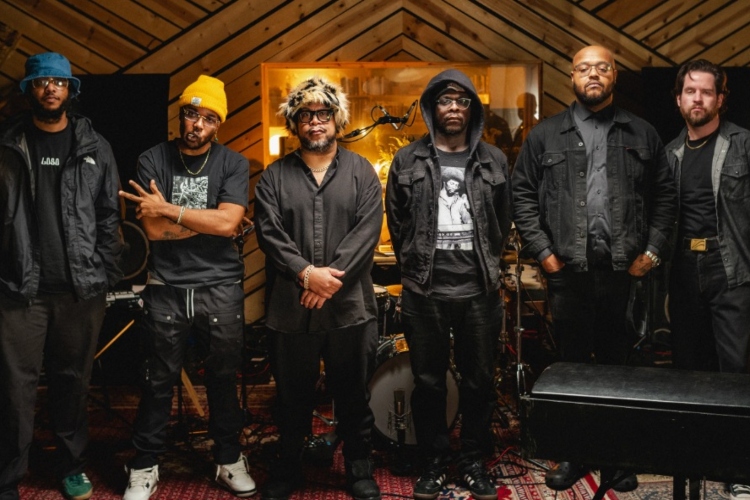

Sometimes a grand project can emerge from a single riff, or even a quote in an improvised solo. A Supreme Blue (Concord, 2026) developed from the latter. Specifically, when Nicholas Payton, sat in with Butcher Brown during the Richmond-based unit’s “Unwind” from Letters from the Atlantic (Concord, 2025) and started quoting “Acknowledgement” from John Coltrane’s A Love Supreme (Impulse!, 1965) on his trumpet. Drummer, Corey Fonville, went into a House groove as the ensemble vamped, prompting Payton to blow Coltrane’s part. After the show, someone posted a clap on Instagram and hashtagged it #AHouseSupreme. And that planted the seed that ultimately bloomed into the A Supreme Blue.
From there, Fonville encouraged the collaborators to not only release a record but one that tackles the daunting of covering two of the most iconic albums in the Black American musical canon: A Love Supreme and Miles Davis’ Kind of Blue (Columbia, 1959). Obviously, such an endeavor was weighed heavily, but with the centennials of Miles Davis and John Coltrane this year, the impetus moved forward. The resulting album is not only one of the boldest reimaginings of both seminal works to come out this year, but one of the most deeply creative.

Going back earlier, Payton first met Fonville in 2010 when the two were at the Brubeck Institute in California, the young drummer as a student and the trumpeter an instructor. So impressed by Fonville during that experience, Payton took him on the road. The admiration proved reciprocal with the younger not long after introducing his elder to his band at home, Butcher Brown: producer/keyboardist DJ Harrison, trumpeter/saxophonist/MC Marcus “Tennishu” Tenney, guitarist Morgan Burrs, and bassist Andrew Randazzo aka R4ND4ZZO. Later, they appeared on each other’s recordings as well, with Payton’s Numbers (self-release, 2014) and the band’s first commercial release, All Purpose Music (Ropeadope, 2014). The decade since has found those collaborative ties only deepening, with several shared projects and live shows like the set in Boston that led to A Supreme Blue.
Of course, combining A Love Supreme and Kind of Blue is, itself not overtly outlandish. The two not only find Coltrane playing modally on tenor but equally adopt heavy spiritual, African-based components. As Ashley Kahn, author of both Kind of Blue: The Making of the Miles Davis’ Masterpiece and A Love Supreme: The Story of John Coltrane’s Signature Album, quotes Payton in the liner notes to Supreme Blue: “…Miles spoke about coming off of the influence of the ‘Ballet Africaine’ [from Guinea] which was a show he saw and the enjoyed the rhythm of the music, the thumb piano and especially the dancers. So there’s that too between Kind of Blue and A Love Supreme: the rhythmic nature of the Mozambique groove that goes into “Acknowledgment” and Elvin [Jones]’s approach in general, which was always coming out of an African conception. That was at the top of [] mind with this project–creating these grooves and the whole rhythmic feel.”

But the essence of A Supreme Blue isn’t mired in works from generations ago. The combined band allowed their sound to incorporate artistic development from the over a half-century since. Of these newer broader stylistic approaches, one particularly rose to the fore. Fonville is a longtime fan of House groove. So, too, is Paul Stache, owner of the NYC club Smoke, where Payton often performs. The latter has long encouraged Payton to create a four-on-the-floor album and A Supreme Blue seemingly met that challenge.
Sessions at Spacebomb Studios in Richmond proceeded with little preparation and no rehearsal, by design. Tracks emerged organically with the players assembled mostly in one room without booths. Although the record is sequenced with renditions of Kind of Blue’s compositions first, the recording process alternated pieces from each. Beyond that, there was minimal verbal communication between the parties; just gifted musicians working quietly. And, as a result, some surprises emerged along the way.

As Fonville recalls, “[H]ow “Pursuance” came out [was particularly] insane… [It] was an example of us being in the room; Andrew started playing this bass line, and we just started grooving out. Nicholas was like, “What’s that?” Alright cool. Roll the tape. Marcus hit the tenor, Morgan on guitar, and it had this darker element to it because there were no keyboards on it. It had a different feel. But we didn’t know that was going to happen a day before, or even 30 minutes before. “Resolution,” same thing. All the songs. I think we really found creative ways to make each of these songs fresh.” Payton provides similar comments on “Resolution, Part II,” “Jimmy Garrison’s bass intro is so epic and the perfect setup for the tune that I decided to double it between the synth bass and Rhodes to make it super thick. Then I created a vamp that moves through all twelve keys, which becomes the bed for Coltrane’s melody. We solo[ed] over the regular chord changes, then vamp[ed] out on Garrison’s riff –but I put chords to it to make it sexy.”
Even casual listeners will quickly pick up on the distinctiveness of the combined group’s whole approach. At times, it may even feel that the music strays from the original, yet the themes always reemerge. The band gives significant credit to engineer Alex DeLong, who did both the recording and mixing, and his intuitive sense. DeLong’s use of echoes snd other effects alone sufficiently distinguishes A Supreme Blue from the usual tribute record. The ensemble is no more trying to capture past artistic glories as it is trying to ignore them.

And, so, what emerges more than anything else on the brilliant collaboration, A Supreme Blue, is how even as sounds and styles change, some core essence in all Black music remains as powerful as ever. The next generations of musicians have carried forward the inheritances of their artistic ancestors while reconsidering it within the context of their own era, experiences, and personalities. Quite frankly, that is something Black musicians have been during for centuries. Melvin Gibbs, another branch on that incredible tree of musical excellence perhaps put it best in the conclusion to his book How Black Music Took Over the World: “Black music will evolve because black people will evolve…New cultural pheno-types will emere as the connections between Black people in the West and Africans in the diaspora and ‘back home’ strengthen. New musical genres will rise as technology changes and musical styles recombine… The backbeat will retain its power, the resolve that birthed the ring shout, the tenacity of our drive to exist as fully human, will birth new forms of expression.” Here’s to the newest phenotype and for the others yet to come.
‘A Supreme Blue’ is out now on Concord Records. You can purchase it on Bandcamp.



Leave a Reply