

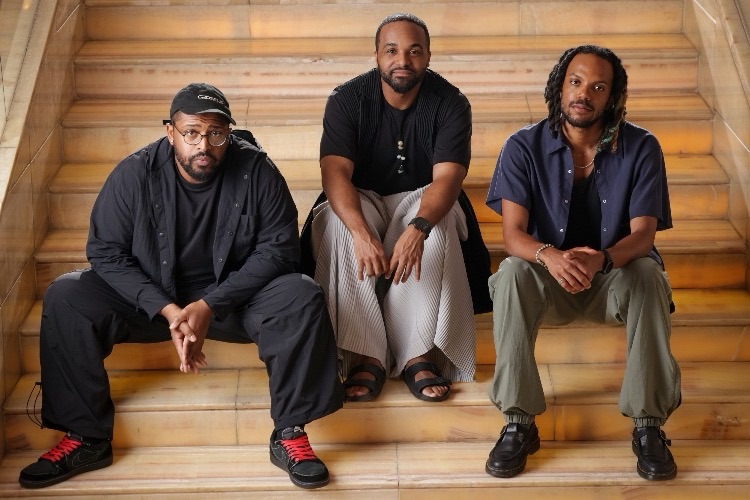

An indelible memory of Sullivan Fortner comes from the 2023 Blue Note at Sea, when the pianist lead a trio with Jeff Ballard and Joe Sanders. Fortner broke into that sly grin of his, proclaiming “I feel a ballad,” before proceeding into a version of “Embraceable You” where he held the mic in his right hand and played the piano with only his left. His releases since then have stretched far beyond ballad repertoire, but it seems many consider him a prototypical piano traditionalist. Leave That In There (Artwork, 2026) hopefully dispels the notion.
Leave moves fluidly between acoustic trio interplay, Hammond B3 organ, synthesizers, marimba, Bàtá drumming, and fully improvised passages. It is the first studio recording featuring Fortner’s working trio with bassist Tyrone Allen II and drummer Kayvon Gordon who also plays the Moog Sub 37.
But, more, the album’s dozen original compositions and one cover pull from many different influences. They include his experience growing up in the church, the rich culture of his native New Orleans, memories pulled from family history, spiritual traditions, and sonic callbacks to earlier works throughout his catalog. Just as in his Grammy-winning Southern Nights (Artwork, 2025) Louisiana native Fortner draws heavily throughout the album from the Gulf South, its landscapes cultural, musical, and historical. Leave’s title itself directly references the Crescent City albeit in a more subtle way. The phrase comes from a line in When the Levees Broke: A Requiem in Four Acts, Spike Lee’s 2006 documentary chronicling the devastation following Hurricane Katrina. As reflected in writer Courtney-Savali L. Andrews’ liner notes, the title reflects the record’s broader themes of memory, survival, humor, grief, ancestry, and resilience.

Leave’s opening synth and marimba heavy “Sugarcane” serves as an entry point into many of the album’s broader themes, drawing from both Fortner’s personal history and the deeper historical landscape of southern Louisiana, With its Bata drumming, the composition reflects the leader’s ongoing engagement with Black diasporic musical traditions while also referencing the histories of labor, migration, and resistance tied to Louisiana’s sugarcane industry. In the liner notes, Andrews connects the piece to the 1811 German Coast uprising, the largest revolt of enslaved Africans in American history, which took place near LaPlace, the town where Fortner grew up.
Leave That In There’s originals are replete with loops and an array of tools and came together in two parts. First, acoustic material was tracked in a single room without any overdubs. Then additional tools and Bata instruments arrived in a second session, six or seven months later. The result is something both familiar as a traditional trio record and something completely unconventional.

“Que Diablos” is a brief piano piece rendered over highly danceable rhythms. The shorter “A Poignant Time” is a section of a B3 jam. “Aerobatics” in a two-part suite, with the first half a psychedelic outing indebted to Fortner’s hero, George Duke. The second part sounds similar to some Fortner’s prior works but rendered electrically. Continuing down the fusion path, the pianist merges Herbie Hancock’s “The Sorcerer” into Donald Brown’s “The Early Bird Gets the Short End of the Stick” on “Sorcerer’s Stick.” It is a criminally brief two minutes track with the leader playing mostly the Steinway. He closes the first side with the organ excursion, “Swirl,” inspired by Thelonious Monk. Those who saw Fortner at this summer’s Newport Jazz Festival witnessed his dazzling organ chops and there is a taste of them here too.

Side B begins with “T295” – perhaps a phone reference? – where Allen takes to bowed bass and electronics mix to pair with jagged, peppy piano. The album’s sole cover is “Number 3,” a fast waltz written by Detroit drummer-composer Lawrence Williams. A staple in Marcus Belgrave’s repertoire – who Sullivan met while at Oberlin – the track is a tribute to Belgrave. At six minutes, it feels refreshing to have a longer, full-formed piece. The trio returns to a maze of hazy electronics in the sci-fi trek of “12 Gallons,” which features an interesting drum shuffle pattern. “Aria II,” revisits material from Fortner’s debut album Aria (Impulse!, 2015), this time repurposed with a strong B3 addition. The meditative tribute to the late Mama Payne, “A Hymn for Linda,” finds Fortner singing over himself, forming a “choir” of sorts. It’s Leave’s only vocal track and its combination of voices, synths, and B3 produce a head-spinning effect. The trio reprises “Another Poignant Time” to close, with Fortner hitting piano and organ chords with equal fervor, seemingly simultaneously.

At first listen, Leave That In There may seem too fragmented. But repeated listens reveal repetitive themes and figures that provide cohesion. Still, fewer shorter pieces in favor of longer ones may have helped the album as a whole. Those quibbles aside, the constant flow of new ideas in Fortner’s musical mind is daunting. He keeps expanding beyond initial impressions.
‘Leave That In There’ is out now on Artwork Records. It can be purchased directly from the label.



Leave a Reply