

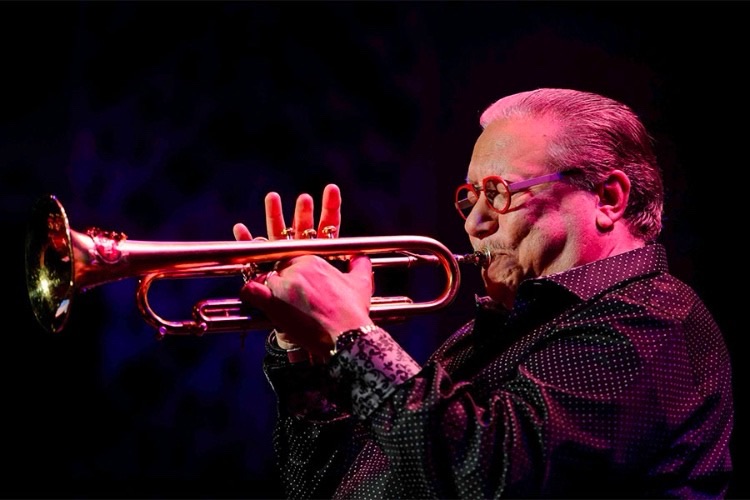

In his autobiography, Music is My Mistress (Da Capo, 1973), Duke Ellington stated that “Jazz is a good barometer of freedom…. [T]he music is so free, that many people say it is the only unhampered, unhindered expression of complete freedom yet produced in this country.” While one can quibble with the use of the term “jazz” – even Duke found the word problematic – his central premise remains compelling. There is a certain freedom inherent in the music born out of improvisation. And for those yearning for liberty, the independence in each note can speak volumes in ways mere words never quite can. In Nazi Germany, jazz was labeled “Negermusik” and stigmatized as culturally degenerate in part because it was built by Black artists, often out of showtune standards penned by Jewish composers. Rebellious youths nevertheless resisted by embracing the music, with some ultimately being sent to concentration camps for it. In the USSR, music was tolerated, but under Stalin it was increasingly labeled “bourgeois” and deemed insufficiently aligned with socialist ideals. Yet common people still sought the music. In Fidel Castro’s Cuba, a young Arturo Sandoval felt the same pull towards improvisation and the freedom it represented. He would spend several months in prison for listening to a jazz radio broadcast. Yet the experience seemed to only further deepen his love of the music. And in the decades and dozens of records since – including his latest, Sangú (TM, 2026) – its pull has grown only stronger.
That love of the freedom inherent in improvisation ultimately led Sandoval to join the groundbreaking Afro-Cuban band Irakere in 1973, an opportunity for the trumpeter to explore bebop in a government-supported setting. But it was still not enough. Next came his own band and then a tour with his soon-to-be friend and mentor Dizzy Gillespie. Yet he still wanted more. In 1990, he – with Gillespie’s assistance – left his home behind for a better life in the United States. America, while imperfect, was a place where he and his family could have opportunities that would never have been afforded to them in Cuba. His subsequent career has produced many albums – some fifty by his count – that might never have existed had he remained in his homeland.
And jazz was the linchpin for Sandoval throughout it all. But it would be a mistake to label Sandoval as solely a jazz artist. Anyone familiar with his work knows the trumpeter is adept at classical music too. However, that is still only a limited facet of Sandoval’s artistry. Instead, as becomes apparent in our conversation with him, he views all good music as one singular thing. Sangú’s title – a play on the phrase “sounds good” – underscores this perspective as well by confirming the album’s unifying force is simply whether the music is emotionally significant and not whether it fits some categorical boxes.
The tracks on Sangú make Sandoval’s advocacy of genreless music even clearer. The opener “Scat” starts with a danceable rhythm on maracas and hand drums that leads to a funky electric bassline. Short guitar riffs – almost evoking sampling – and tight horn blasts come next in the track that lands somewhere between 70s CTI, the Tijuana Brass, and Blaxploitation soundtracks. And that’s before getting to the inspiration for the track’s name – a bebop-inspired vocal improvisation by the leader. “Azulito” is a meeting of the sound of scorching smoky room organ trios and a poppish yet bluesy melody. “With the People” is the album’s most overtly Afrobeat-inspired track, though traces of it appear elsewhere, even in “Scat.” However, even here, it is not purely a recreation of the music of Nigeria, equally suggesting the vibe of a late-night New York club.
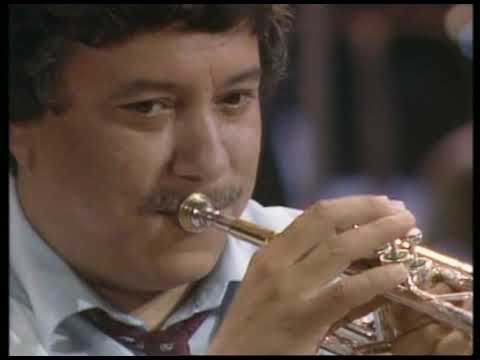
If there is one unifying theme across Sangú, it is that even as he inches closer to his eighth decade, Sandoval is not slowing down in terms of experimenting or seeking out new avenues. That would seem to extend to live performances as well. An Emmy Award for a soundtrack to a film about his life (which you can watch below), Grammy Awards, the Presidential Medal of Freedom, and a Kennedy Center Honor leave few recognitions unawarded to Sandoval. Until now, however, he has yet to appear on the landmark Austin City Limits program. That changes on Friday, September 25, 2026, when he will perform at ACL Live at The Moody Theater. The performance will be livestreamed on YouTube and broadcast on PBS sometime next year. We sat down with Sandoval to discuss his creative process, Sangú, and his own musical heroes.

PostGenre: You have stated in other interviews that your compositional process is to sit at the piano and simply have the music come to you.
Arturo Sandoval: It’s true. During the pandemic, I was like everybody else and spent more than two years at home. And that was a huge change for me because all of my life, I have been traveling and playing music. And in that time, I started writing two or three tunes every single day for more than two years. That was the repertoire that became Sangú. My son and daughter-in-law came to our house and said that they had an idea for us to go through the hundreds of songs I wrote during that period and to pick out twelve that would become an album. And that’s the album.
I was impressed when they first came to me with the idea because while they are not musicians per se, they had a clear idea of what they wanted. When the producer knows exactly what they want, man, that helps a lot. Every comment or indication by them made sense because they had a clear idea of what they wanted in the record. I was impressed, to be honest.
PG: Do you plan on releasing some of the other compositions at some point as well?
AS: Oh yeah. I’m working on a bunch of new tunes now. I don’t know when we will be in the studio to record them, but we are already working on the next album. It will probably be out sometime next year.
But, yes, the piano was key to my writing the songs. The piano itself always suggests ideas to me. I start with some chord changes. The melody came later, but I always record a sequence of chord changes to get a structure of a possible song. And then I improvise the melody on top of it.

PG: And the piano you are using to do this was once owned by Oscar Peterson, right?
AS: Yes, sir. I’ve had that piano for more than thirty years. But I also have a couple of keyboards around in the studio that I use as well.
PG: Do you feel Peterson’s music can be heard in some way in the pieces you write when using his piano?
AS: Of course, that piano has a pedigree and a history. Just to sit at that piano is a suggestion to me. The piano itself is such a great instrument. It’s a Bösendorfer with nine extra notes in the bottom. It’s a beautiful instrument. Beautiful.
PG: You were asked in another interview to name some of your musical heroes and you selected several pianists. Do you feel your attraction to the piano makes you approach the trumpet differently in some way than if you focused more on trumpet influences?
AS: You know, I listen to everything and everybody. My favorite composer ever is Sergei Rachmaninov because of his piano concertos. Not everything he wrote is heaven to me, but those concertos are something unbelievable. I’m also a huge fan of Oscar. Herbie Hancock. Chick Corea. All those people. But I listen to everything. As Duke Ellington said, “There are two kinds of music. Good music, and the other kind.” The other kind, I don’t bother knowing about.

PG: One of those musical interests of yours has been in vocal music. While you have been scatting in live performances for decades, Sangú’s “Scat” is the first time you have recorded it in a studio setting. What took so long for your scatting to show up on a studio album?
AS: Well, I learned how to scat from the source. I played with Dizzy for many years and [James] Moody was in the band too. Like Dizzy, Moody was good at scatting. And I listened to them. I also listened to Ella Fitzgerald. Ella was amazing. She was unbelievable. I learned to listen to all those people, and then at the end, I came out with my own noises and things.
A lot of things that I do with my scatting are done to entertain myself and my band. I scat every night with my band and I use different kinds of sounds. It makes my bandmates and the audience laugh about the different noises and effects I make with my voice. Some people get confused by my scatting and believe it is a comedy art. But no, it is a scat vocal based on bebop. It can sound funny, but it is art first and foremost.
To scat, I need to feel relaxed and ready. And when I’m on the stage, I feel more relaxed than in a studio because I like to connect with the people. When that connection gets established, it’s a unique feeling, man. It’s a gift from God when you see the people getting involved in your music and connected with you and what you are doing. That kind of feeling is unique.
PG: Since you mentioned God, do you see your music as coming from God, with you as essentially an intermediary for the higher power?
AS: We musicians are only the vehicle. We are the vehicle to transmit things. Of course, everything comes from God, man. Everything. Every single thing. And we are blessed when we are used as a vehicle to transmit ideas. But we are each only an instrument that God is using to communicate.
PG: So, how much of your improvisation comes from your own affirmative actions on your own ideas, and how much of it is dependent on stepping out of the way to be used by God in that way?
AS: We have to respect the word “improvisation.” With improvisation, you’re creating things in the moment. It’s not fair when you preprogram or preprepare things and say “I’m gonna play this phrase this particular way.” If you plan too much, something important gets lost when you improvise. The real value of improvisation lies in creation in the moment.

PG: Do you feel, then, that there is something unavoidably revolutionary in improvisation that is missing in pre-composition? When you were in Cuba, Castro’s government did not want you to listen to jazz music, a form based around improvisation. And, in a much different way, Dizzy ran for president in 1964 in large part to draw attention to racial issues in America and used jazz as his core starting point. It would seem there may be something inherent in improvisation itself that challenges social conventions?
AS: In Cuba, we had no chance to hear any jazz music. In all my years there, there were no record labels, record stores, or radio stations that played jazz. At all. For many years, the only way we could listen to jazz was on a radio show called Jazz Hour that was on the Voice of America. Willis Conover hosted the show and broadcast it out of Washington, D.C. I never missed any of his programs.
When I was in the obligatory military service in Cuba, I was in the corner of the barrack, listening to that show. The sergeant caught me and I was put in jail for three and a half months for listening to “the voice of the enemy.” But I kept listening to it because it was my only way to learn about what was going on with the music. I was hungry for that kind of information and I never missed that program.
PG: It was worth going to jail for you to hear it?
AS: Yes, no question. They put me in jail because they said I was listening to the voice of imperialism. Which is such stupidity because jazz is a very personal language that comes from the heart. It’s not related to any political preference or ideology.
PG: It reflects something deeper than politics.
AS: Absolutely, absolutely. It’s from the soul.

PG: On Sangú, there are moments where the music takes influence from Afrobeat. Fela Kuti and Tony Allen made that music in response to the right-wing military dictatorship in Nigeria and your music, at its beginning, was partly within the context of communist Cuba. Was your decision to combine the two partly driven by the decision to express how the music transcends political ideology?
AS: Bringing in the Afrobeat influences was my son and my daughter-in-law’s idea, to be honest. They also drew influence from South African musicians like [Hugh] Masakela. They brought African influences in because they provide an interesting combination of rhythm and harmony. They bring their own richness in how they reach the audience.
Both Afrobeat and Cuban jazz came out of systems where the government did not want us making our music but there is something stronger at play. When you really want something and have passion and respect for it, you’re going to try to find out about it no matter what. Your desire to get informed and to learn as much as you can about that style is stronger than any prohibition.

PG: And, of course, you also end up with your own approach to the music that reflects not only those external influences but also those of your origins. You can see this well with Irakere, which is also referenced in Sangú’s liner notes. Over half a century later, what do you feel is that band’s legacy?
AS: In the beginning, the dictatorship wouldn’t allow us to use the cymbals of the drums because they said that they sounded too American. That prohibition made us focus on other instruments, like a batá drum, a juka drum, and a synth. We started to use all those things. But in the end, we just wanted to play bebop. We would masquerade our improvisation and the heads of our tunes. They were absolutely bebop, but with the rhythms we were using, the government could not say anything because it was still Afro-Cuban music.
It was a great time being in Irakere. We started in 1974 and I was in the band until December of 1980. Then, in January ‘81, I put my own smaller band together and I played with that band until I got to the United States.

PG: Changing gears a little, earlier we discussed some of your piano influences, but you have significant trumpet ones as well. You released Trumpet Evolution (Columbia, 2003) close to twenty-five years ago. It is an incredible record.
AS: Wow. Now you made my day because I have made fifty albums, but Trumpet Evolution is, was, and always will be my favorite album ever. I had picked nineteen songs by nineteen different trumpeters, each with a different voice. Different styles. Different sounds. Different horns. Different mouthpieces. Different everything.
The album is my strong dedication with a lot of respect and admiration for all those people who came before me on trumpet. I learned from them, of course. And I’m so proud of that album because it’s a testimony of my love for the instrument and for the musicians who really created its sound. It reflects my respect and admiration for all those artists who came before. It also shows my strong discipline and dedication to listening carefully to the essence of all those different styles they present. And that is true of not only jazz but also classical music because the album also has pieces by Maurice André and Timofei Dokshizer who are my two biggest classical trumpet heroes.

PG: You also have a gorgeous version of “La Virgen de la Macarena.”
AS: Yes, by the Mexican trumpet player Rafael Méndez. Man, unbelievable. Unbelievable.
And for the album, I got a lot of quotes and comments from many of the people I honored. Freddie Hubbard. The daughter of Fats Navarro. Clark Terry. Maynard Ferguson. Maurice André. Timofei Dokshizer. Doc Cheatham. They all wrote beautiful things in the liner notes to the album. I have no words for how much I appreciate and love all the beautiful things they said about the record. Reading them filled my heart, to be honest.
PG: In the years that have passed since you released Trumpet Evolution, has anyone emerged that you feel would be worth honoring on the record if you were to remake it today?
AS: I think I would do the album exactly the same way I did back then. I haven’t really heard anybody who has stood out to me since then. Wynton [Marsalis] was included as the last one.
But, I gotta tell you that if there was one person whose work I wish I could have featured on the album and didn’t, it would be Doc Severinsen. When I put together the album, I had to choose between Bunny Berigan, Harry James, or Doc Severinsen because there was not enough space on the album for all three. And by the way, the guy who helped me to put together the repertoire and everything for the album was the great, late great Clark Terry. He helped me a lot. I went to his house several times and we listened to a lot of things and talked about them.

PG: Severinsen definitely belongs in the conversation. It seems like too often people just write him off because of his work as Johnny Carson’s bandleader on The Tonight Show.
AS: Yeah, but he’s an incredible trumpet player, man. Incredible. By the way, I talked to him a few days ago. He’s ninety-nine years old. Unbelievable man. He’s such a sweet guy with a beautiful, great personality. Very funny too. I’ve never met anyone more dedicated to the instrument than Doc.
PG: Not even Dizzy?
AS: No. Doc’s dedication is at such a high level. He is always practicing like crazy. And when you talk to him, it’s impossible to talk about anything else besides the trumpet. He wants to talk about mouthpieces and practice techniques. He’s monothematic. He’s obsessed with practicing. Obsessed.

PG: You mentioned classical and jazz earlier and we talked about Afrobeat as one of the other influences that show up on Sangú. You even visit an Alicia Keys song on your Blue Note live album [Live at the Blue Note (Half Note, 2005)]. Do you feel that you approach these styles differently in some way or are they all kind of the same thing to you?
AS: I love all kinds of good music, man. I listen to all kinds of things and feel blessed that I can switch from one style to another. It’s all just a matter of respect for other approaches. For my duet album [Ultimate Duets (Universal, 2018)], I recorded with Al Jarreau, Stevie Wonder, Pharrell Williams, and Plácido Domingo. I enjoyed playing with them all so much. I enjoyed it as much as I enjoyed playing with Dizzy, Clark Terry, or any of those people. And that’s ultimately because all good music is only one, man. Whatever is good is good.
‘Sangú’ is out now on TM Records. It can be purchased on Bandcamp. You can learn more about Sandoval on his website. His Austin City Limits performance on September 25, 2026 will be broadcast on PBS sometime in 2027. It will also be live-streamed on Youtube



Leave a Reply